


























Views
Downloads

Fruits Crossword Worksheet | Essential Kindergarten ELA
Paste this activity's link or code into your existing LMS (Google Classroom, Canvas, Teams, Schoology, Moodle, etc.).
Students can open and work on the activity right away, with no student login required.
You'll still be able to track student progress and results from your teacher account.
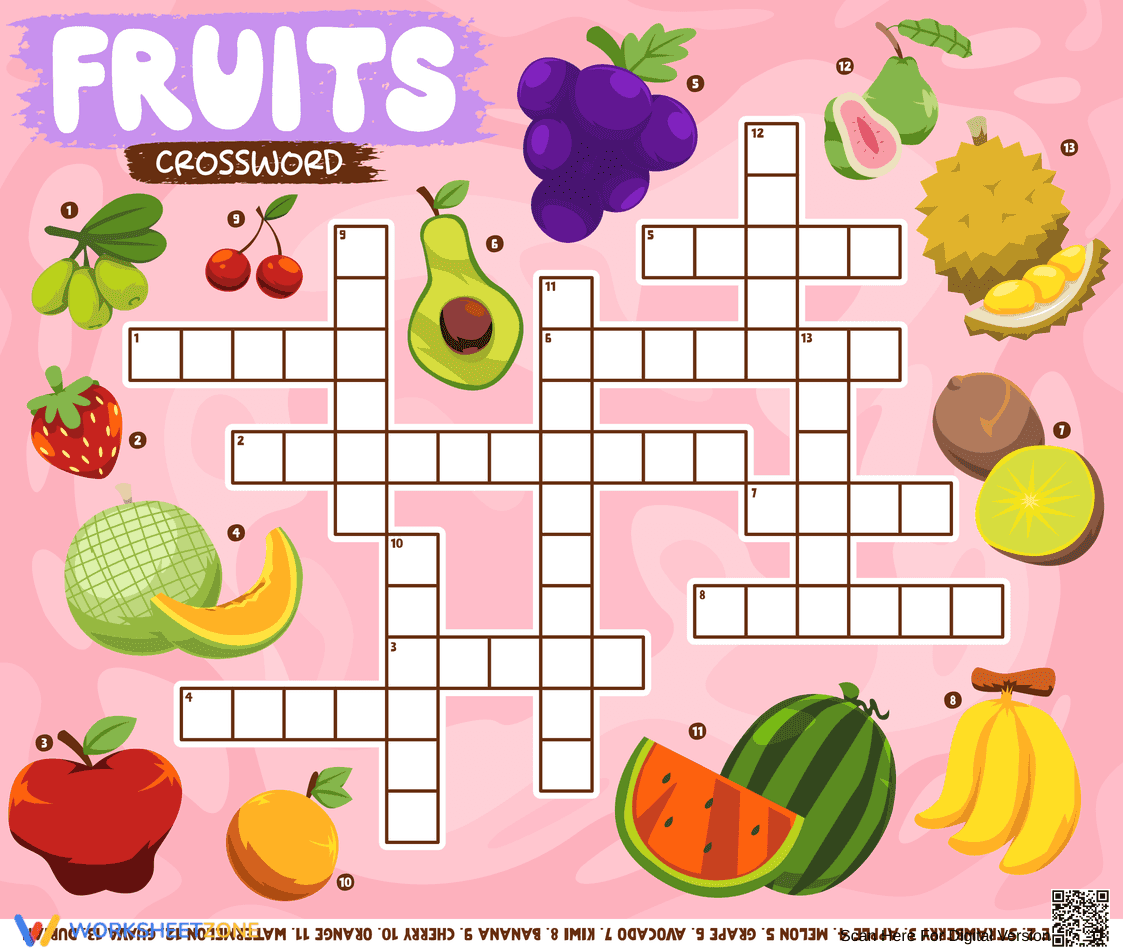
This Kindergarten fruits crossword worksheet helps young learners master essential vocabulary and spelling through visual cues. By connecting 13 vibrant fruit illustrations to their written names, students develop strong letter-sound correspondence and category recognition. It provides a structured yet engaging way to reinforce early literacy skills in a classroom or home setting.
At a Glance
- Grade: Kindergarten · Subject: ELA
- Standard:
CCSS.ELA-LITERACY.L.K.5.A— Sort common objects into categories to gain a sense of the concepts the categories represent- Skill Focus: Vocabulary & Spelling
- Format: 1 page · 13 problems · Answer key included · PDF
- Best For: Independent morning work or literacy centers
- Time: 15–20 minutes
The worksheet features a high-quality 1-page layout containing a central crossword grid surrounded by 13 numbered fruit illustrations. These visual prompts include common items like apples and bananas alongside more unique fruits like durian and guava. A built-in word bank is provided at the bottom of the page, which can be used as a scaffold or covered to increase the difficulty for advanced learners.
This resource is designed for a zero-prep workflow to save teacher time. First, print the single-page PDF (30 seconds). Second, distribute the sheets to students during a literacy block or as a transition activity (1 minute). Third, review the completed puzzles as a whole group to check spelling and pronunciation (5 minutes). Total preparation time is under 2 minutes, making it an ideal sub-plan or emergency filler.
This activity aligns with CCSS.ELA-LITERACY.L.K.5.A, which focuses on sorting common objects into categories to build conceptual understanding. By identifying various fruits, students practice categorization while simultaneously working on CCSS.ELA-LITERACY.L.K.1.A by printing letters in the grid. Both standard codes can be copied directly into lesson plans, IEP goals, or district curriculum mapping tools.
Use this worksheet during a healthy eating unit or as a formative assessment after teaching fruit-related vocabulary. It works best after direct instruction on letter formation. For a quick assessment, observe if students can match the picture to the word bank independently. Completion typically takes 15 to 20 minutes depending on the student's familiarity with the specific fruit names.
This resource is designed for Kindergarten students but is also suitable for English Language Learners (ELL) and students in Grade 1 needing spelling intervention. It pairs naturally with a fruit-themed picture book or an anchor chart displaying common food groups. The visual nature of the clues supports students who are still developing their reading fluency.
Research from Fisher & Frey (2014) emphasizes the importance of visual scaffolds in early vocabulary acquisition, noting that pairing images with text significantly increases retention for emergent readers. This fruits crossword applies these principles by requiring students to translate a visual concept into a specific orthographic sequence. By engaging with 13 distinct vocabulary items, students reinforce their understanding of the fruit category as defined by CCSS.ELA-LITERACY.L.K.5.A. The inclusion of a word bank provides the necessary support for Kindergarteners to practice letter placement without the frustration of total recall, aligning with the gradual release of responsibility model. Such activities are essential for building the foundational spelling skills required for later writing proficiency. According to the NAEP, early exposure to structured vocabulary tasks predicts better reading comprehension outcomes in later elementary years, making this printable a valuable tool for early literacy development.


