


























Views
Downloads

Printable Fruit Counting Worksheet | Grade K Math
Paste this activity's link or code into your existing LMS (Google Classroom, Canvas, Teams, Schoology, Moodle, etc.).
Students can open and work on the activity right away, with no student login required.
You'll still be able to track student progress and results from your teacher account.
This printable fruit counting worksheet provides Grade K students with structured practice in identifying quantities and associating them with numerical symbols. By counting vibrant fruit sets and writing or matching numbers, learners build the foundational one-to-one correspondence skills necessary for early mathematical fluency and confident number recognition.
At a Glance
- Grade: Kindergarten · Subject: Math
- Standard:
K.CC.B.5— Count to answer "how many?" questions about sets of up to 20 objects- Skill Focus: One-to-one correspondence and number writing
- Format: 3 pages · 8 problems · Answer key included · PDF
- Best For: Early finishers or small group math centers
- Time: 15–20 minutes
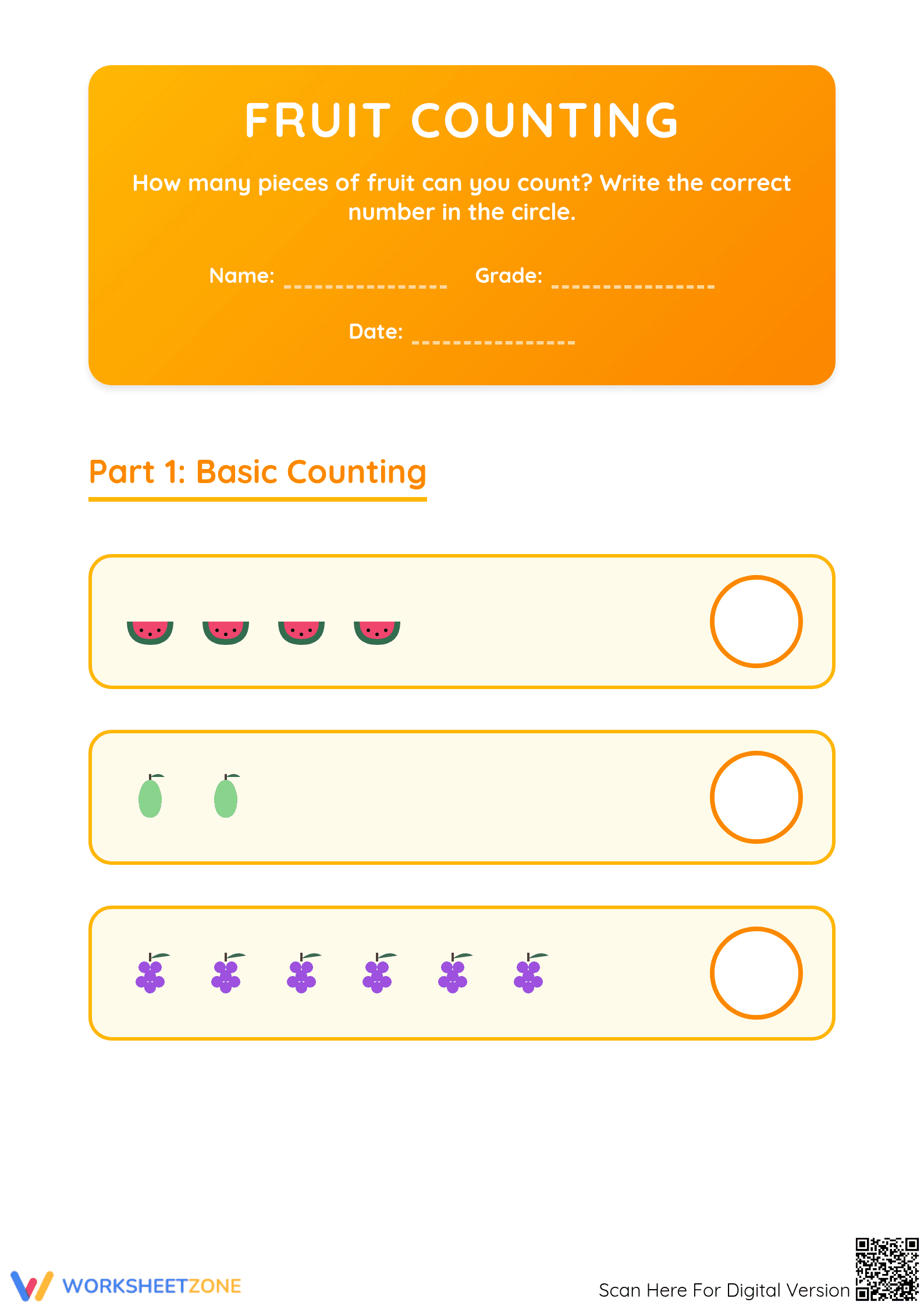
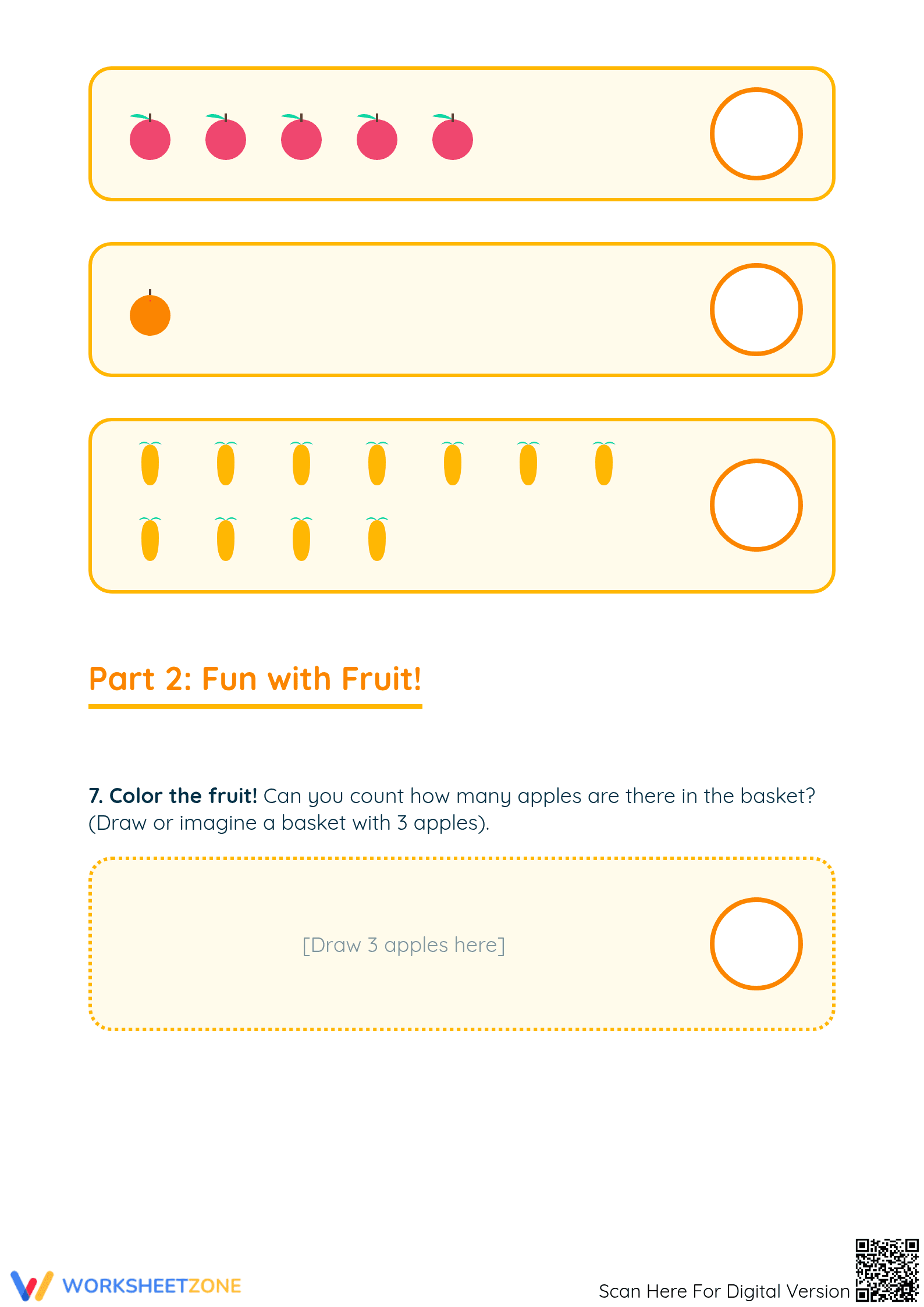
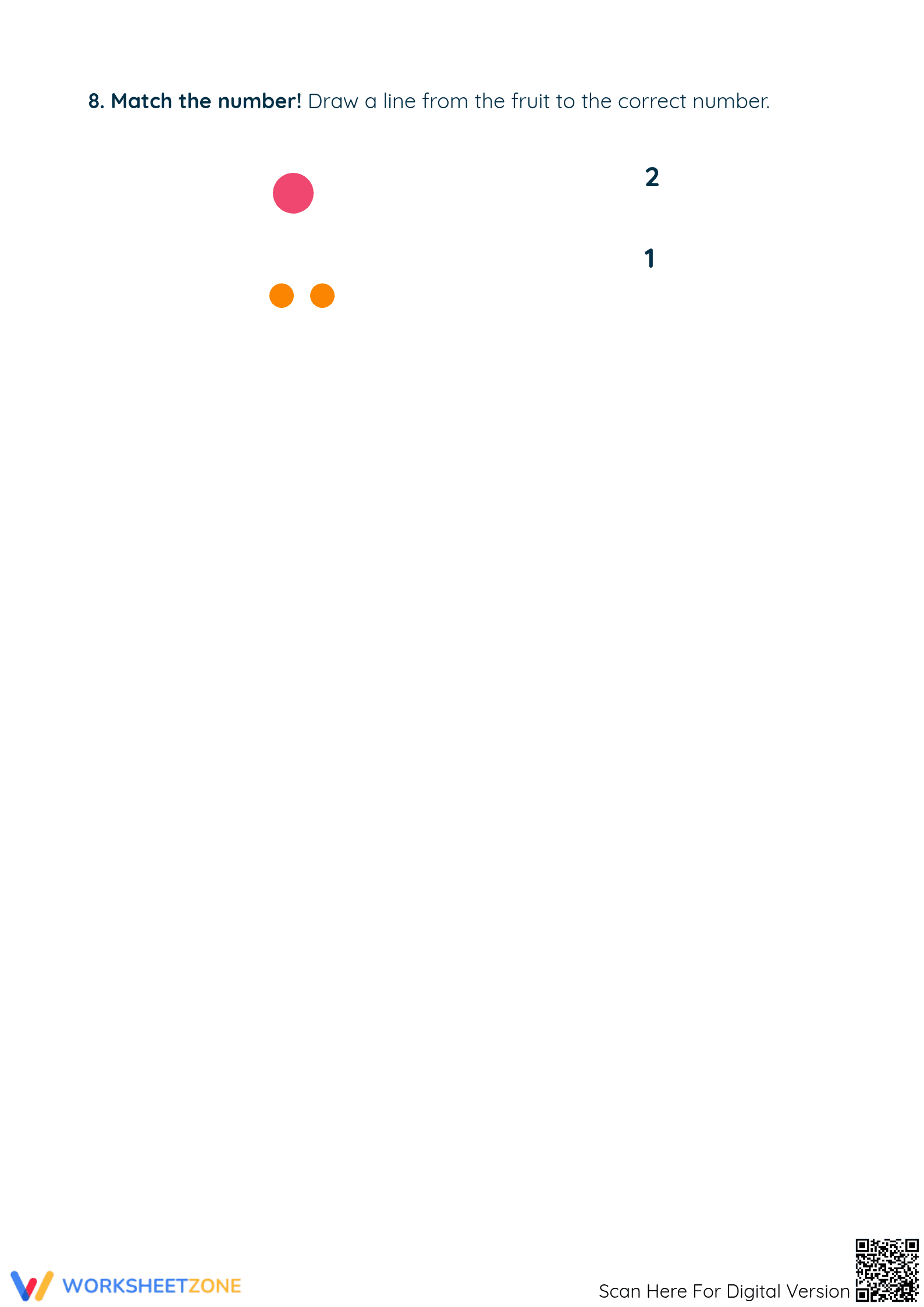
The worksheet spans three pages and includes eight distinct tasks. Part 1 features six counting blocks with rows of watermelons, grapes, and oranges. Part 2 introduces a creative drawing task where students illustrate a specific quantity, followed by a matching exercise connecting visual groups to numbers. The clean, spacious layout provides ample room for young learners to write comfortably.
Skill Progression
- Guided Practice: Early problems feature simple linear arrangements (1-5) to help students establish a counting rhythm and practice writing single digits.
- Supported Practice: Mid-level tasks increase complexity with sets up to 11 and a drawing component requiring students to create a visual set from a prompt.
- Independent Practice: The final matching section requires discriminating between quantities and linking them to symbols without visual answer guides.
This sequence follows a gradual-release model to move students from teacher-supported observation to independent mastery.
Standards Alignment
The primary focus is CCSS.MATH.CONTENT.K.CC.B.5: "Count to answer 'how many?' questions about as many as 20 things arranged in a line, a rectangular array, or a circle." This resource also supports K.CC.A.3 by requiring students to write numbers. Both standard codes can be copied directly into lesson plans, IEP goals, or district curriculum mapping tools.
How to Use It
Use this worksheet as a formative assessment after a whole-group lesson on counting. Alternatively, place it in a math center with plastic fruit manipulatives so students can mirror the sets before writing. During completion, observe if students "tag" objects with their fingers—this is a key milestone in mastering one-to-one correspondence. The activity typically takes 15 to 20 minutes to complete in a standard classroom setting.
Who It's For
This resource is tailored for Kindergarten students and Pre-K learners ready for numerical writing. It serves as an excellent intervention for Grade 1 students needing support with number-quantity association. Pair this worksheet with a counting bin or a fruit-themed picture book to provide a multi-sensory experience bridging the gap between concrete objects and abstract numbers.
The development of one-to-one correspondence is a critical predictor of later mathematical success, as highlighted by NAEP reports on early childhood numeracy. Research from Fisher & Frey (2014) emphasizes that scaffolded practice, such as the transition from counting linear arrays to matching quantities, helps solidify the cardinality principle. This worksheet utilizes K.CC.B.5 to bridge the gap between perceptual subitizing and conceptual counting. By providing eight focused tasks across three pages, it ensures students engage with number-quantity relationships in multiple formats, including writing, drawing, and matching. This variety prevents cognitive fatigue while reinforcing core mathematical standards. Educators can confidently integrate this tool into their curriculum, knowing it aligns with evidence-based instructional strategies for early math development and provides the repetitive, high-success practice required for foundational mastery. This resource supports the gradual acquisition of complex number sense skills.


