




























Views
Downloads




Free Scientific Notation Operations Worksheet | Grade 8 Math

Paste this activity's link or code into your existing LMS (Google Classroom, Canvas, Teams, Schoology, Moodle, etc.).
Students can open and work on the activity right away, with no student login required.
You'll still be able to track student progress and results from your teacher account.
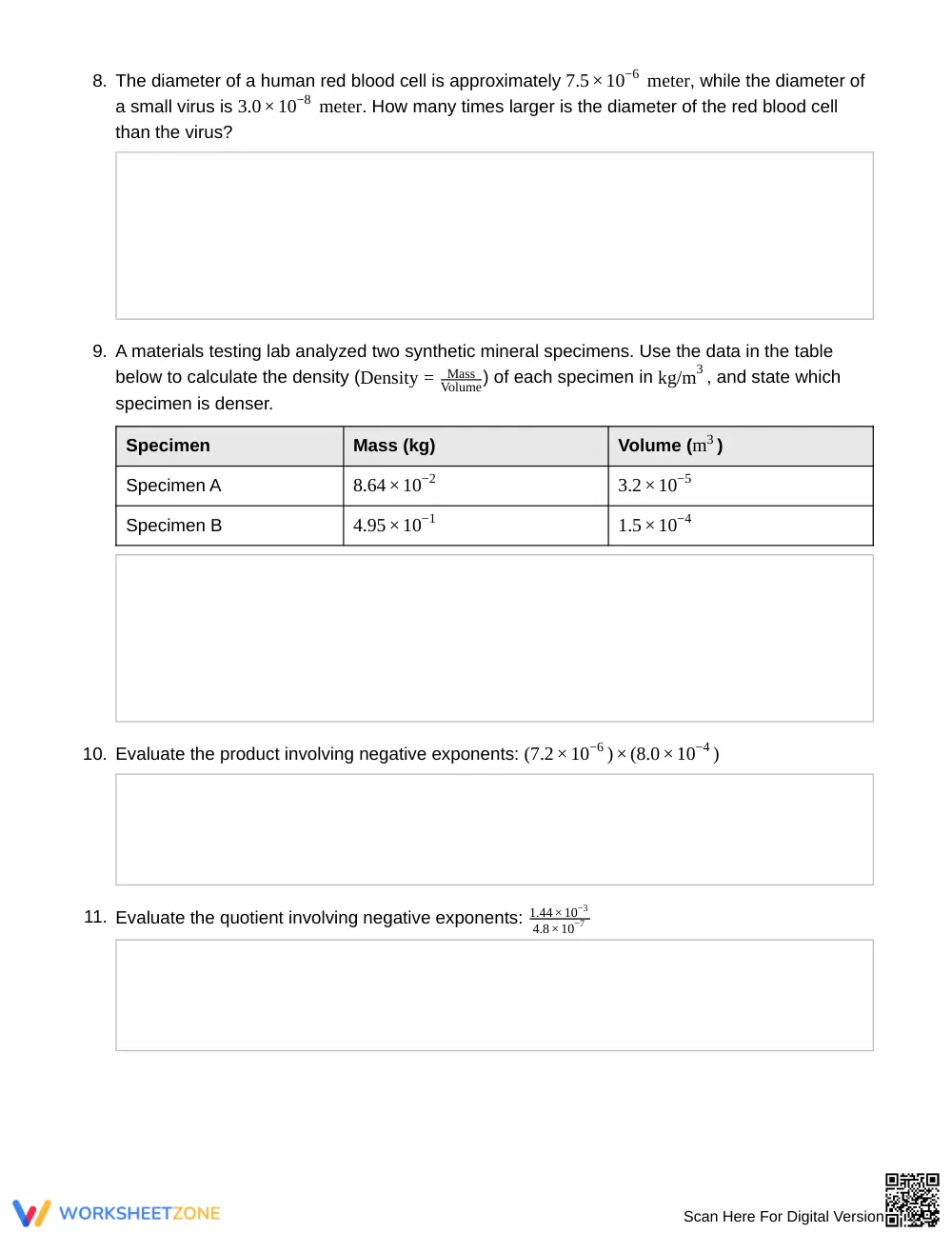
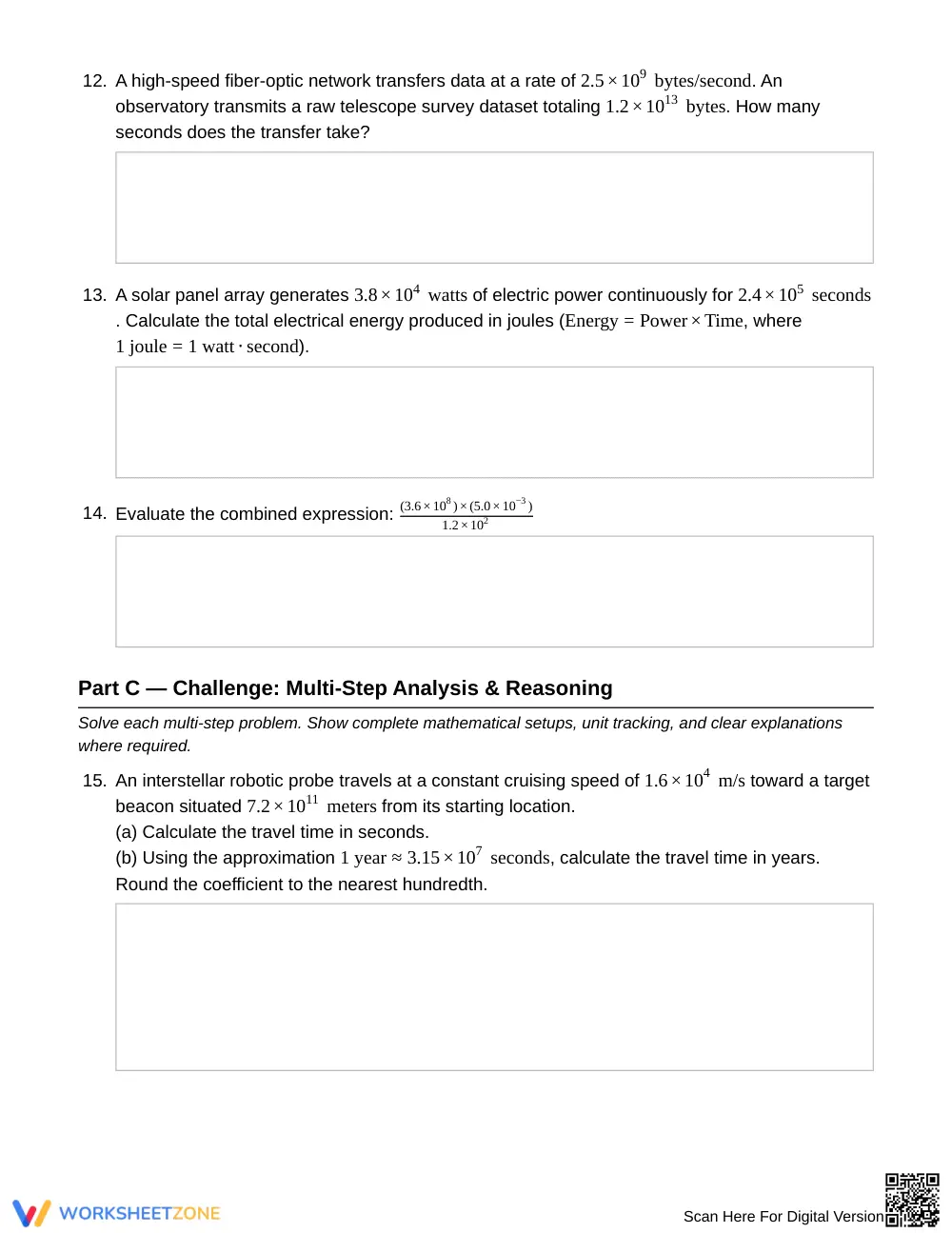
Mastering scientific notation operations requires calculating products and quotients of numbers with large and small magnitudes while applying exponent rules. This 18-problem worksheet guides Grade 8 math students through evaluating numerical expressions, renormalizing decimal coefficients into proper scientific form, and solving multi-step word problems involving real-world scientific data.
At a Glance
- Grade: 8 · Subject: Math
- Standard: Multiply and divide numbers expressed in scientific notation with positive and negative powers
- Skill Focus: Compute Products and Quotients in Scientific Notation
- Format: 5 pages · 18 problems · Answer key included · PDF
- Best For: Skill consolidation, independent practice, and STEM modeling
- Time: 45–60 minutes
What's Inside
This 5-page printable resource includes a targeted 2-page student task set and a detailed 3-page answer key showing full algebraic setups. A foundational reference box reinforces exponent addition and subtraction rules alongside coefficient renormalization criteria. Students tackle numeric evaluations, density calculations from lab data tables, astronomical distances, microchip volume geometry, and targeted student error analysis.
Skill Progression
- Guided Practice: Part A offers 4 foundational problems where students isolate coefficients and apply direct exponent product or quotient rules with explicit regrouping prompts.
- Supported Practice: Part B expands into 10 contextual problems requiring students to translate real-world scenarios—such as bacterial mass, planetary distances, and data transfer rates—into proper scientific expressions.
- Independent Practice: Part C challenges learners with 4 advanced multi-step tasks, including geometric volume modeling, unit conversions over time, and diagnosing computational errors.
This structure follows an intentional gradual-release model, transitioning students from mechanical fluency to conceptual mastery and higher-order mathematical critique.
Standards Alignment
This resource aligns with middle school mathematics standards requiring students to perform operations with numbers expressed in scientific notation, including problems where both decimal and scientific notation are used. Supporting work incorporates the laws of integer exponents to simplify expressions. Both standard codes can be copied directly into lesson plans, IEP goals, or district curriculum mapping tools.
How to Use It
Deploy this worksheet after direct instruction on exponent properties and scientific notation conventions. For active formative assessment, monitor Part A to observe whether students remember to adjust exponents when renormalizing coefficients. Expect students to complete the entire 18-problem set within 45 to 60 minutes of focused classroom work or homework.
Who It's For
This activity supports general Grade 8 math students, pre-algebra learners, and physical science classes analyzing metric measurements. Provide the embedded rule box for students needing reference scaffolds, while assigning Part C as an extension for advanced learners. Pair this worksheet directly with an introductory lesson on integer exponent laws.
According to Fisher & Frey (2014), structured gradual-release frameworks significantly improve student retention in secondary mathematics by systematically shifting cognitive responsibility from explicit procedural modeling to independent analysis. This Grade 8 scientific notation worksheet puts that research into action across 18 targeted tasks that guide learners to compute products and quotients of numbers written in scientific notation. Students begin by manipulating isolated coefficients and integer exponents, progress to applying scientific calculations to real-world physics and biological data sets, and culminate in diagnosing simulated calculation errors. By grounding complex mathematical notation in applied STEM contexts—such as cellular mass, celestial distances, and data transmission—the resource reinforces conceptual understanding while building procedural fluency. The complete 5-page packet features an instructional rule box and a 3-page comprehensive solution key that documents every intermediate step, providing middle school educators with a reliable, classroom-tested tool for rigorous standards-based practice.


