




























Views
Downloads


Free Low-Voltage Circuit Design Worksheet | Grade 12 Physics

Paste this activity's link or code into your existing LMS (Google Classroom, Canvas, Teams, Schoology, Moodle, etc.).
Students can open and work on the activity right away, with no student login required.
You'll still be able to track student progress and results from your teacher account.
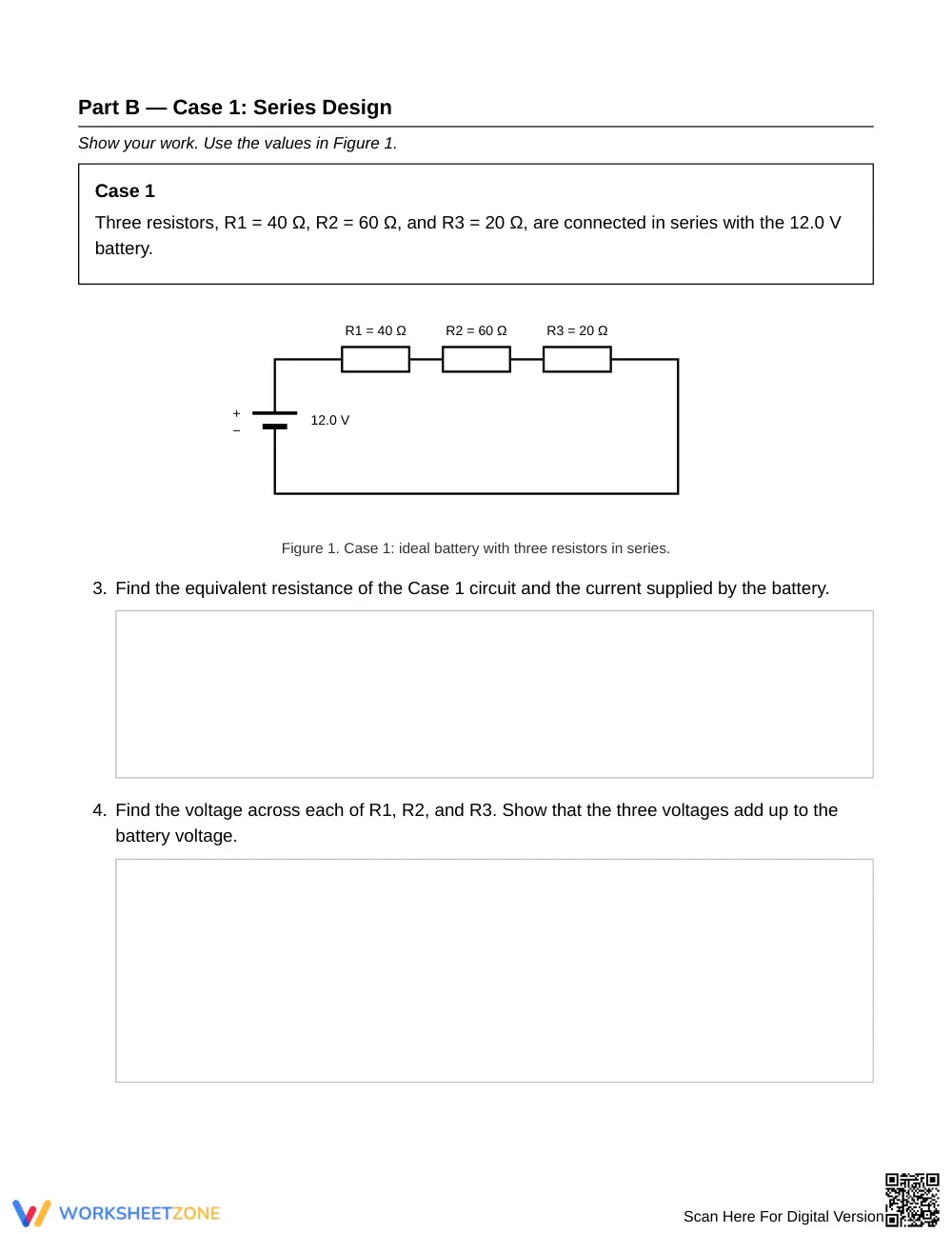
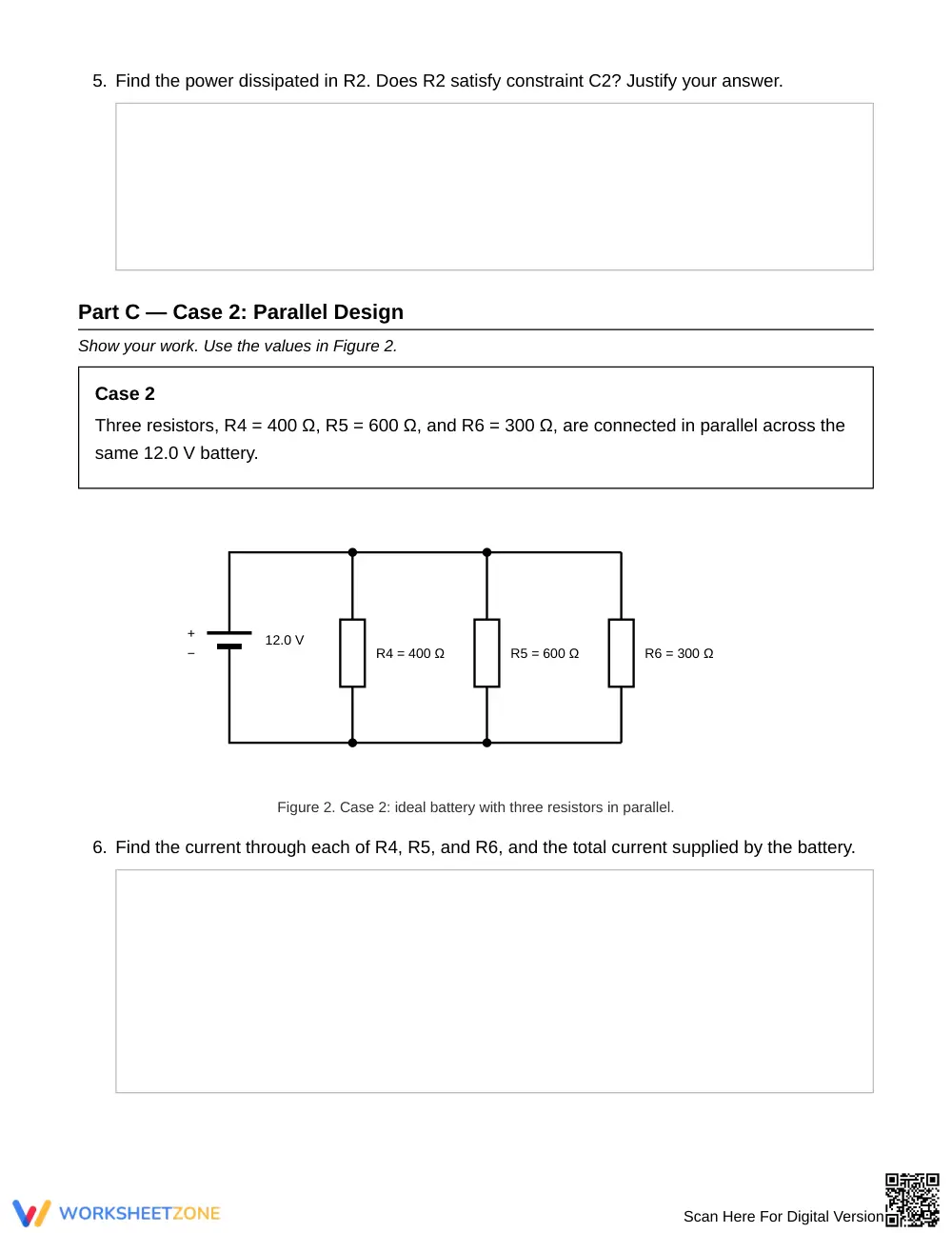
This worksheet teaches Grade 12 physics students to judge whether a low-voltage circuit design meets stated limits. Students calculate current, voltage, and power in a series network and a parallel network on a 12.0 V battery, then test two student conclusions against their own numbers.
At a Glance
- Grade: 12 · Subject: Physics
- Standard: Not assigned — students compare calculated total current and per-resistor power with stated limits.
- Skill Focus: Evaluate a low-voltage circuit design against current and power limits
- Format: 5 pages · 10 problems · Answer key included · PDF
- Best For: Review, homework, or formative checks
- Time: 40–50 minutes
What's Inside
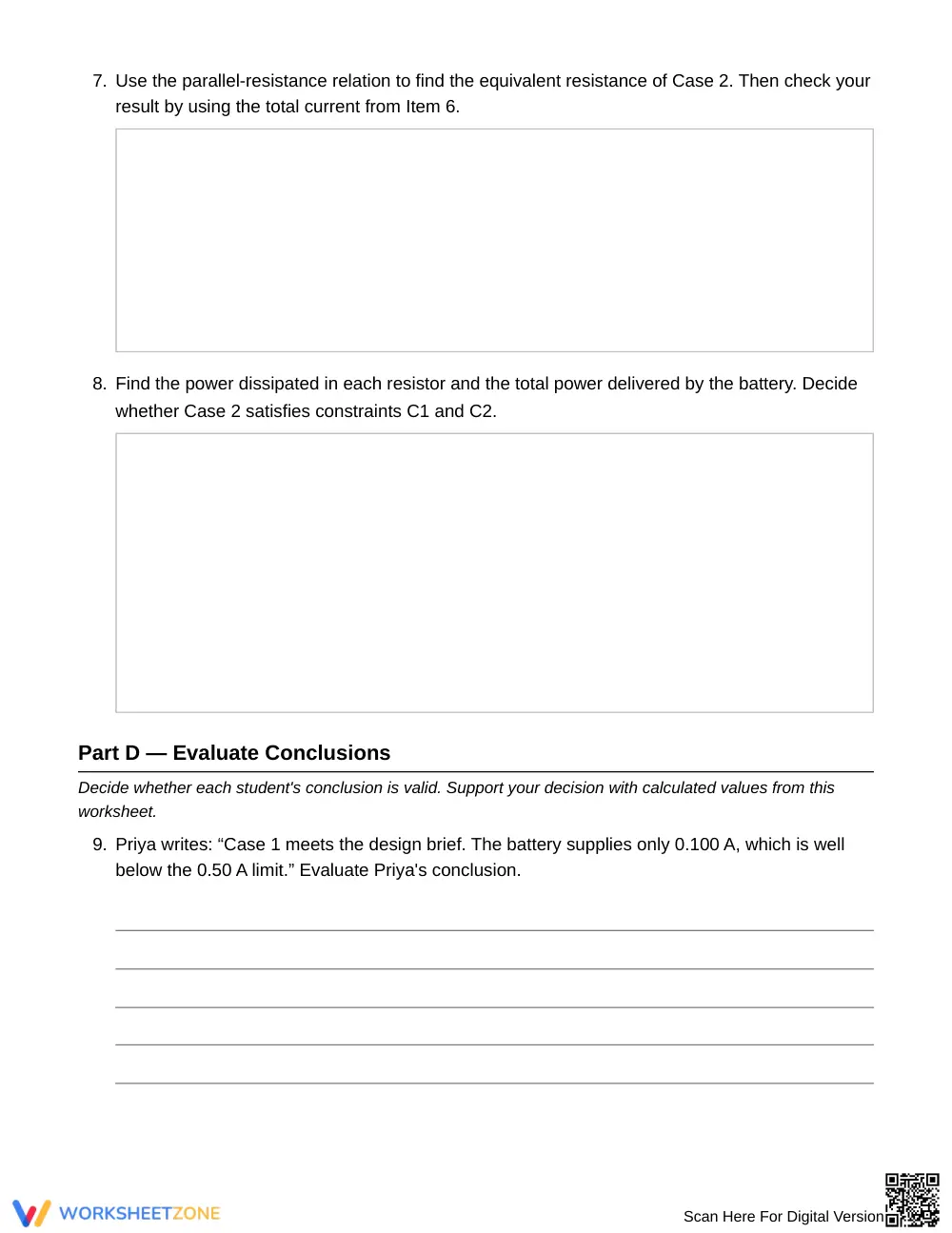
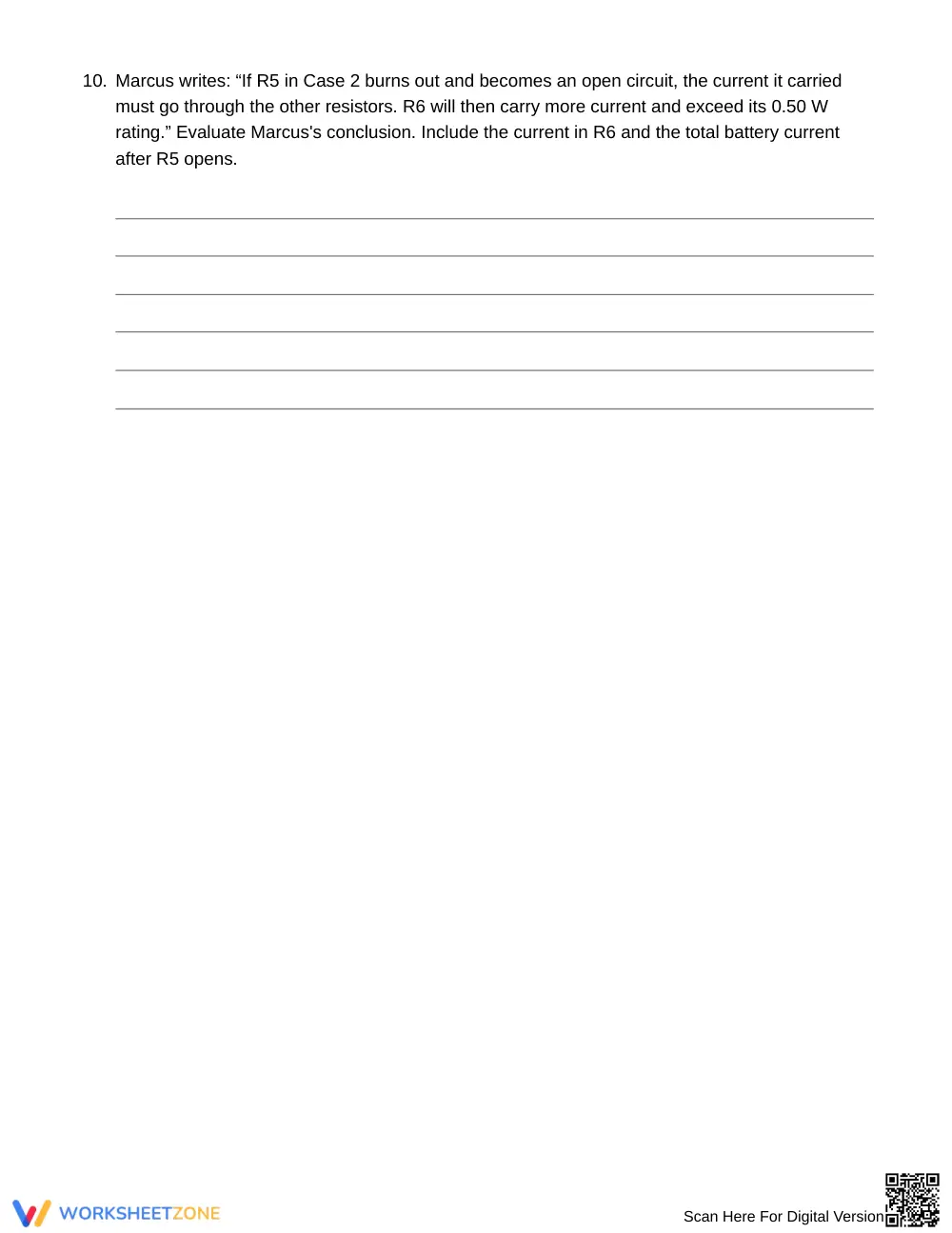
Four parts and 10 tasks over 5 pages: two conceptual items (multiple choice and fill-in), three series calculations, three parallel calculations, and two claim evaluations. A reference box lists the relations and rounding rule, and two circuit figures support the calculations. A 3-page answer key shows worked values.
Skill Progression
- Guided practice: Part A, 2 items, multiple choice and fill-in that set up the constraints and circuit types.
- Supported practice: Parts B and C, 6 items, with figures and a relations box as scaffolds.
- Independent practice: Part D, 2 items, where students evaluate claims using their own calculated values.
This sequence follows gradual release: I Do, We Do, You Do.
Standards Alignment
No standard code was supplied for this worksheet. The skill aligns with high school physics expectations that students apply Ohm's law and electrical power relations to analyze series and parallel circuits and evaluate whether a design meets constraints. Teachers can copy the skill statement into lesson plans, IEP goals, or district curriculum mapping tools.
How to Use It
- After direct instruction on series and parallel circuits, assign Parts A–C as guided practice.
- Use Part D as a review or exit task before a unit test.
Formative tip: while students work, check whether they compare power in each resistor, not just total current. Expect 40–50 minutes in total.
Who It's For
Built for Grade 12 physics students in an Electricity & Circuits unit. Students who need support can lean on the relations box and figures; advanced students can extend Part D by testing other open-circuit failures. Pair it with a direct instruction lesson on equivalent resistance.
The Evaluating a Low-Voltage Circuit Design worksheet is a Grade 12 physics resource for the Electricity & Circuits unit. Its 10 tasks teach students to evaluate a design by comparing calculated total current and per-resistor power with stated limits of 0.50 A and 0.50 W. Students analyze a series network of 40 Ω, 60 Ω, and 20 Ω resistors and a parallel network of 400 Ω, 600 Ω, and 300 Ω resistors on an ideal 12.0 V battery, then critique two student conclusions using their own calculations. The 5-page PDF includes an answer key and involves no mains wiring. The structure follows the gradual release model described by Fisher & Frey (2014), moving from identifying constraints to supported calculation to independent evaluation. No standard code was supplied for this worksheet, so teachers should map it to their own course standards. It suits review, homework, or formative assessment of Ohm's law and electrical power.


