




























Views
Downloads



Free Essential & Incidental Details Worksheet | Grade 7 ELA

Paste this activity's link or code into your existing LMS (Google Classroom, Canvas, Teams, Schoology, Moodle, etc.).
Students can open and work on the activity right away, with no student login required.
You'll still be able to track student progress and results from your teacher account.
This Grade 7 reading worksheet trains students to separate essential supporting evidence from incidental details in informational texts. Using an original passage about a student-run radio station, learners analyze how facts uphold central ideas, filter out decorative trivia, and construct precise objective summaries.
At a Glance
- Grade: 7 · Subject: ELA
- Standard:
RI.7.2— Determine central ideas and write objective summaries without incidental details- Skill Focus: Separate Essential and Incidental Details
- Format: 5 pages · 12 problems · Answer key included · PDF
- Best For: Summary writing practice and reading intervention
- Time: 35–45 minutes
What's Inside
The 5-page printable resource includes a foundational reminder rule box, a journalistic passage titled "On the Air at WWMS," 12 scaffolded tasks, and a 2-page answer key. Students complete text-dependent multiple-choice items, an essential-versus-incidental classification chart, and written responses leading into an objective summary.
Skill Progression
- Guided practice (Part A, 3 tasks): Students locate explicit evidence and identify foundational details supporting professional enterprise and ethical broadcasting.
- Supported practice (Part B, 6 tasks): Learners evaluate two central ideas, categorize four statements in an essential-versus-incidental matrix, exclude conversational trivia, and analyze objective summary statements.
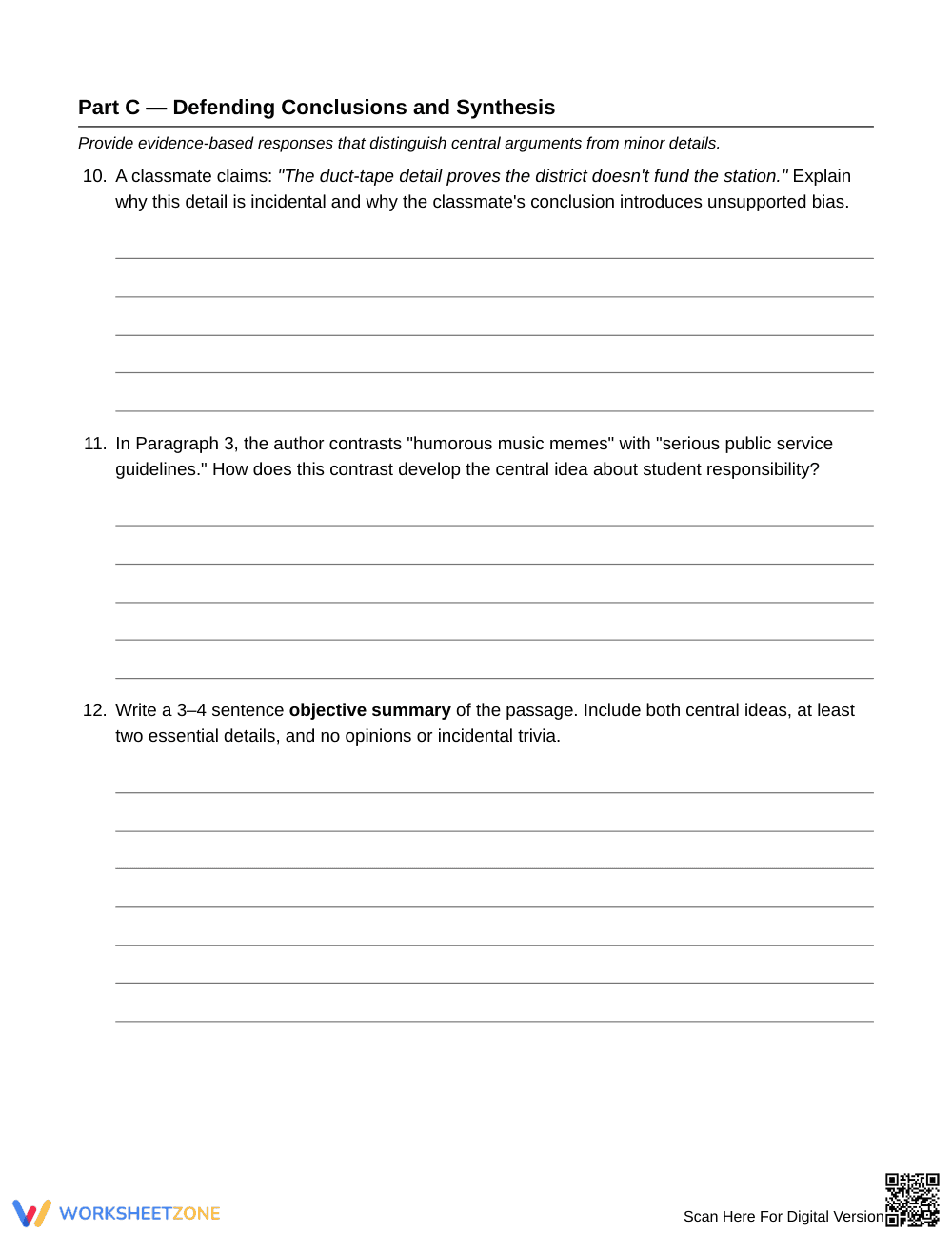
- Independent practice (Part C, 3 tasks): Students evaluate peer claims for unsupported bias, analyze descriptive contrast, and write an original 3-to-4 sentence objective summary.
This gradual release progression guides middle school readers from identifying textual evidence to synthesizing objective summaries independently.
Standards Alignment
This worksheet aligns directly to primary standard `RI.7.2`: Determine two or more central ideas in a text and analyze their development over the course of the text; provide an objective summary of the text. In addition, it supports `RI.7.1` by requiring text evidence to justify detail classification. Both standard codes can be copied directly into lesson plans, IEP goals, or district curriculum mapping tools.
How to Use It
Assign this worksheet after direct instruction on text summarization, using Parts A and B for guided practice and Part C for independent evaluation. During station rotations, use it for targeted intervention to help students isolate claims before drafting summaries. Check the Part B classification table formatively to catch misconceptions early. Completion time is 35 to 45 minutes.
Who It's For
This resource serves general education Grade 7 ELA classes, reading intervention groups, and English language learners practicing summary writing. Differentiate by providing targeted paragraph markers during Part B. It pairs naturally with an anchor chart distinguishing main ideas from interesting facts.
According to Fisher & Frey (2014), explicit instruction in distinguishing critical arguments from incidental text details is essential for adolescent literacy development. When middle school students encounter complex informational texts, they frequently confuse engaging descriptive trivia—such as personal anecdotes or setting descriptions—with foundational claims. Standard RI.7.2 requires seventh graders to evaluate how central ideas develop and synthesize that understanding into an objective summary free of extraneous information. This 12-task worksheet establishes explicit evaluative criteria through a four-item classification matrix, structured multiple-choice analysis, and independent synthesis writing. By isolating essential evidence from colorful context, learners build the metacognitive discernment needed to generate disciplined academic summaries across content areas. Structured practice in separating vital data from supporting color ensures that students master textual hierarchy, producing objective writing grounded in verified facts rather than surface-level interest.


