




























Views
Downloads

Fragments to Sentences Printable Worksheet | Grade 4

Paste this activity's link or code into your existing LMS (Google Classroom, Canvas, Teams, Schoology, Moodle, etc.).
Students can open and work on the activity right away, with no student login required.
You'll still be able to track student progress and results from your teacher account.
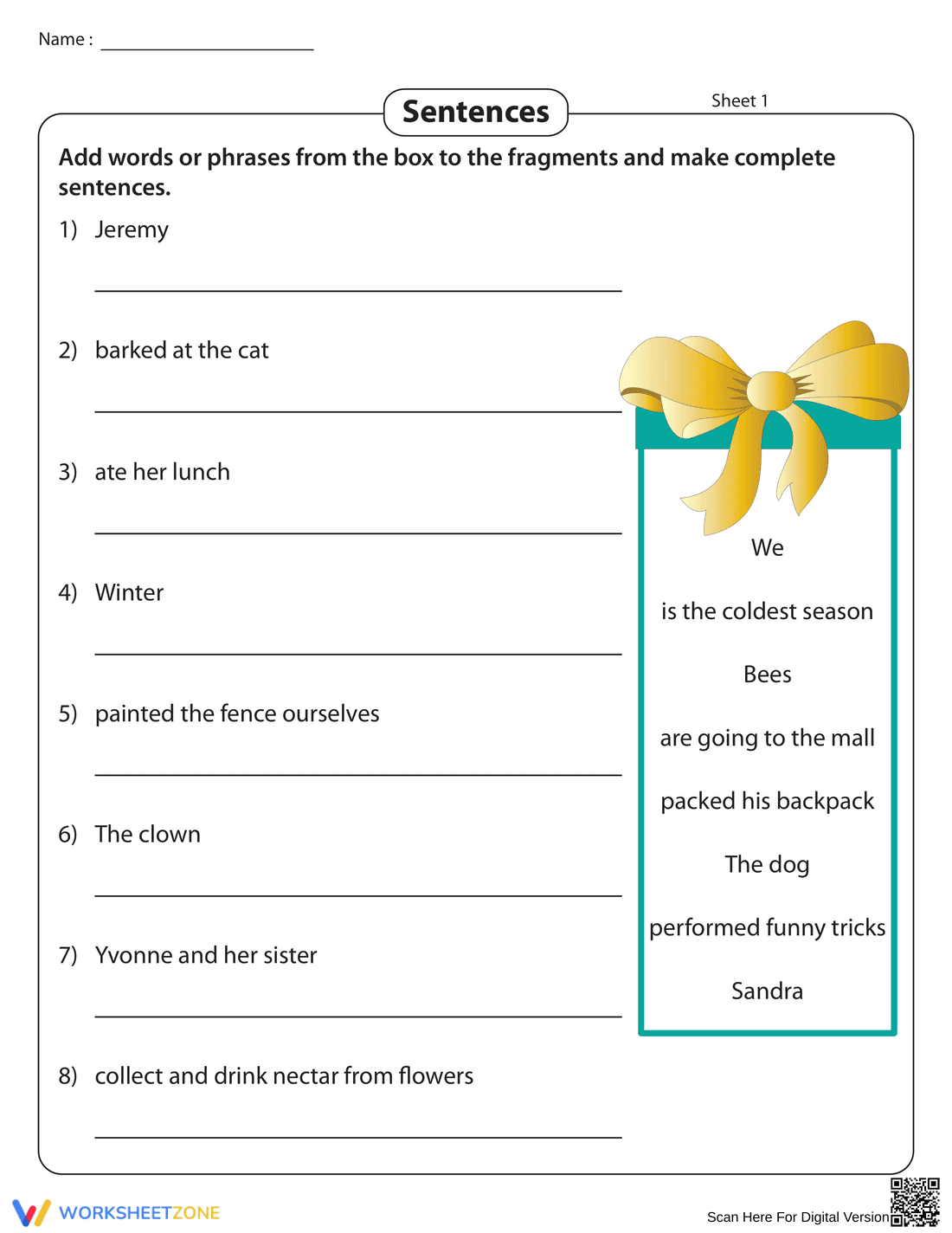
Mastering the distinction between fragments and complete sentences is a fundamental pillar of early literacy and clear communication. This Grade 4 ELA worksheet provides students with targeted practice in identifying missing sentence components and repairing them using a provided word bank. By bridging these grammatical gaps, learners develop a stronger intuition for proper sentence structure and syntax.
At a Glance
- Grade: 4 · Subject: English Language Arts (ELA)
- Standard:
CCSS.ELA-LITERACY.L.4.1.f— Produce complete sentences by recognizing and correcting inappropriate fragments and run-on sentences- Skill Focus: Sentence Construction and Fragment Correction
- Format: 1 page · 8 problems · Answer key included · PDF
- Best For: Independent practice or quick formative assessment
- Time: 10–15 minutes
Inside this printable PDF, you will find a clean, focused layout featuring eight distinct sentence-building tasks. The worksheet uses a split-structure approach: the left side lists sentence fragments (either subjects or predicates), while a decorative box graphic on the right contains the corresponding phrases needed to complete the thoughts. This visual scaffolding helps students recognize what is missing to make a sentence whole.
The zero-prep workflow for this resource is designed for maximum teacher efficiency. First, print the single-page document (30 seconds). Second, distribute it to students for a quick warm-up activity (30 seconds). Finally, review the eight completed sentences as a class for immediate feedback (1 minute). Total preparation time is under two minutes, making it ideal for substitute plans or literacy blocks.
This activity is rigorously aligned to CCSS.ELA-LITERACY.L.4.1.f. The standard requires students to produce complete sentences while recognizing and correcting inappropriate fragments. By actively matching missing components, students demonstrate their understanding of basic sentence mechanics. This standard code can be copied directly into lesson plans, IEP goals, or district curriculum mapping tools to ensure instructional alignment.
Use this worksheet as a "Check for Understanding" after direct instruction on fragments. Teachers can observe which students struggle to pair subjects with logical predicates, providing a window into their syntactic reasoning. Alternatively, assign it as a collaborative "Turn and Talk" activity where partners read completed sentences aloud to verify they sound like finished thoughts, aiding in the auditory processing of grammar.
This resource is tailored for students in Grades 3 through 5 who are refining their writing mechanics. It is particularly effective for English Language Learners (ELLs) who benefit from the provided sentence frames and word bank scaffolding. It pairs naturally with a short mentor text or a grammar anchor chart that defines the essential parts of a complete sentence.
Fisher & Frey (2014) emphasize that the gradual release of responsibility model is most effective when supported by structured practice that isolates specific linguistic skills. This worksheet implements that philosophy by providing a word bank scaffold, allowing students to focus exclusively on the logic of sentence completion. By addressing CCSS.ELA-LITERACY.L.4.1.f through a matching format, the cognitive load is reduced, enabling students to successfully produce complete sentences and recognize fragments. This targeted approach is essential for developing the automaticity required for more complex composition tasks in later grades. Research shows that mastering these micro-skills leads to improved writing quality and clearer communication. This resource serves as a reliable tool for educators seeking to reinforce critical grammar foundations through proven instructional methods. This standalone summary of the standard provides a clear evidence-based rationale for its inclusion in any rigorous ELA curriculum.


