


























Views
Downloads



Fraction to Decimal Worksheet | Printable Grade 4-5 Math
Paste this activity's link or code into your existing LMS (Google Classroom, Canvas, Teams, Schoology, Moodle, etc.).
Students can open and work on the activity right away, with no student login required.
You'll still be able to track student progress and results from your teacher account.
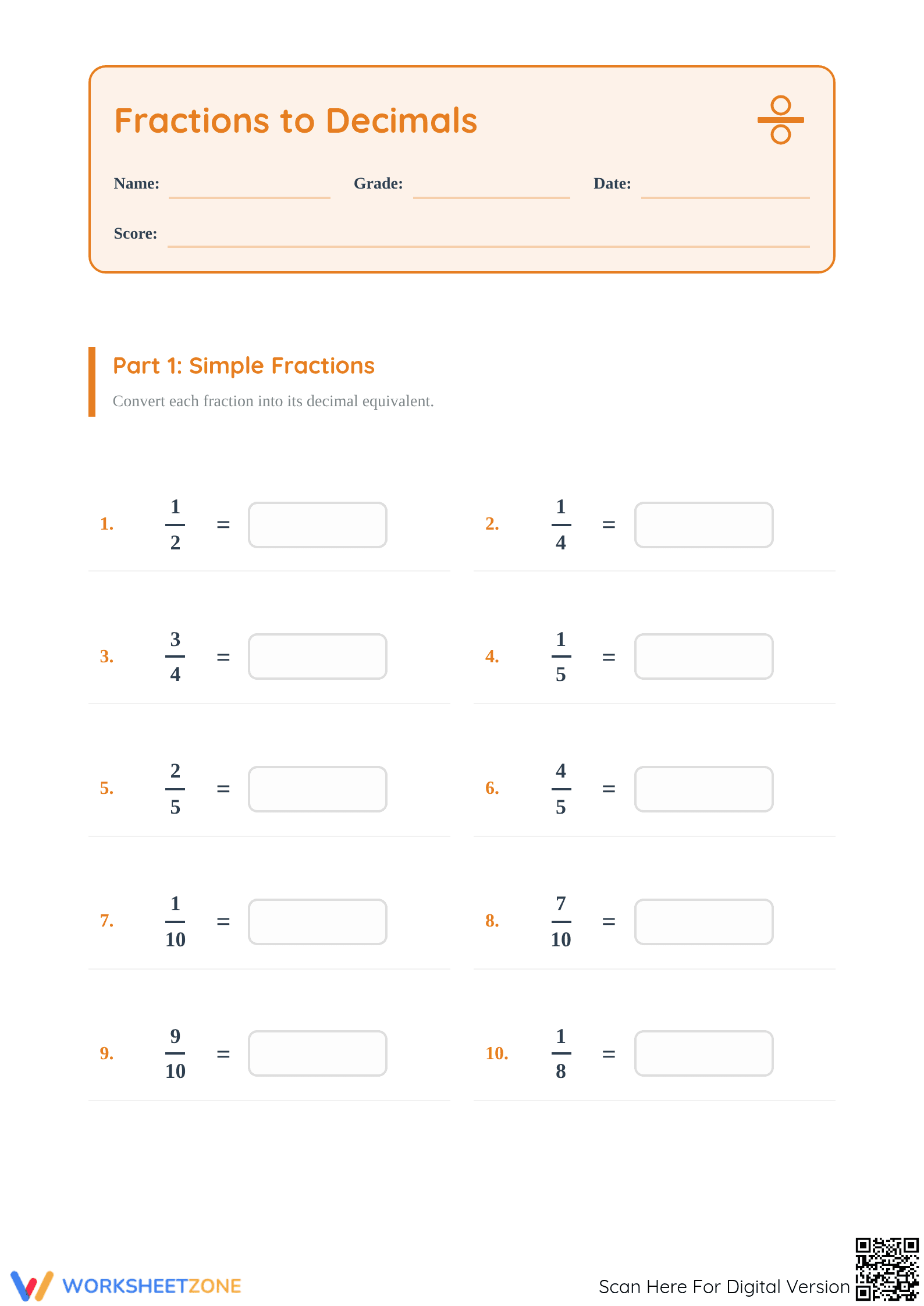
This comprehensive math worksheet helps students master the fundamental skill of converting fractions to decimals. By focusing on denominators of ten and one hundred, learners develop a concrete understanding of place value and decimal notation. Students will gain the confidence needed to translate visual fraction representations into numerical decimal formats efficiently and accurately.
At a Glance
- Grade: 4–5 · Subject: Math
- Standard:
CCSS.MATH.CONTENT.4.NF.C.6— Use decimal notation for fractions with denominators 10 or 100- Skill Focus: Fraction to Decimal Conversion
- Format: 3 pages · 120 problems · Answer key included · PDF
- Best For: Independent practice and reinforcement of place value
- Time: 20–30 minutes
What's Inside
This resource includes three full pages of targeted practice, containing a total of 120 unique conversion problems. Each page features a clear, organized grid layout that allows students to focus on one calculation at a time. The worksheet primarily utilizes tenths and hundredths to ensure a smooth transition into decimal concepts. A complete answer key is provided for rapid grading and immediate student feedback.
Skill Progression
- Guided practice: The initial section provides clear formatting to help students visualize the relationship between denominators and decimal places.
- Supported practice: Intermediate tasks increase in complexity by mixing tenths and hundredths, requiring students to identify the correct place value.
- Independent practice: The final page offers rapid-fire conversion tasks to build fluency and speed without additional scaffolding.
This structured approach follows the Gradual Release of Responsibility model, moving from supported identification to independent mastery.
Standards Alignment
This resource is directly aligned to `CCSS.MATH.CONTENT.4.NF.C.6`: "Use decimal notation for fractions with denominators 10 or 100; for example, rewrite 0.62 as 62/100; describe a length as 0.62 meters; locate 0.62 on a number line." This standard is a critical building block for understanding the base-ten system. Both standard codes can be copied directly into lesson plans, IEP goals, or district curriculum mapping tools.
How to Use It
Use this worksheet during independent practice after a direct instruction lesson on decimals and fractions. It serves as an excellent formative assessment tool; teachers should observe if students are correctly placing the decimal point for hundredths versus tenths. The expected completion time for all three pages is approximately 25 minutes, making it ideal for a focused math center or homework assignment.
Who It's For
This worksheet is designed for fourth and fifth-grade students who are beginning their journey into decimal arithmetic. It is particularly helpful for visual learners who benefit from repetitive, structured practice to internalize mathematical patterns. Pair this resource with a place value anchor chart or decimal number lines to provide extra support for students who may be struggling with the concept.
Mastering the conversion between fractions and decimals is a pivotal milestone in elementary mathematics, as identified in the NAEP framework. Research from Fisher & Frey (2014) emphasizes that high-volume, targeted practice helps students automate lower-level processing skills, such as recognizing CCSS.MATH.CONTENT.4.NF.C.6 patterns. This automation allows cognitive resources to be redirected toward higher-order problem-solving and multi-step decimal operations. The RAND AIRS 2024 report highlights that consistent exposure to tenths and hundredths in varied formats—such as the 120 problems provided here—significantly reduces common misconceptions about decimal magnitude. By grounding the transition from fractions to decimals in the familiar base-ten system, educators can bridge the gap between whole number arithmetic and rational number theory. This worksheet provides the essential scaffolding required for students to achieve proficiency in early decimal notation, ensuring they are prepared for the more rigorous demands of middle school algebra and complex data analysis.


