


























Views
Downloads

Printable Fraction and Decimal Conversions | Grade 7-9 Math
Paste this activity's link or code into your existing LMS (Google Classroom, Canvas, Teams, Schoology, Moodle, etc.).
Students can open and work on the activity right away, with no student login required.
You'll still be able to track student progress and results from your teacher account.
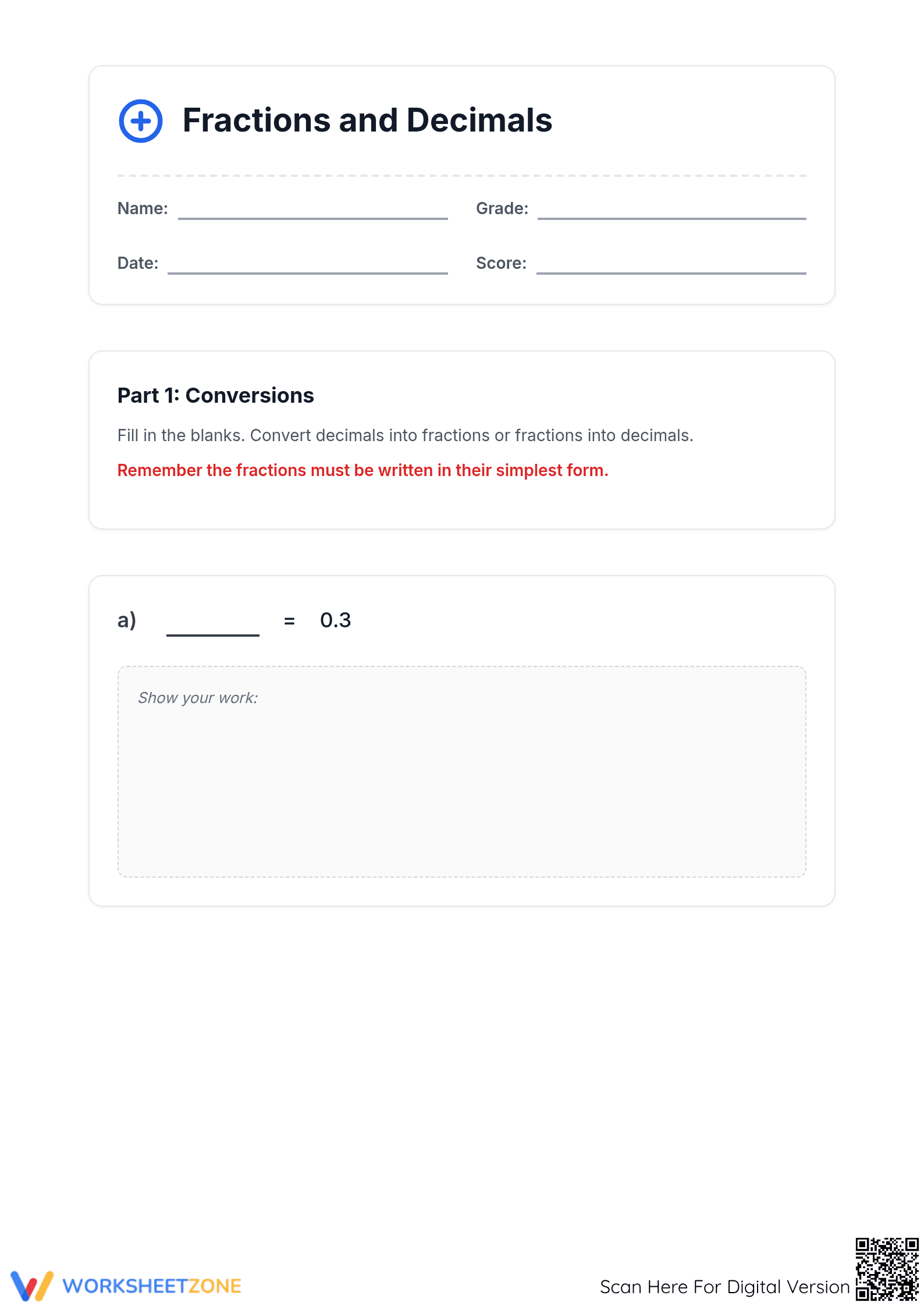
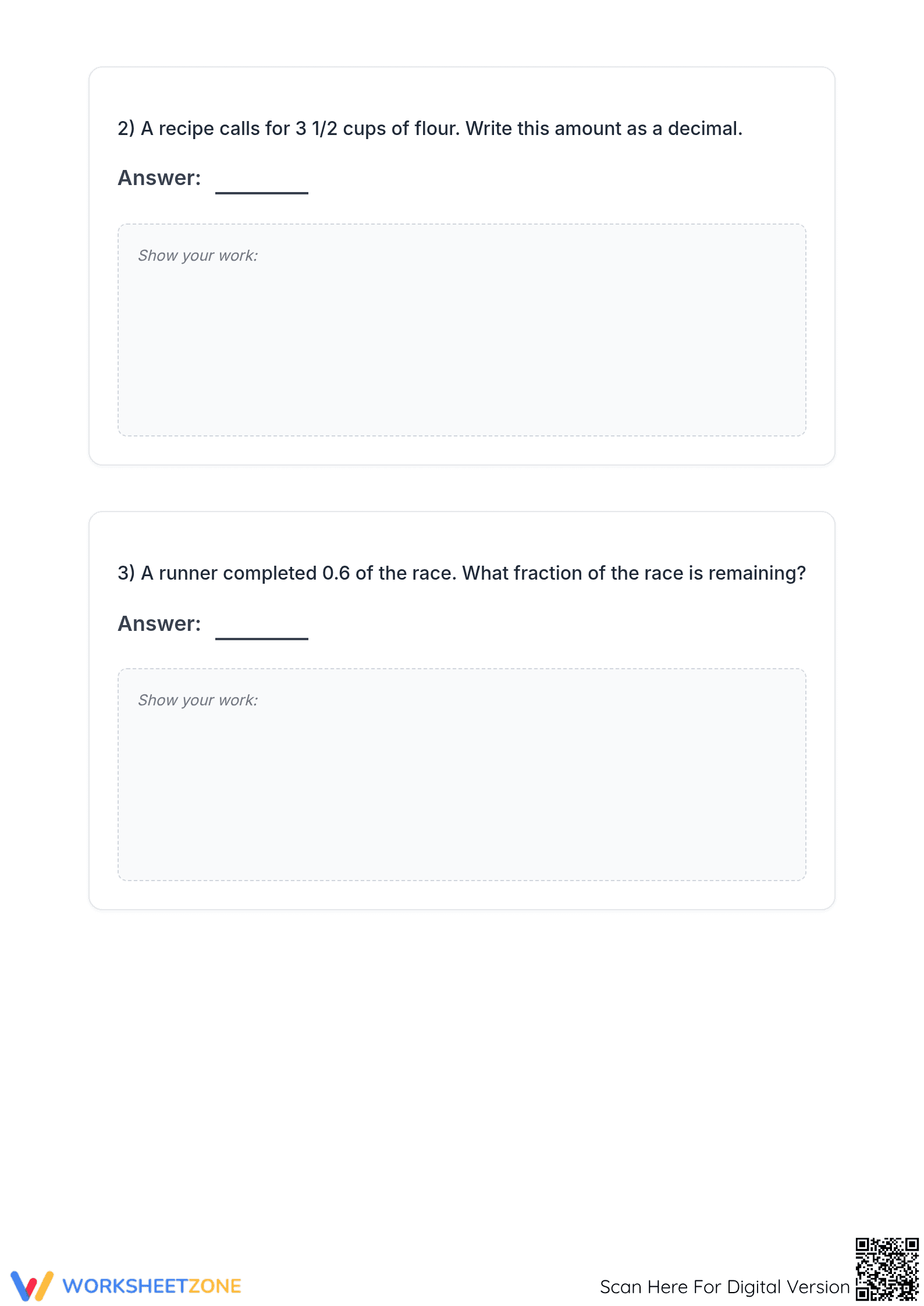
This worksheet provides comprehensive practice for students mastering the conversion between fractions and decimals. By working through varied numerical representations, learners build the fluency needed for algebra and real-world financial literacy. It is designed to bridge the gap between abstract rational numbers and practical decimal notation through repetitive, high-volume practice.
At a Glance
- Grade: 7–9 · Subject: Decimals
- Standard:
CCSS.MATH.CONTENT.7.NS.A.2.D— Convert rational numbers to decimals using division and identify repeating patterns.- Skill Focus: Fraction and decimal equivalence
- Format: 5 pages · 60 problems · Answer key included · PDF
- Best For: Independent practice, warm-ups, or homework
- Time: 25–40 minutes
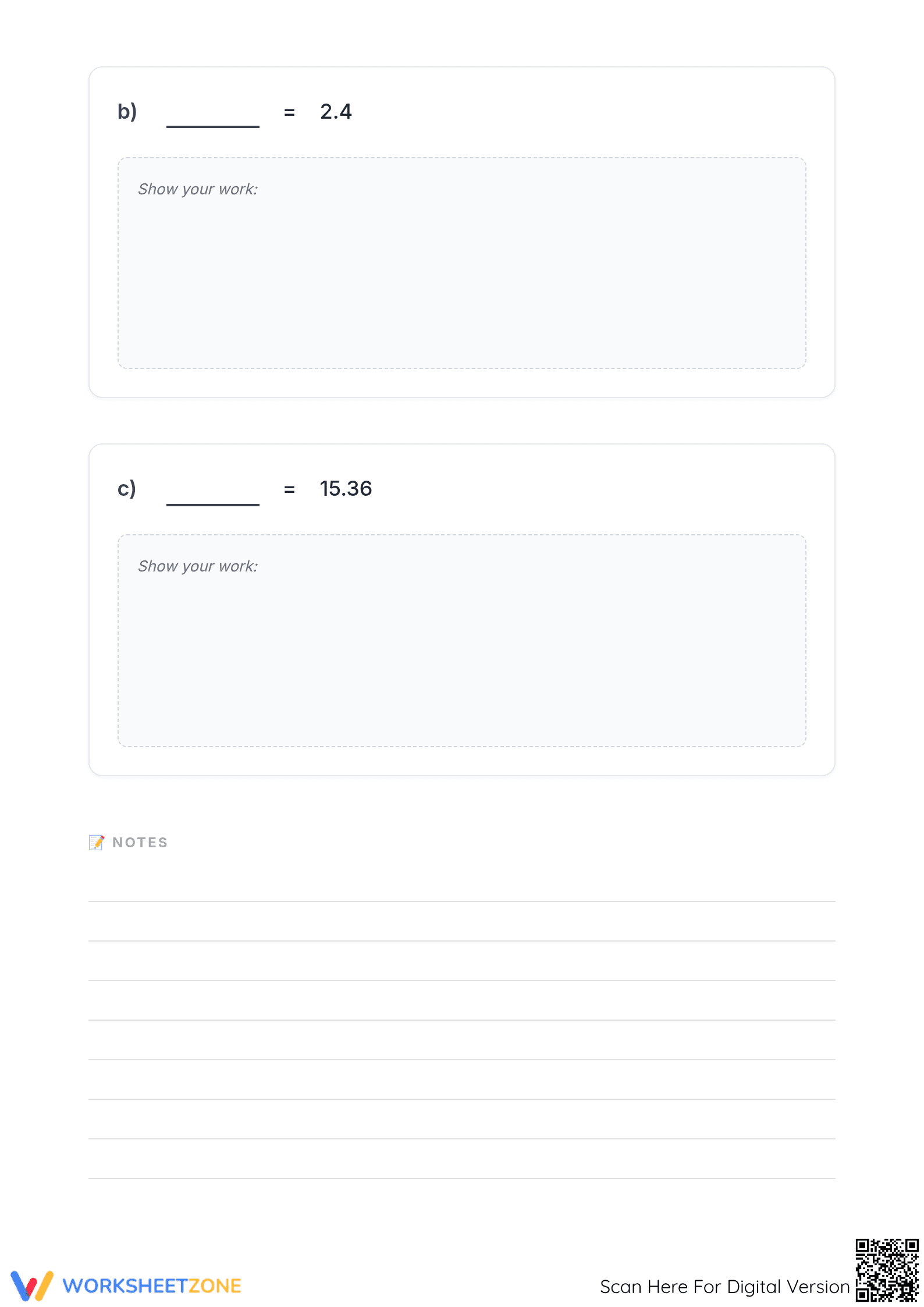
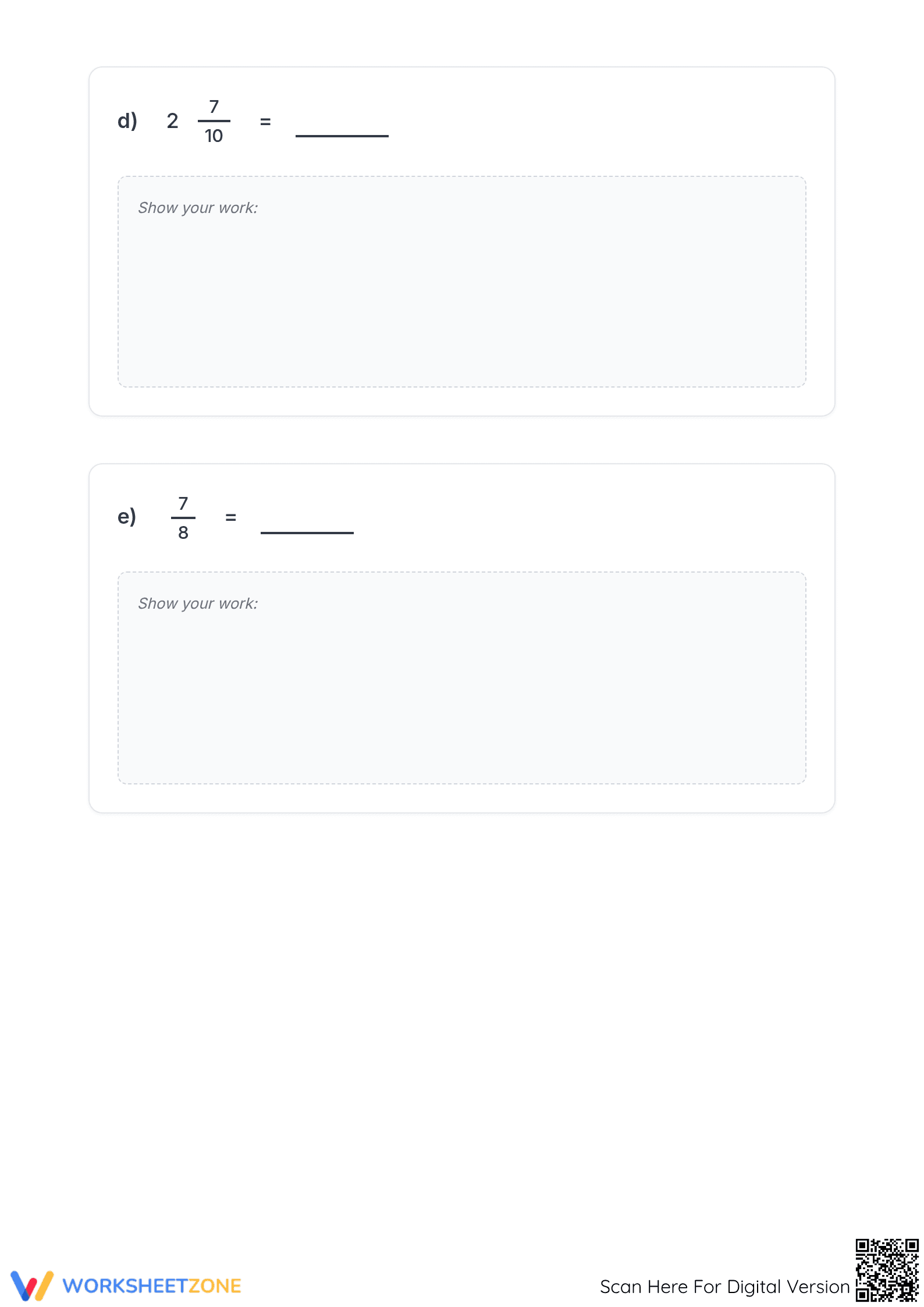
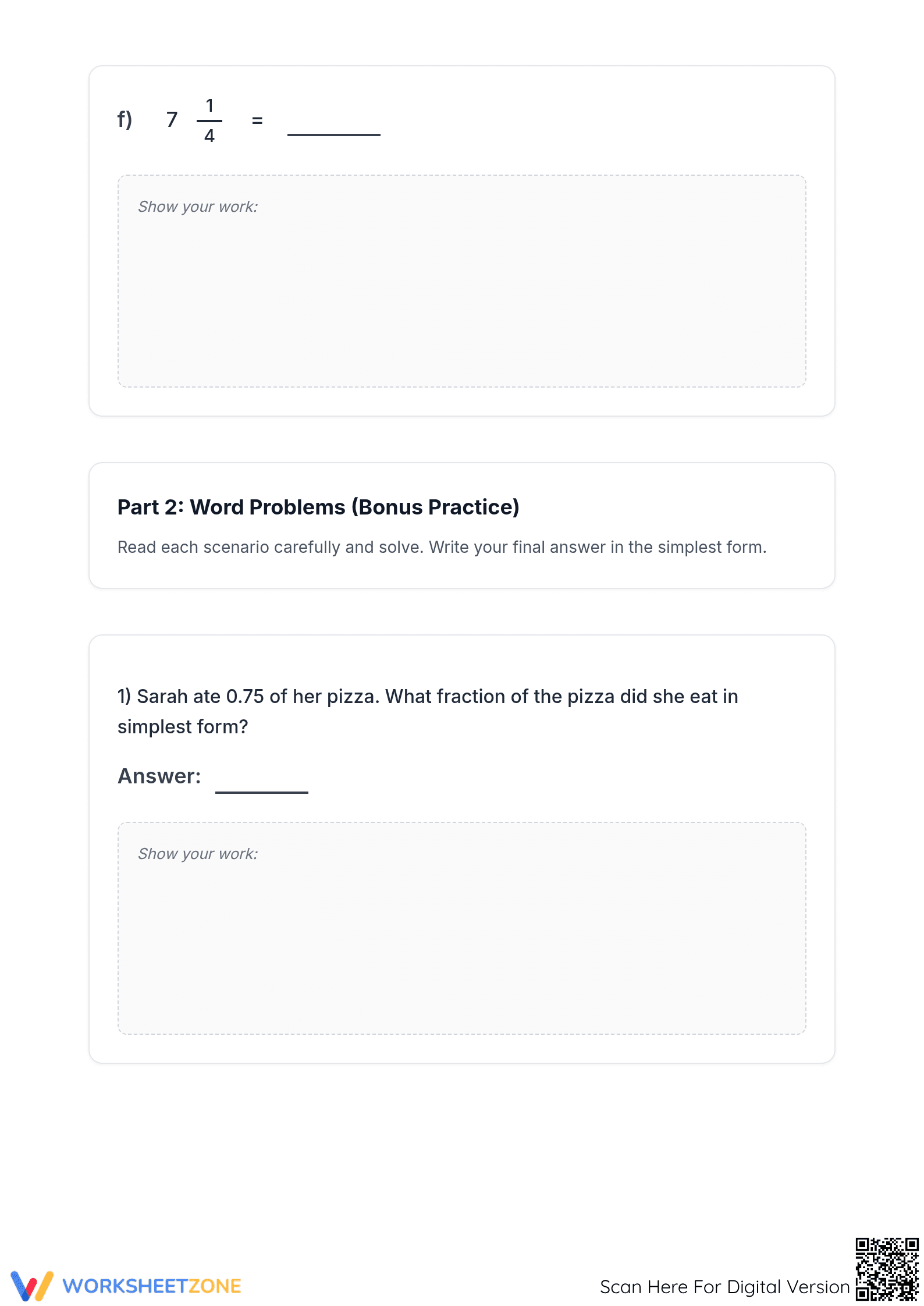
This extensive five-page PDF includes 60 unique conversion tasks presented in a clean, tabular format. Students are prompted to convert fractions into their decimal counterparts and vice-versa, ensuring a dual-directional understanding of numerical equivalence. A full answer key is provided to facilitate rapid grading or student self-check sessions, making it ideal for both classroom and remote learning environments.
Skill Progression
- Guided Practice: The initial page introduces common benchmarks like halves and fourths to build confidence and establish a baseline for equivalence.
- Supported Practice: Subsequent tasks move into denominators like eighths and twentieths, requiring students to apply division or scaling strategies.
- Independent Practice: The final pages challenge students with less common fractions, reinforcing the long-division method required for mastery.
This gradual-release approach ensures students move from recognition of simple patterns to the independent application of mathematical algorithms.
Standards Alignment
This resource is strictly aligned to CCSS.MATH.CONTENT.7.NS.A.2.D, which requires students to know that the decimal form of a rational number terminates in 0s or eventually repeats. By converting a variety of fractions, students gain empirical evidence of this mathematical law. Both standard codes can be copied directly into lesson plans, IEP goals, or district curriculum mapping tools.
How to Use It
Assign this worksheet as a bell ringer at the start of a unit on rational numbers to assess prior knowledge. Teachers should observe whether students are attempting to find common denominators like 100 or using long division, as this reveals their current level of mathematical strategy. Expect completion in approximately 30 minutes depending on student fluency.
Who It's For
This practice set is ideal for middle school students in grades 7 and 8, as well as high schoolers in grade 9 who require remedial support in rational number operations. It pairs naturally with an anchor chart displaying common fraction-to-decimal conversions or a guided lesson on terminating versus repeating decimals.
According to the RAND AIRS (2024) report on mathematics education, repetitive fluency practice with rational number conversions is a critical prerequisite for success in early algebra and proportional reasoning. This worksheet addresses that need by providing 60 structured conversion tasks aligned to the CCSS.MATH.CONTENT.7.NS.A.2.D standard. By moving beyond simple memorization of benchmarks to the procedural application of division, students develop a more robust mental model of how different numerical systems represent the same value. The inclusion of an answer key supports the immediate feedback loop cited by researchers as essential for correcting misconceptions. This resource serves as a reliable tool for classroom teachers and tutors looking to provide high-quality, standards-based practice that meets the rigorous demands of state and national frameworks while remaining accessible for independent student use.


