


























Views
Downloads
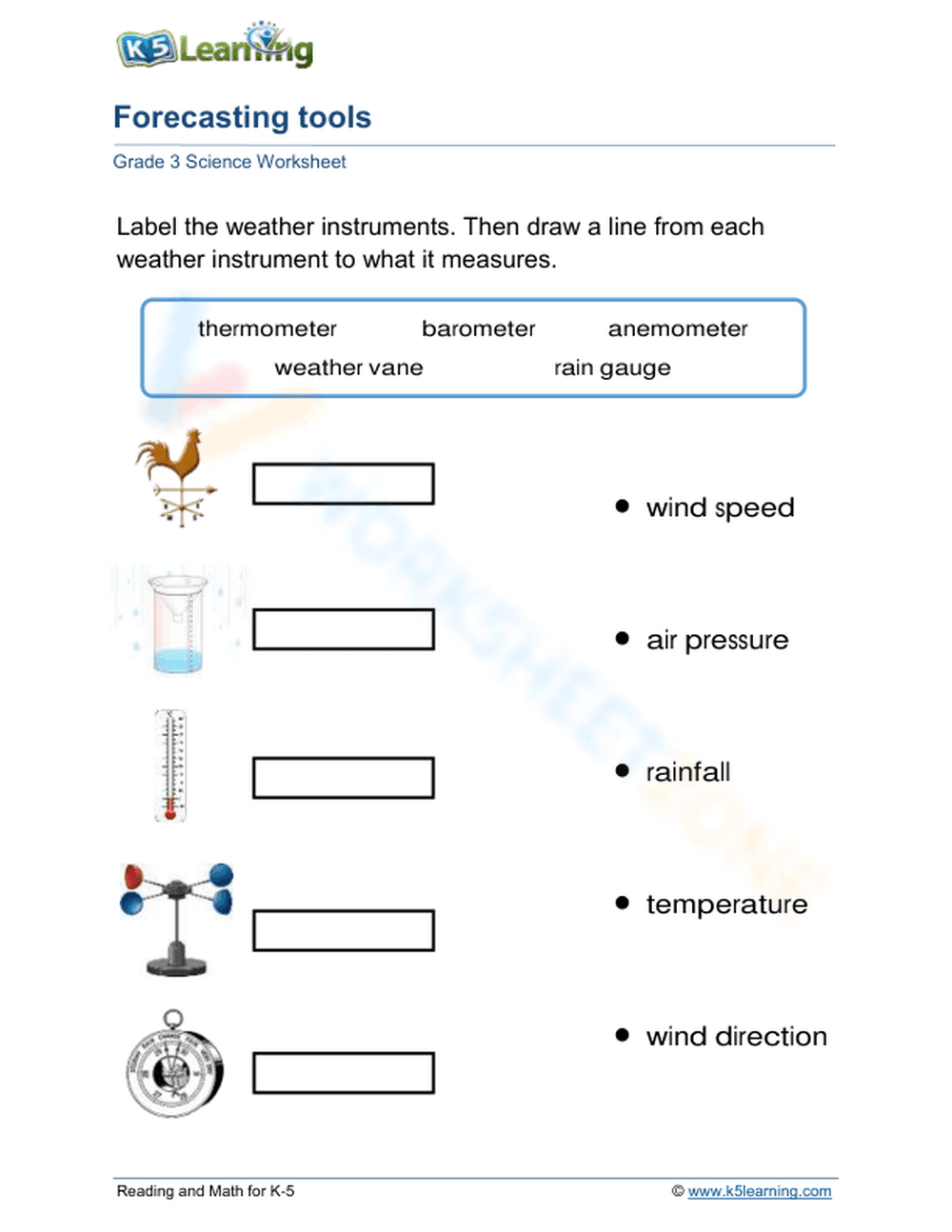


Essential Forecasting Tools Worksheet | Grade 3 Science
Paste this activity's link or code into your existing LMS (Google Classroom, Canvas, Teams, Schoology, Moodle, etc.).
Students can open and work on the activity right away, with no student login required.
You'll still be able to track student progress and results from your teacher account.
This Grade 3 Science worksheet helps students identify the core instruments used in modern meteorology. By matching visual representations of tools like the anemometer and barometer to their specific functions, learners build the foundational vocabulary needed to describe and predict weather patterns. It ensures a clear understanding of how scientists quantify the natural world.
At a Glance
- Grade: Grade 3 · Subject: Science
- Standard:
3-ESS2-1— Represent data to describe typical weather conditions expected during a particular season- Skill Focus: Weather instruments and measurements
- Format: 2 pages · 10 problems · Answer key included · PDF
- Best For: Independent practice or quick formative assessment
- Time: 15–20 minutes
What's Inside
This two-page PDF includes a student worksheet and a full-color answer key. The worksheet features five illustrations of weather tools: weather vane, rain gauge, thermometer, anemometer, and barometer. Students label each instrument using the word bank and match it to its measurement, such as wind speed or air pressure.
Zero-Prep Workflow
- Print (30 seconds): Simply open the PDF and send the single student page to your printer.
- Distribute (1 minute): Hand out the sheets for a bell-ringer activity or a quick science center rotation.
- Review (30 seconds): Use the included answer key for rapid grading or project it for a whole-class check.
Total teacher preparation time is under two minutes, making this an ideal resource for emergency sub plans.
Standards Alignment
Aligned to 3-ESS2-1: "Represent data in tables and graphical displays to describe typical weather conditions expected during a particular season." Understanding the tools used to collect this data is a prerequisite for successful data interpretation. This standard code can be copied directly into lesson plans, IEP goals, or district curriculum mapping tools.
How to Use It
Use this worksheet as a mid-unit check after introducing weather vocabulary. Alternatively, assign it as a post-lesson assessment. Observe if students distinguish between the wind vane and anemometer, indicating mastery of meteorological functions. Completion typically takes 15 to 20 minutes.
Who It's For
This resource is for third-grade students exploring Earth science. It provides visual scaffolds for ELLs and students who benefit from matching activities. It pairs well with a classroom weather station or a textbook passage on weather forecasting tools.
According to the RAND AIRS 2024 analysis, the integration of visual-verbal matching tasks significantly enhances the retention of technical scientific vocabulary in elementary education. This worksheet utilizes these principles by requiring students to connect iconic representations of weather instruments with their specific measurement functions. By mastering the standard 3-ESS2-1 through the identification of tools like the rain gauge and thermometer, students develop the necessary schema for advanced meteorological data interpretation. The structured nature of the 10 problems ensures that learners encounter the most common variables in weather forecasting in a low-stakes, high-impact format. This approach aligns with best practices in science literacy, providing a bridge between observational experience and formal data recording. Educators can rely on this resource as a validated component of a comprehensive weather and climate unit, ensuring all students meet the core requirements for Grade 3 Earth and Space Sciences.


