


























Views
Downloads

Essential Forces and Direction Worksheet | Grade 1 Science
Paste this activity's link or code into your existing LMS (Google Classroom, Canvas, Teams, Schoology, Moodle, etc.).
Students can open and work on the activity right away, with no student login required.
You'll still be able to track student progress and results from your teacher account.
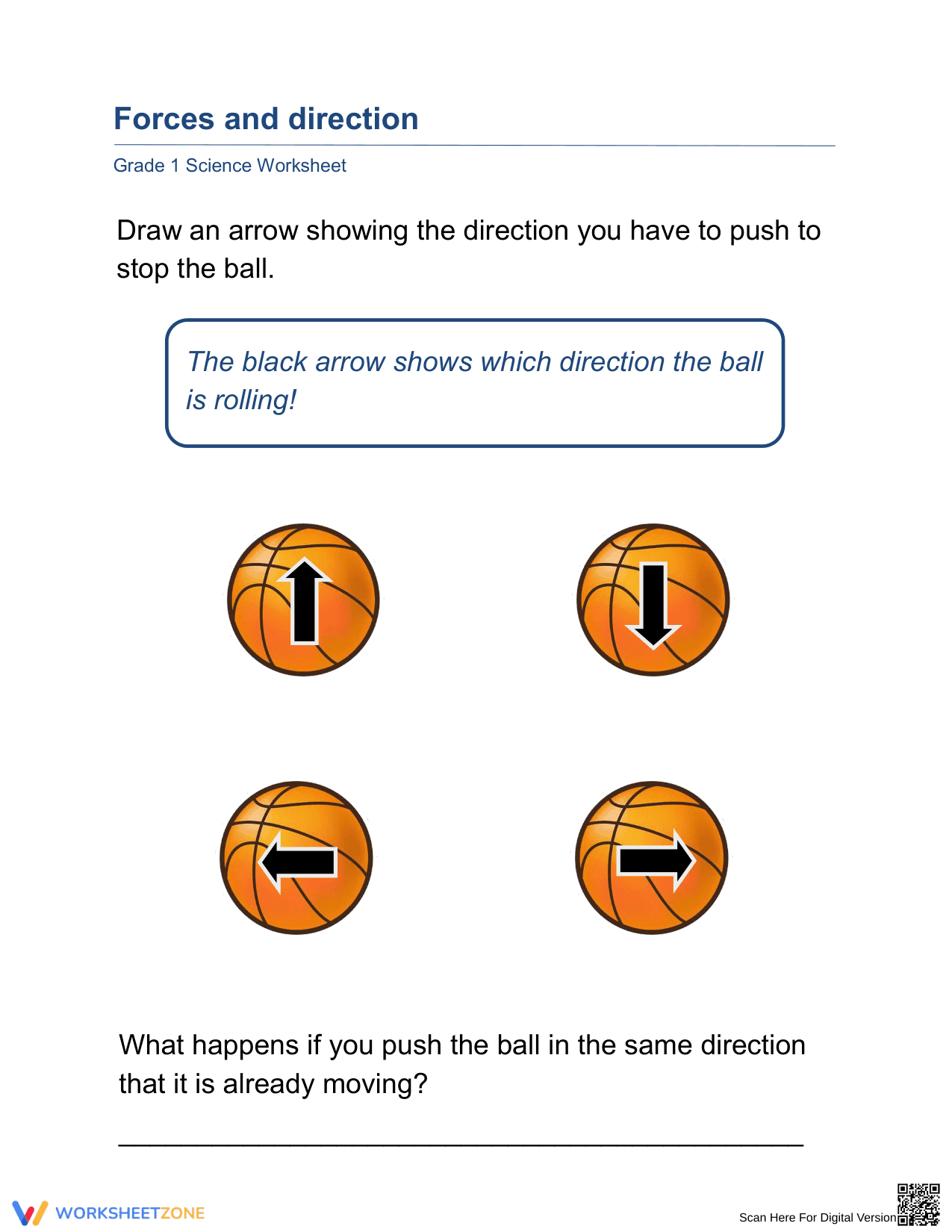
This Grade 1 science worksheet helps young learners understand that forces are directional by requiring them to predict movement outcomes. Students practice identifying the specific push needed to stop a rolling basketball, reinforcing the foundational concept that forces cause motion changes in the same direction they are applied.
At a Glance
- Grade: 1 · Subject: Science
- Standard:
1-PS2-1— Identify how pushes and pulls change the direction of an object- Skill Focus: Directional forces and motion
- Format: 1 page · 5 problems · Answer key included · PDF
- Best For: Introduction to physical science concepts
- Time: 10–15 minutes
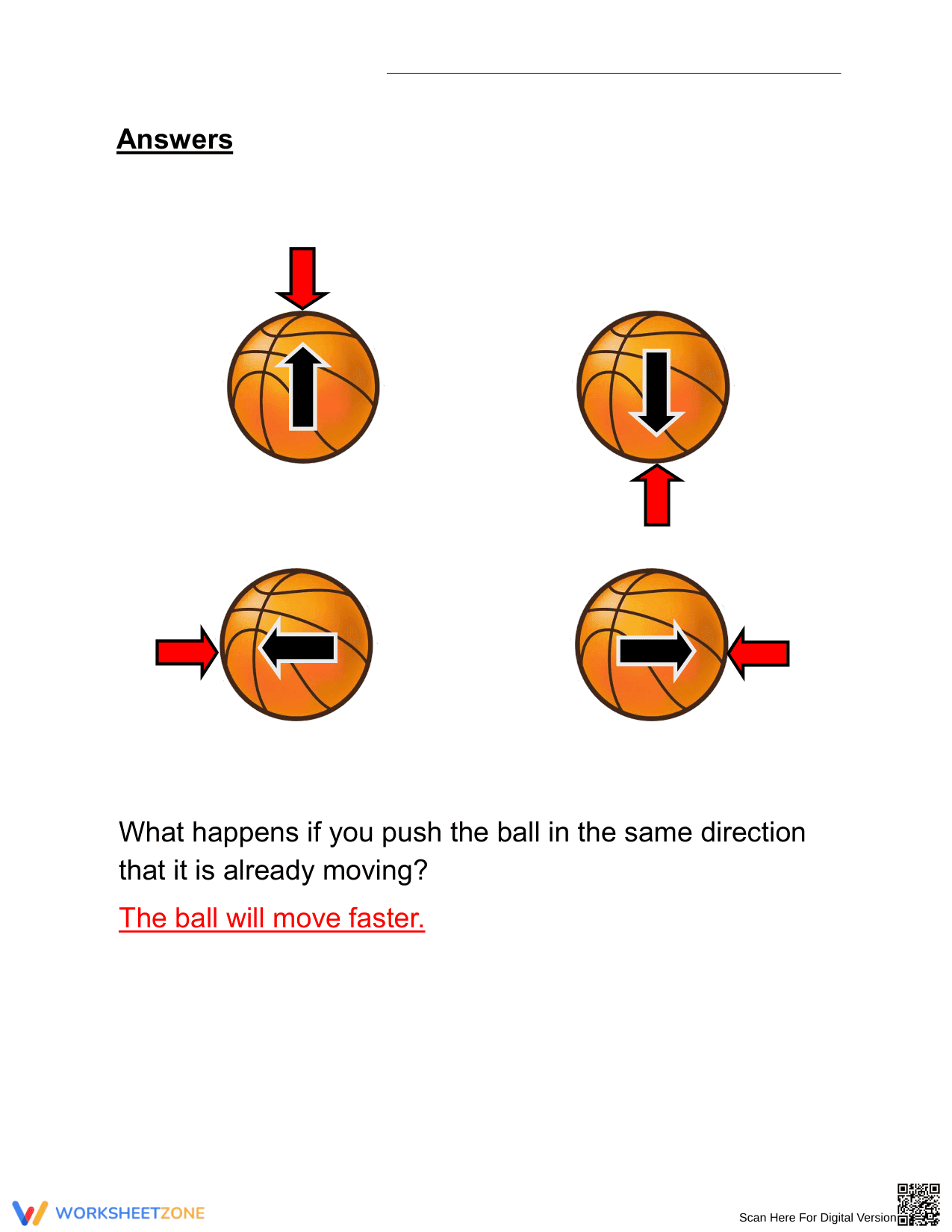
The resource features a clear instructional prompt followed by four visual scenarios involving basketballs rolling in various directions (up, down, left, right). Students draw arrows to represent opposing forces. It concludes with a critical thinking question asking students to predict what happens when a force aligns with an object's current motion.
Zero-Prep Workflow
Teachers can implement this activity in under two minutes. Simply print the single-page PDF and distribute it to students during a physical science unit. The self-explanatory layout requires no prior setup or specialized materials, making it an ideal choice for morning work, independent practice, or a quick-start lesson component for substitutes.
Standards Alignment
Aligned to 1-PS2-1, this worksheet focuses on the observable effects of pushes and pulls on object motion. It provides concrete practice in spatial reasoning and vector directionality. The standard code can be copied directly into lesson plans, IEP goals, or district curriculum mapping tools to ensure rigorous alignment with physical science frameworks.
How to Use It
Use this worksheet as a formative assessment after a hands-on demonstration of pushing real balls across the floor. Observe if students correctly orient their arrows against the direction of motion, which indicates an understanding of deceleration. It works effectively as a five-minute exit ticket or as a guided practice activity during whole-group instruction on forces.
Who It's For
Designed for first-grade students, this resource supports varied learners through heavy visual scaffolding and minimal text. It is especially helpful for English language learners (ELLs) who benefit from the diagrammatic representation of science vocabulary. Pair this with a physical push/pull anchor chart to maximize student retention of directional concepts.
Mastering the concept of directional forces in early elementary years is critical for developing the mental models required for later physics education. According to the RAND AIRS 2024 report on early science literacy, providing students with structured visual tasks that isolate a single variable—in this case, the direction of a push—significantly improves their ability to predict physical outcomes in more complex systems. This worksheet targets the 1-PS2-1 standard by asking students to apply the logic of opposing forces to stop motion. By engaging with 5 distinct tasks, learners transition from intuitive observation to academic application of physical laws. The integration of diagrammatic arrows bridges the gap between concrete experience and abstract scientific representation. Research suggests that these early interventions in motion and stability set the stage for mastery of Newton's laws in middle school, ensuring a robust foundation in STEM-aligned physical science disciplines.


