


























Views
Downloads

Essential Force & Motion Worksheet | Moving Things Grade 1
Paste this activity's link or code into your existing LMS (Google Classroom, Canvas, Teams, Schoology, Moodle, etc.).
Students can open and work on the activity right away, with no student login required.
You'll still be able to track student progress and results from your teacher account.
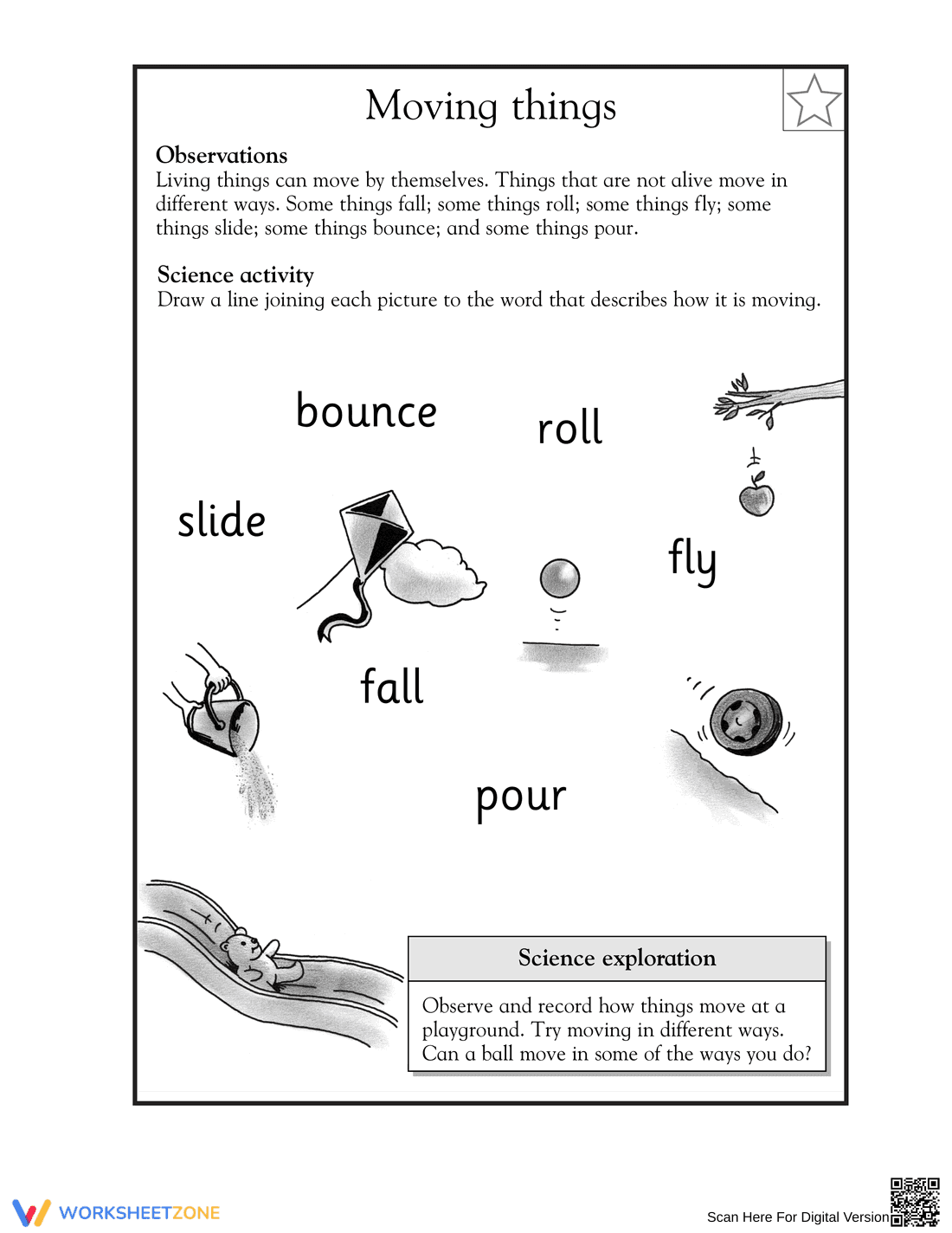
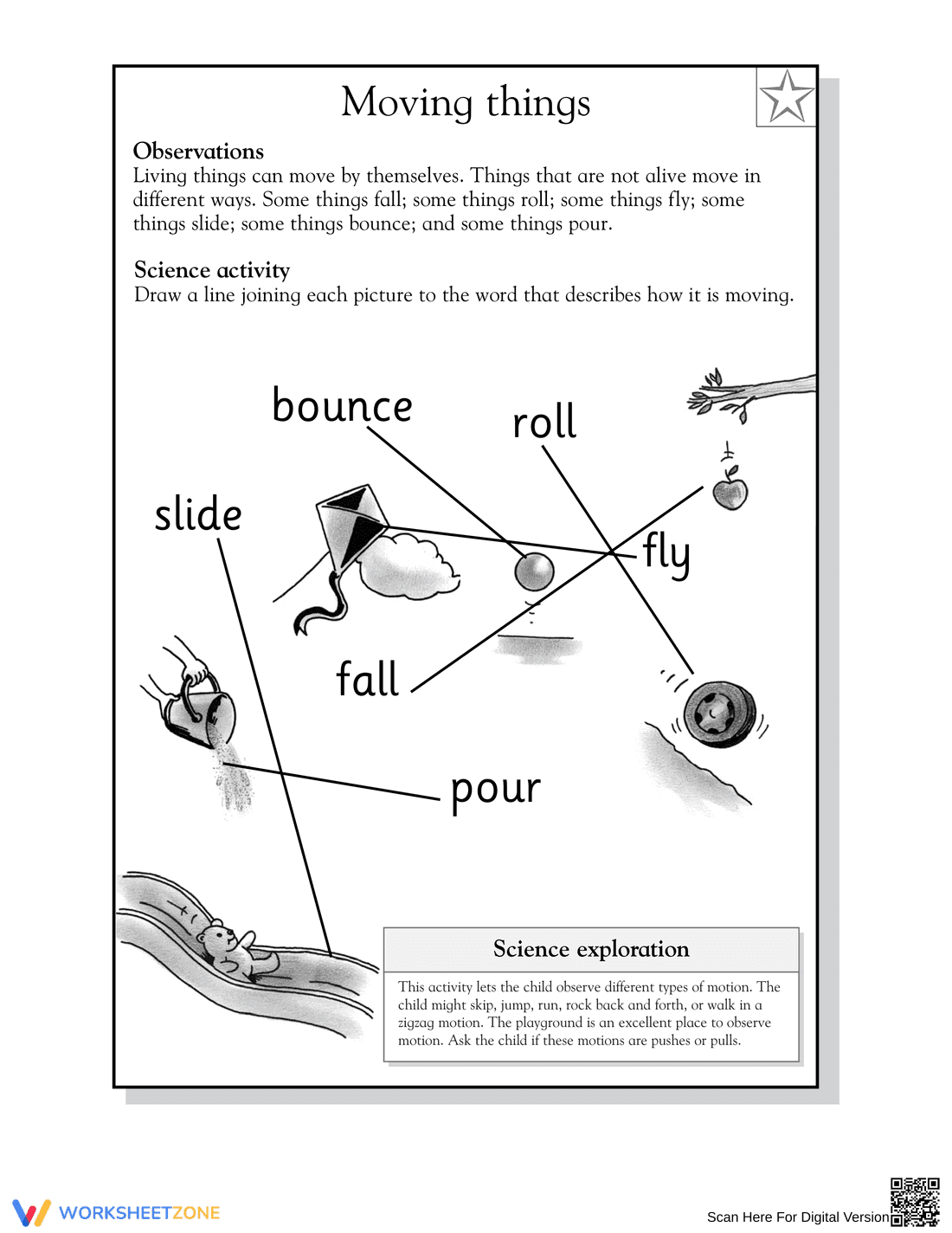
This Grade 1 physical science worksheet focuses on the fundamental concepts of motion by having students observe and categorize how different objects move. By identifying movement patterns like rolling, sliding, and flying, learners build the observational skills necessary for complex mechanical principles. Students achieve immediate success through visual recognition and simple vocabulary reinforcement.
At a Glance
- Grade: 1 · Subject: Science
- Standard:
K-PS2-1— Plan and conduct an investigation to compare the effects of pushes and pulls- Skill Focus: Movement Patterns & Describing Motion
- Format: 1 page · 6 problems · Answer key included · PDF
- Best For: Introduction to physical science and motion units
- Time: 15–20 minutes
The "Moving Things" worksheet includes a concise reading section about motion, followed by a matching activity with six distinct tasks. Students connect realistic illustrations—such as a kite, an apple, and a tire—to descriptive verbs like "bounce," "roll," and "fly." The document also features a "Science exploration" box that encourages applying learning to playground observations.
The zero-prep design allows teachers to implement this activity in under two minutes. Step 1: Print the single-page PDF for your class or set of students. Step 2: Distribute the worksheet during transition periods or as an independent center task. Step 3: Review the results as a whole group to spark a discussion about the physical forces causing each movement. This structure makes it ideal for substitute plans or quick formative assessments.
This resource aligns with `K-PS2-1`, which asks students to plan and conduct an investigation to compare the effects of different strengths or different directions of pushes and pulls on the motion of an object. By identifying motion types first, students prepare for higher-level analysis of the forces that create those movements. This standard code can be copied directly into lesson plans, IEP goals, or district curriculum mapping tools.
Use this worksheet as a "hook" activity before a hands-on lab involving toy cars or balls. Alternatively, assign it as an exit ticket after a playground-based science observation to see if students can accurately categorize the movements they witnessed. A great formative observation tip is to watch if students can justify why an apple "falls" while a tire "rolls," indicating an understanding of basic physical properties.
This activity is designed for first-grade students and early learners who benefit from visual aids and direct matching tasks. It provides excellent support for English Language Learners (ELLs) by pairing common verbs with clear, recognizable images. It pairs naturally with a physical science anchor chart or a short reading passage about basic forces and simple machines.
According to the RAND AIRS 2024 analysis of primary science education, the early introduction of descriptive vocabulary for physical phenomena significantly improves long-term retention of scientific principles. By providing students with structured opportunities to observe and record movement patterns, educators lay the groundwork for understanding Newton's laws in later grades. This worksheet facilitates the observation of motion through a scaffolded matching format that adheres to the evidence-based practices outlined in Fisher & Frey (2014) regarding gradual release of responsibility. Specifically, the inclusion of a real-world exploration task aligns with the NAEP recommendation that science literacy should be grounded in everyday observations. This Grade 1 resource ensures that the plain-English skill of describing how objects move, as defined by the K-PS2-1 standard, is mastered before students are asked to calculate or measure force vectors. The combination of visual matching and active exploration meets the rigorous criteria for high-quality instructional materials in primary science classrooms.


