


























Views
Downloads

Reversible Changes Worksheet | Essential Grade 2 Science
Paste this activity's link or code into your existing LMS (Google Classroom, Canvas, Teams, Schoology, Moodle, etc.).
Students can open and work on the activity right away, with no student login required.
You'll still be able to track student progress and results from your teacher account.
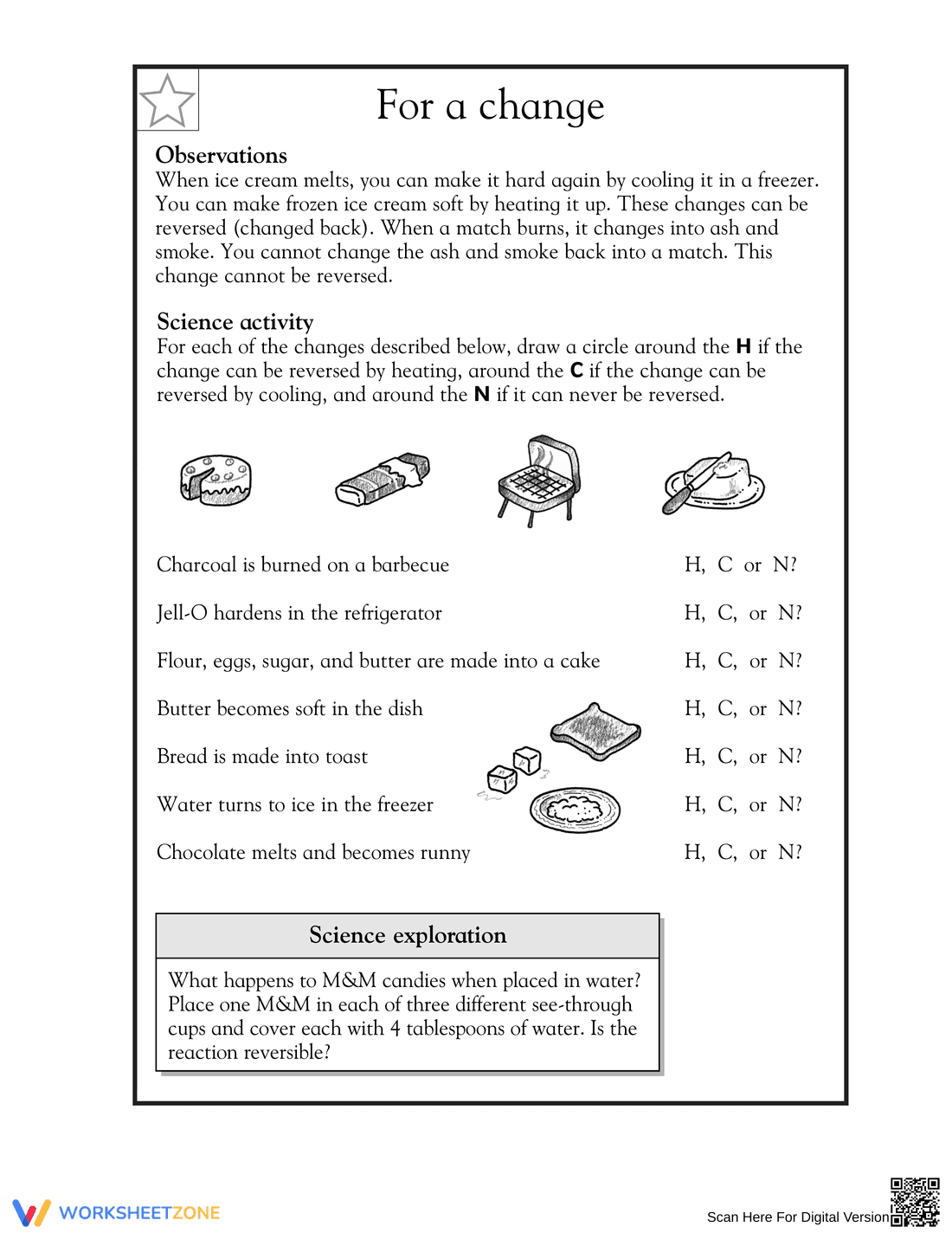
This Grade 2 science worksheet provides a structured way for students to explore the properties of matter and temperature changes. By examining items like ice cream and toast, children learn to distinguish between reversible physical changes and permanent chemical changes, building a foundational understanding of physical science principles and phase transformations.
At a Glance
- Grade: 2 · Subject: Science
- Standard:
2-PS1-4— Construct evidence that changes from heating or cooling can be reversed or not- Skill Focus: Reversible and Irreversible Changes
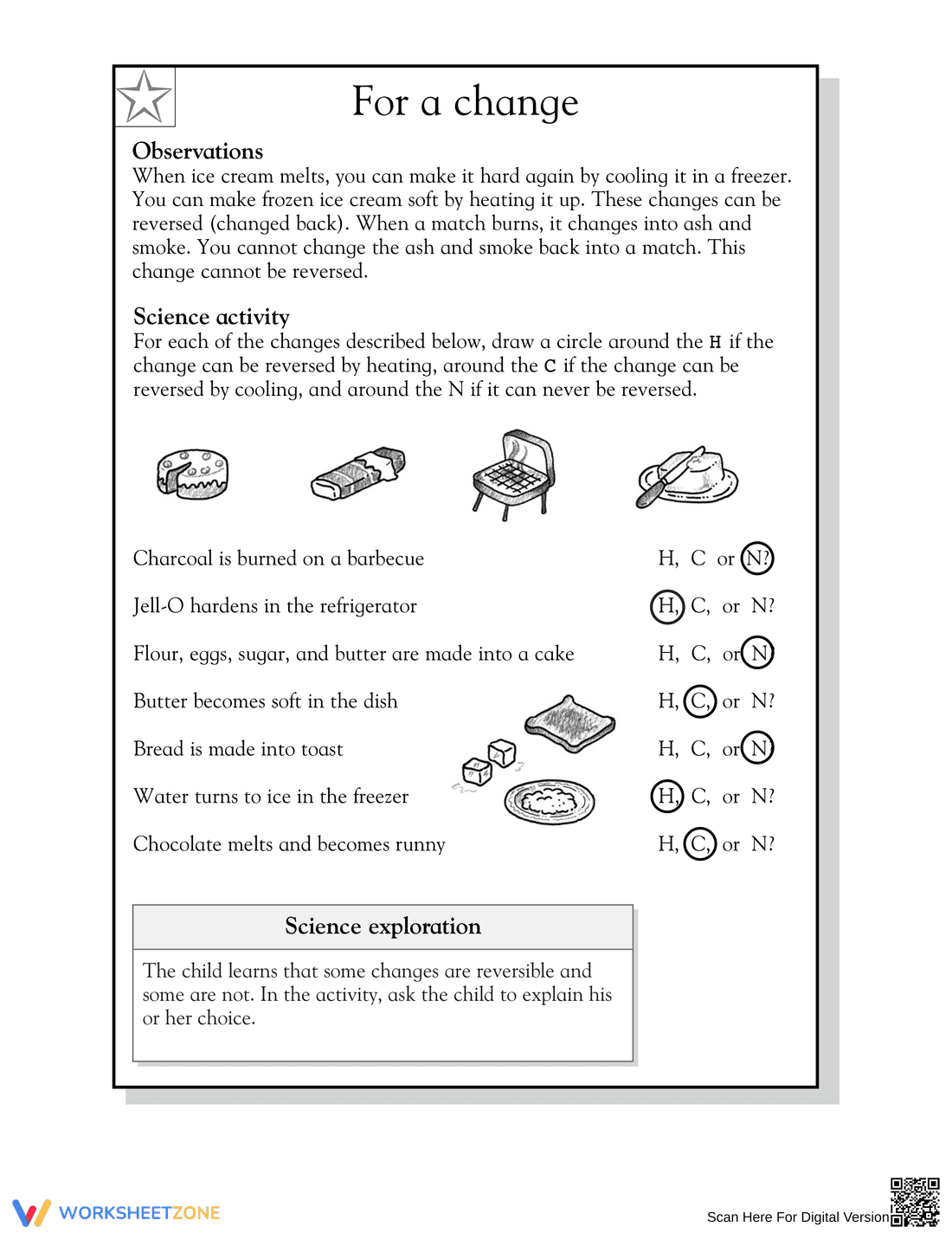
- Format: 1 page · 8 tasks · Answer key included · PDF
- Best For: Independent practice or science centers
- Time: 15–20 minutes
The "For a Change" worksheet features a single, information-dense page divided into three distinct learning segments. It begins with an observation guide that explains the concept of reversible versus irreversible changes using ice cream and burnt matches as anchor examples. The main science activity contains seven classification tasks where students evaluate common household items. Finally, a science exploration box introduces a hands-on experiment involving candies and water to encourage real-world application of the lesson.
This resource is designed for a frictionless classroom experience. The workflow is simple: first, print the single-page PDF (30 seconds); second, distribute the worksheet as a bell-ringer or exit ticket (1 minute); and third, review the answers as a group to address misconceptions about physical reactions (5 minutes). It serves as an excellent emergency sub-plan or a low-stakes formative assessment requiring no prior teacher setup or specialized laboratory materials.
This activity is directly aligned with the Next Generation Science Standard 2-PS1-4: "Construct an argument with evidence that some changes caused by heating or cooling can be reversed and some cannot." Students analyze evidence from common experiences—such as melting butter or toasting bread—to categorize physical and chemical transformations. This standard code can be copied directly into lesson plans, IEP goals, or district curriculum mapping tools to ensure instructional compliance.
Use this worksheet as a concluding activity after a direct instruction lesson on the states of matter. It works effectively as a science center rotation where students can discuss their reasoning before circling an answer. During the activity, observe if students can explain why burning bread is different from melting chocolate; this serves as a critical formative-assessment observation point for identifying mastery of chemical properties. Expected completion time is 15 to 20 minutes.
This worksheet is ideal for Grade 2 students, but suitable for Grade 3 review or Grade 1 enrichment. The clear text and visual cues make it accessible for English Language Learners, while the "Science Exploration" task provides necessary depth for students who finish quickly. It pairs naturally with a classroom anchor chart on melting and freezing or a short video demonstration of reversible phase changes.
According to a ScienceDirect TpT Analysis, physical science instruction in early elementary grades is most effective when students connect abstract concepts like thermodynamic reversibility to tangible, everyday objects. This Grade 2 worksheet bridges that gap by requiring students to analyze seven distinct scenarios involving heating, cooling, and irreversible chemical reactions. By classifying changes in common items such as butter, bread, and chocolate, learners build a conceptual framework for the NGSS 2-PS1-4 standard, which emphasizes constructing evidence-based arguments about the nature of matter. The inclusion of a hands-on 'Science Exploration' task involving candies and water further reinforces observational skills and the scientific method. This dual approach—combining analytical classification with experimental inquiry—ensures that students move beyond rote memorization toward a deep understanding of how energy transfers affect material properties. It is an essential tool for teachers looking to provide rigorous, standards-aligned science practice in a concise, accessible format.


