


























Views
Plays


Essential Food Chains & Pyramids Worksheet | Grade 5 Science
Paste this activity's link or code into your existing LMS (Google Classroom, Canvas, Teams, Schoology, Moodle, etc.).
Students can open and work on the activity right away, with no student login required.
You'll still be able to track student progress and results from your teacher account.
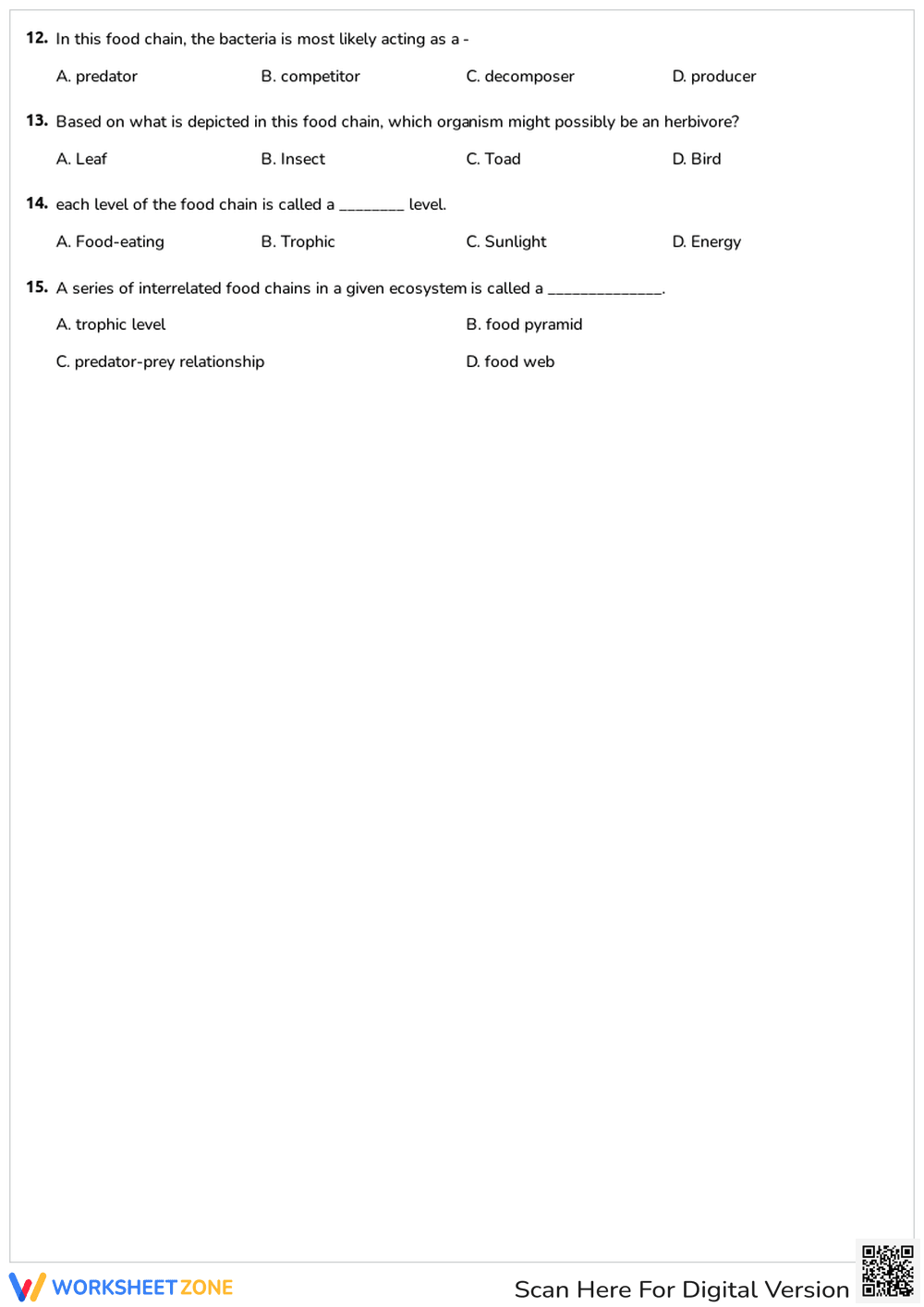
This Grade 5 science worksheet provides a comprehensive review of how energy moves through an ecosystem. Students will identify the roles of producers, consumers, and decomposers while analyzing the specific mechanics of energy transfer between trophic levels. By the end of these 15 questions, learners will demonstrate a clear understanding of how matter and energy cycle through living systems.
At a Glance
- Grade: 5 · Subject: Science
- Standard:
5-LS2-1— Describe the movement of matter among plants, animals, decomposers, and the environment- Skill Focus: Trophic levels and energy flow
- Format: 2 pages · 15 problems · Answer key included · PDF
- Best For: Formative assessment or quick sub plans
- Time: 20–30 minutes
What's Inside: This two-page PDF features 15 multiple-choice questions designed to test both vocabulary and conceptual application. The worksheet covers classification of organisms (omnivores, carnivores, autotrophs), identification of specific roles within a food chain (primary vs. tertiary consumers), and the mathematical 10% rule of energy transfer. A full answer key is provided to ensure quick grading and immediate student feedback.
Zero-Prep Workflow
- Print (1 minute): Simply select the two pages and print enough copies for your roster. No complex assembly or cutting required.
- Distribute (1 minute): Hand out the sheets as a quiet bell-ringer or a mid-unit check for understanding. The clear layout allows students to work independently.
- Review (5 minutes): Use the included answer key to facilitate a whole-class review, allowing students to self-correct and discuss why specific organisms occupy certain trophic levels.
This resource is a reliable option for emergency sub plans, as the questions are self-contained and require no prior teacher setup or specialized lab equipment.
Standards Alignment: This resource is primarily aligned to `5-LS2-1`: "Develop a model to describe the movement of matter among plants, animals, decomposers, and the environment." It also supports middle school concepts regarding the flow of energy in ecosystems. Both standard codes can be copied directly into lesson plans, IEP goals, or district curriculum mapping tools.
How to Use It: Assign this worksheet during the "Explain" or "Evaluate" phase of a 5E lesson cycle. It serves as an excellent formative assessment tool to identify misconceptions about energy loss in pyramids. For a quick check, observe student responses to question 10; if they struggle with the 10% rule, it indicates a need for a targeted mini-lesson on metabolic heat loss. Expect completion within 20 to 30 minutes.
Who It's For: This is designed for 5th-grade general education classrooms but is highly effective for middle school life science review. The multiple-choice format provides necessary scaffolding for ELL students and those with IEPs who benefit from reduced writing demands. It pairs naturally with a food web anchor chart or a direct instruction lesson on ecosystem dynamics.
According to the RAND AIRS 2024 analysis of instructional materials, high-quality science worksheets that focus on the 5-LS2-1 standard must bridge the gap between simple identification and the conceptual understanding of energy transfer. This worksheet achieves that by requiring students to not only name organisms but also calculate the percentage of energy passed between trophic levels. Research by Fisher & Frey (2014) emphasizes that structured independent practice with immediate feedback loops—such as those provided by the 15 targeted questions in this set—is essential for moving students toward mastery of complex ecological systems. By isolating the variables of producers, consumers, and decomposers, this resource ensures that learners can accurately model the cycling of matter. The inclusion of the 10% rule provides the quantitative rigor necessary for modern science standards, making it a robust tool for any Grade 5 or middle school science curriculum.


