


























Views
Downloads

Printable Insect Dichotomous Key Worksheet | Grade 3 Science
Paste this activity's link or code into your existing LMS (Google Classroom, Canvas, Teams, Schoology, Moodle, etc.).
Students can open and work on the activity right away, with no student login required.
You'll still be able to track student progress and results from your teacher account.
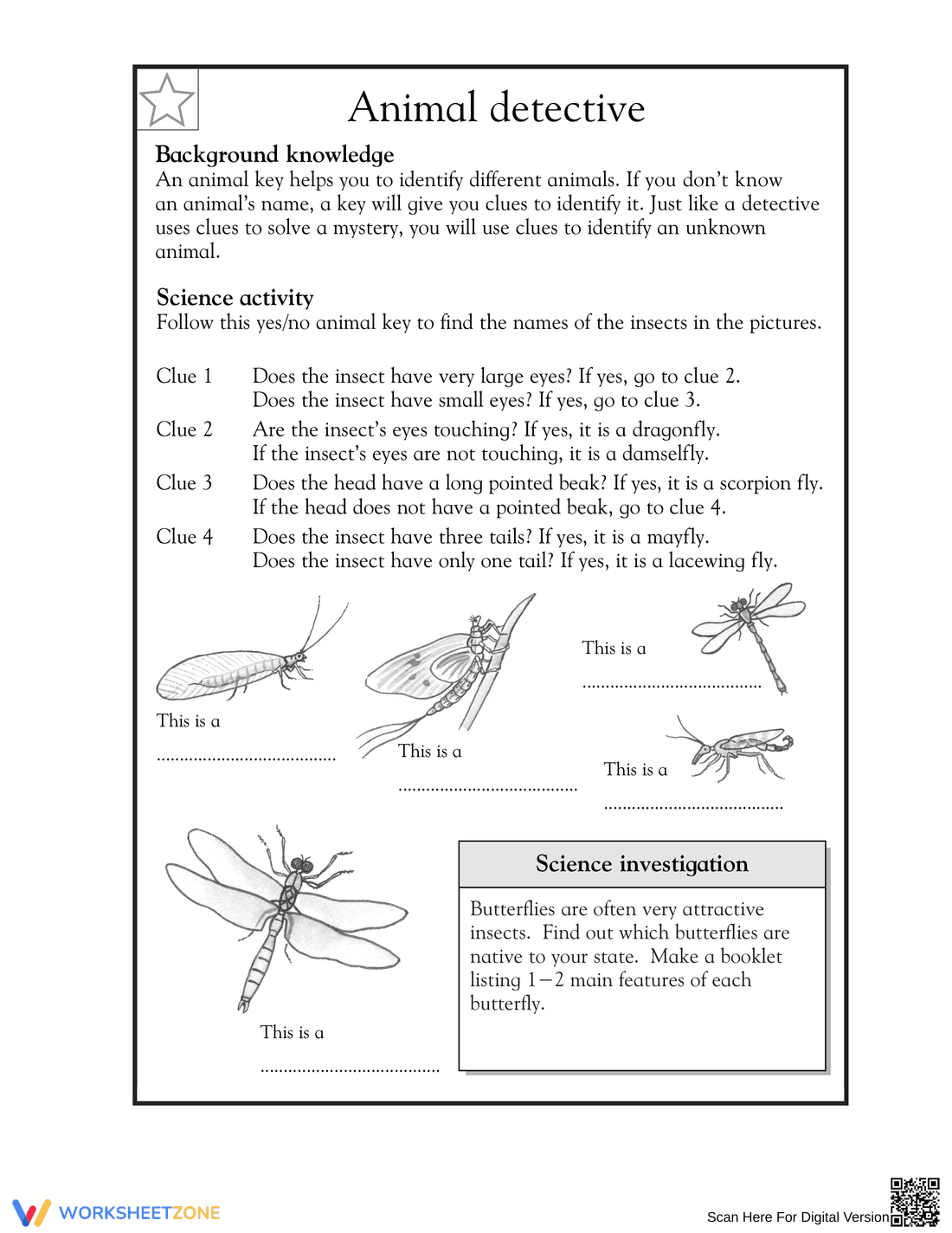
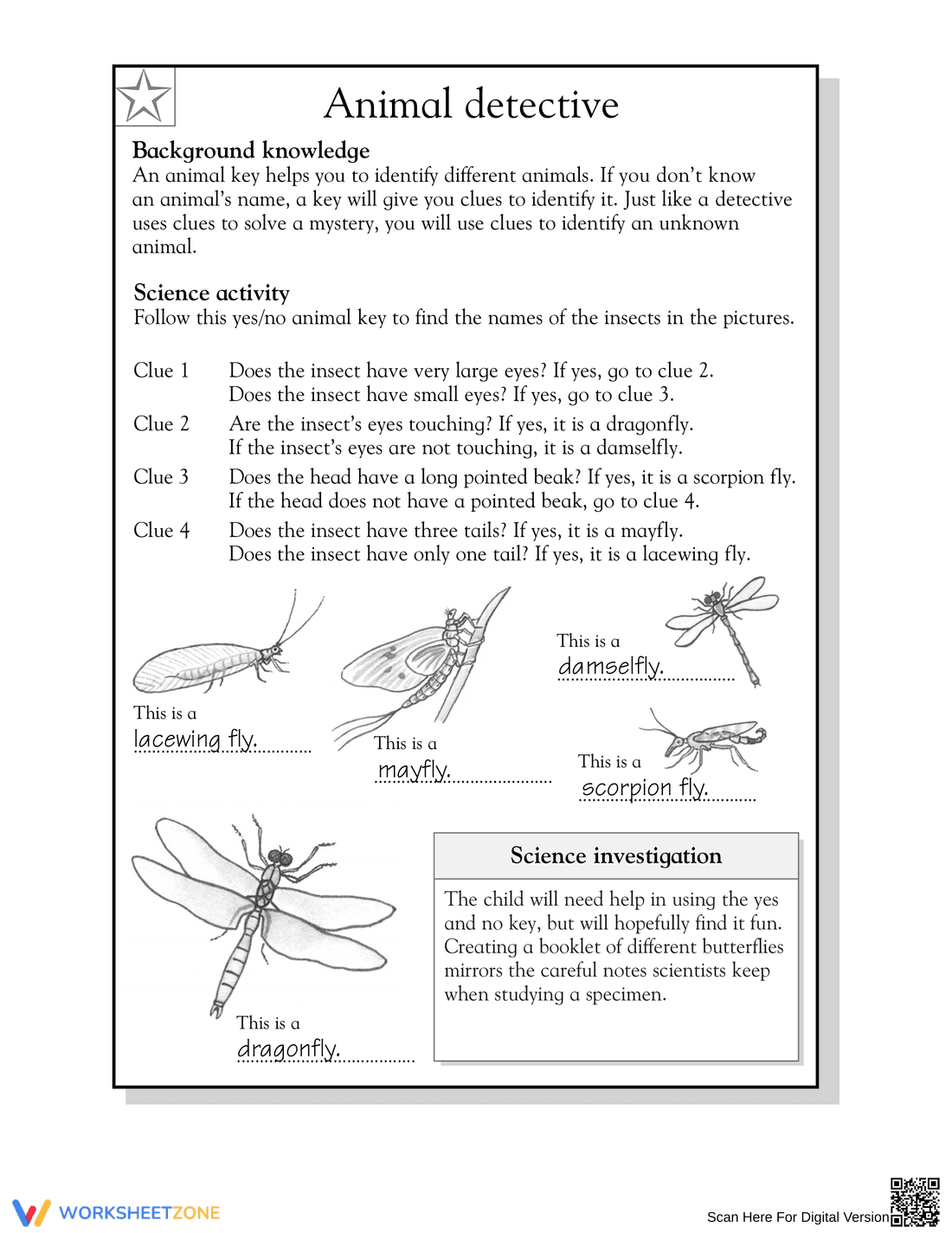
This Grade 3 Fly Detective worksheet helps students master the skill of using a dichotomous key to identify various insect species. By following a series of yes/no clues, learners observe physical structures like eye size and wing shapes to name insects correctly. This activity builds critical observation and classification skills essential for life science mastery.
At a Glance
- Grade: 3 · Subject: Living Things
- Standard:
3-LS3-1— Analyze inherited traits to identify and classify similar organisms- Skill Focus: Dichotomous Key Identification
- Format: 1 page · 5 problems · Answer key included · PDF
- Best For: Science centers or quick formative assessment
- Time: 15–20 minutes
This single-page science resource features a background knowledge section explaining how animal keys work, followed by a structured "Animal Detective" activity. Students use a four-clue dichotomous key to identify five different insects, including dragonflies and mayflies. The layout includes clear illustrations and dedicated lines for identification. An extension "Science Investigation" task prompts students to research native butterflies, adding a research component to the lesson.
Step 1: Print (30 seconds). Simply print the single-page PDF for each student or pair. Step 2: Distribute (1 minute). Hand out the worksheets and briefly review the "Background Knowledge" section with the class. Step 3: Review (30 seconds). Use the included answer key to quickly check student identifications as they complete the activity. This worksheet requires zero teacher setup beyond printing, making it an ideal choice for substitute plans. Total prep time is under two minutes.
The primary alignment is 3-LS3-1, focusing on analyzing and interpreting data to provide evidence of inherited traits. By using the key, students directly engage with observable traits like beak shape and tail count to classify organisms. This resource also supports 4-LS1-1 regarding external structures that function to support behavior and identification. Both standard codes can be copied directly into lesson plans, IEP goals, or district curriculum mapping tools.
Use this worksheet during the "Explain" or "Elaborate" phase of a 5E lesson on biological classification. It serves as a concrete bridge between direct instruction on animal traits and more complex field identification tasks. As a formative assessment tip, observe students as they navigate the branching clues; difficulty here often indicates a need for more support in observing fine details. Expected completion time is 15 to 20 minutes.
This resource is designed for Grade 3 and Grade 4 students learning about biodiversity and classification. It is particularly effective for visual learners who benefit from the clear insect diagrams. Differentiation is naturally supported through the structured clues, and it pairs perfectly with an introductory passage on insect anatomy or a classroom anchor chart showing various insect orders to provide additional context for the identification process.
According to RAND AIRS 2024, structured identification tasks that utilize dichotomous keys significantly improve elementary students' ability to recognize and categorize biological variations. This "Fly Detective" worksheet implements this research-backed strategy by requiring students to perform five distinct identification tasks based on specific physical traits. By engaging with standard 3-LS3-1, learners build a foundation in systematic observation that is critical for higher-level biology and scientific inquiry. The dual-path logic of the yes/no key mirrors computational thinking patterns, reinforcing valuable cross-disciplinary skills. ScienceDirect TpT Analysis highlights that such zero-prep, focused resources are highly effective for maintaining instructional momentum in diverse classrooms. This worksheet provides a practical application of trait analysis, ensuring students can accurately identify organisms while understanding the underlying principles of inherited characteristics. Teachers can use this data to inform future lessons on species diversity and adaptation.


