




























Views
Downloads


Preschool Curved Line Tracing | Essential Pre-Writing

Paste this activity's link or code into your existing LMS (Google Classroom, Canvas, Teams, Schoology, Moodle, etc.).
Students can open and work on the activity right away, with no student login required.
You'll still be able to track student progress and results from your teacher account.
This Preschool tracing worksheet provides foundational fine motor practice to help young learners develop the muscle memory required for letter formation. By guiding butterflies, bees, and birds along curved paths, students strengthen their grip and hand-eye coordination. This activity serves as a critical bridge between simple scribbling and intentional writing.
At a Glance
- Grade: Preschool · Subject: Early Literacy
- Standard:
CCSS.ELA-LITERACY.RF.PK.1— Demonstrate understanding of the organization and basic features of print- Skill Focus: Curved line tracing & fine motor control
- Format: 2 pages · 7 tracing tasks · No-prep · PDF
- Best For: Pre-writing centers and morning work
- Time: 10–15 minutes
What's Inside
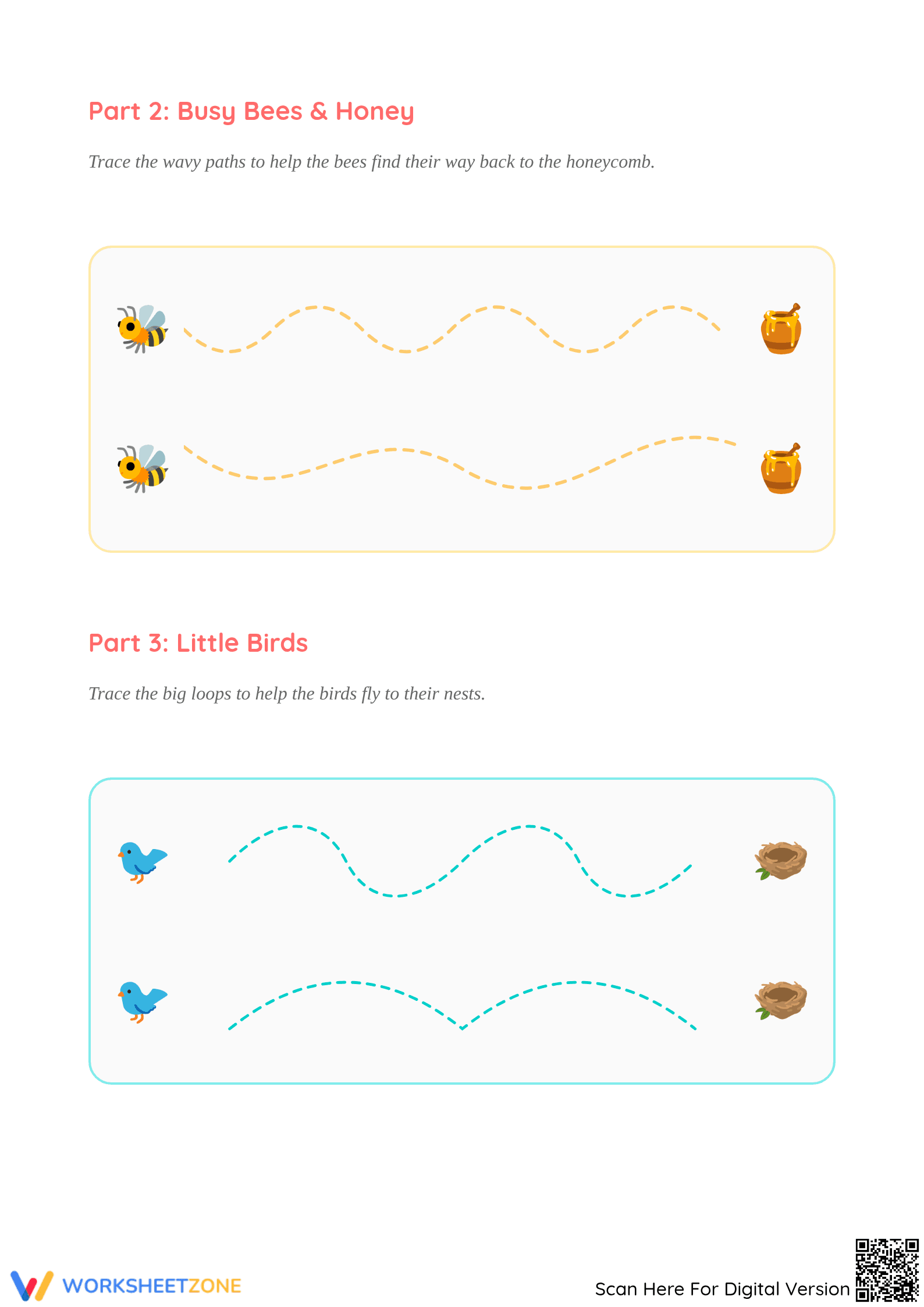
This two-page PDF features seven distinct tracing paths organized into three thematic sections. Part 1 includes three wavy paths helping butterflies reach flowers. Part 2 focuses on two tighter wavy lines for bees returning to honeycombs. Part 3 provides two large loops for birds heading to their nests. The clear dotted lines and engaging visuals provide high-contrast cues for early learners.
Zero-Prep Workflow
The zero-prep workflow for this resource is designed for busy early childhood educators. First, print the two-page PDF (30 seconds). Second, distribute the sheets with crayons or markers to students during center rotations (1 minute). Third, provide immediate verbal feedback as students complete the paths (30 seconds). Total teacher preparation time is under 2 minutes, making this an ideal emergency sub-plan addition.
Standards Alignment
The primary standard addressed is `CCSS.ELA-LITERACY.RF.PK.1`, which focuses on demonstrating an understanding of the organization and basic features of print. While this worksheet specifically targets the physical mechanics of writing, it supports the foundational literacy goal of moving from left to right across a page. This standard code can be copied directly into lesson plans, IEP goals, or district curriculum mapping tools.
How to Use It
Use this worksheet as a quiet morning arrival activity to settle students as they enter the classroom. It also functions effectively as a formative assessment tool; observe students to see if they can maintain the path without lifting their writing utensil. Expected completion time ranges from 10 to 15 minutes depending on the child's developmental stage.
Who It's For
This resource is designed for preschool and Pre-K students, as well as older students receiving Occupational Therapy (OT) services for fine motor delays. It pairs naturally with alphabet anchor charts or finger-painting activities that emphasize similar curved motions.
According to research by Fisher & Frey (2014) regarding the gradual release of responsibility, providing structured scaffolds like dotted-line tracing is essential for developing the motoric automaticity required for later academic tasks. This worksheet targets the CCSS.ELA-LITERACY.RF.PK.1 standard by reinforcing the left-to-right progression of English print through engaging, thematic tracing paths. By isolating the skill of curved line formation, educators allow students to focus entirely on pencil control before introducing the cognitive load of letter recognition. Studies in early childhood development suggest that consistent practice with varied line types—wavy, looped, and arched—significantly improves a child's ability to transition to formal handwriting in Kindergarten. This resource provides 7 specific opportunities for this high-frequency practice, ensuring that students build the necessary hand strength and coordination for long-term literacy success.


