




























Views
Downloads
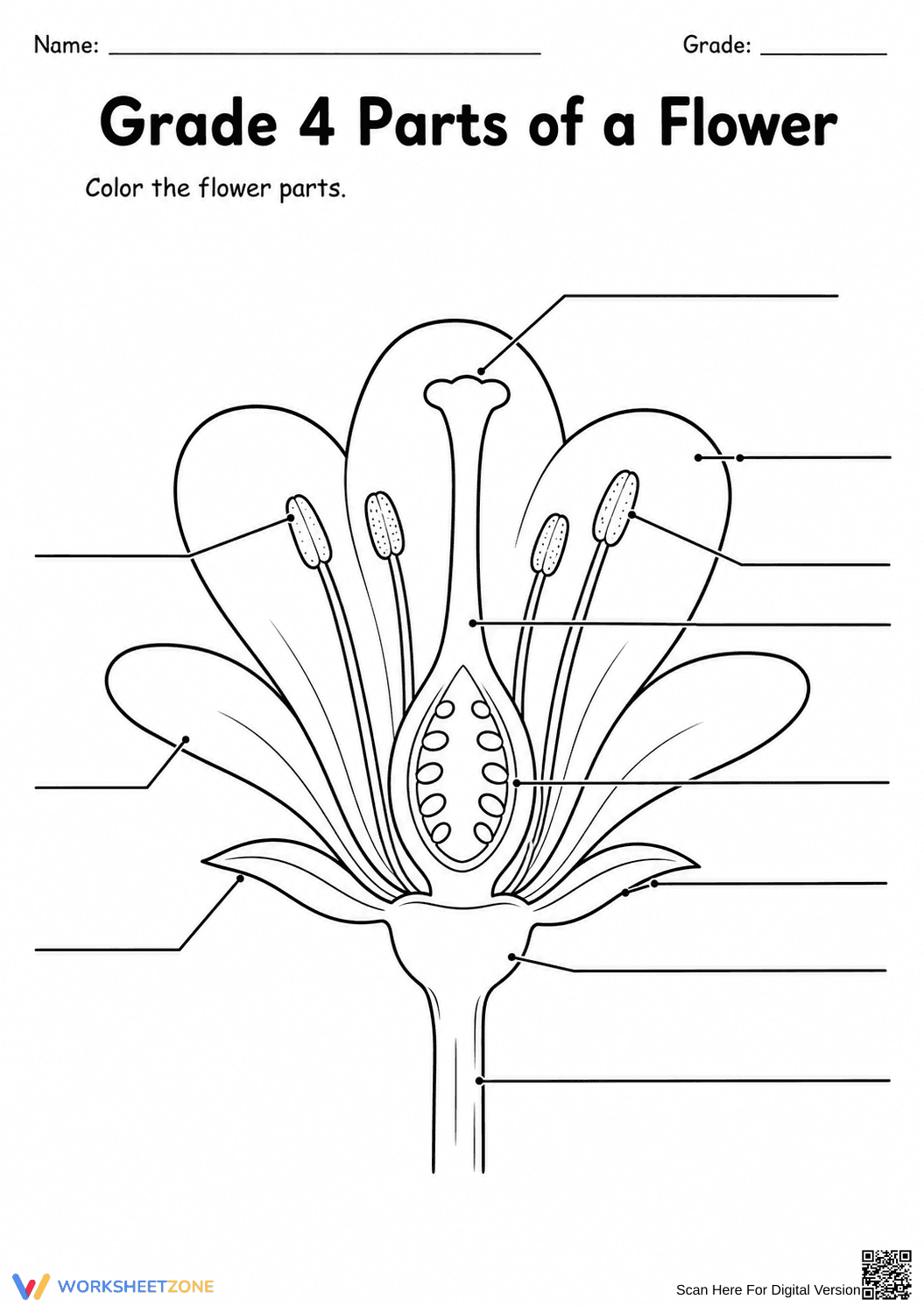

Printable Grade 4 Parts of a Flower No-Prep Worksheet

Paste this activity's link or code into your existing LMS (Google Classroom, Canvas, Teams, Schoology, Moodle, etc.).
Students can open and work on the activity right away, with no student login required.
You'll still be able to track student progress and results from your teacher account.
This Grade 4 science worksheet provides a clear, engaging visual of a flower's internal structures. Students color the cross-section to familiarize themselves with essential plant anatomy, including the petals, pistil, and stamen. This simple activity builds foundational knowledge of how plant structures support reproduction and growth before moving to complex labeling or dissection.
At a Glance
- Grade: 4 · Subject: Science
- Standard:
4-LS1-1— Identify internal and external plant structures that support survival, growth, and reproduction- Skill Focus: Identifying and visualizing plant anatomy through coloring
- Format: 1 page · 1 task · No answer key · PDF
- Best For: Morning work, science centers, or early finishers
- Time: 10–15 minutes
What's Inside
Inside this single-page download, educators will find a high-quality drawing of a flower cross-section. The illustration clearly delineates the major reproductive parts, offering a blank canvas for students to color or label. This PDF does not include a formal answer key, allowing for open-ended artistic expression or teacher-led identification. Structural features include clear lead lines for optional labeling.
Zero-Prep Workflow
This resource is designed for a zero-prep workflow, making it an ideal sub plan.
- Print (1 minute): Download the PDF and print a class set. No color ink required.
- Distribute (1 minute): Hand out pages with colored pencils.
- Review (0 minutes): As an open-ended observation task, no formal grading is needed.
Total teacher prep time is under two minutes.
Standards Alignment
This activity aligns with primary standard 4-LS1-1: Construct an argument that plants and animals have internal and external structures that function to support survival, growth, behavior, and reproduction. By examining the cross-section of the flower, students visually identify the specific internal structures responsible for plant reproduction. Both standard codes can be copied directly into lesson plans, IEP goals, or district curriculum mapping tools.
How to Use It
Use this page before direct instruction as an engagement hook. Ask students to color the parts they think are most important, priming them for a lesson on plant reproduction. Alternatively, use it during science centers where students reference a textbook to accurately color-code the anatomy. As a formative assessment observation tip, ask students to point to the pollen-producing areas while they color. Expected completion time is 10 to 15 minutes.
Who It's For
This resource is primarily for fourth-grade students, but its visual nature makes it accessible for English Language Learners and special education. To differentiate, provide a color-coded anchor chart for visual support, or challenge advanced learners to label microscopic pollen grains. It pairs perfectly with a flower dissection lab or a direct instruction lesson.
Integrating visual arts into science instruction significantly enhances student comprehension of complex biological systems. When students engage with standard 4-LS1-1 to identify internal and external plant structures, the physical act of coloring helps solidify their spatial memory of the anatomy. According to a ScienceDirect TpT Analysis, incorporating low-stakes visual tasks like coloring pages before rigorous academic vocabulary instruction reduces cognitive overload and increases subsequent vocabulary retention by providing a concrete mental model. This foundational step ensures that when students later construct arguments about how these structures support survival and reproduction, they have a clear, accurate internal visualization of the flower's reproductive organs. By bridging the gap between abstract scientific concepts and tangible visual representation, this simple activity lays the groundwork for deeper scientific inquiry and long-term mastery of elementary biology standards. This approach is essential for building scientific literacy in early elementary grades.


