


























Views
Downloads


Essential Flashcard Sorting Worksheet | Grade K Math
Paste this activity's link or code into your existing LMS (Google Classroom, Canvas, Teams, Schoology, Moodle, etc.).
Students can open and work on the activity right away, with no student login required.
You'll still be able to track student progress and results from your teacher account.
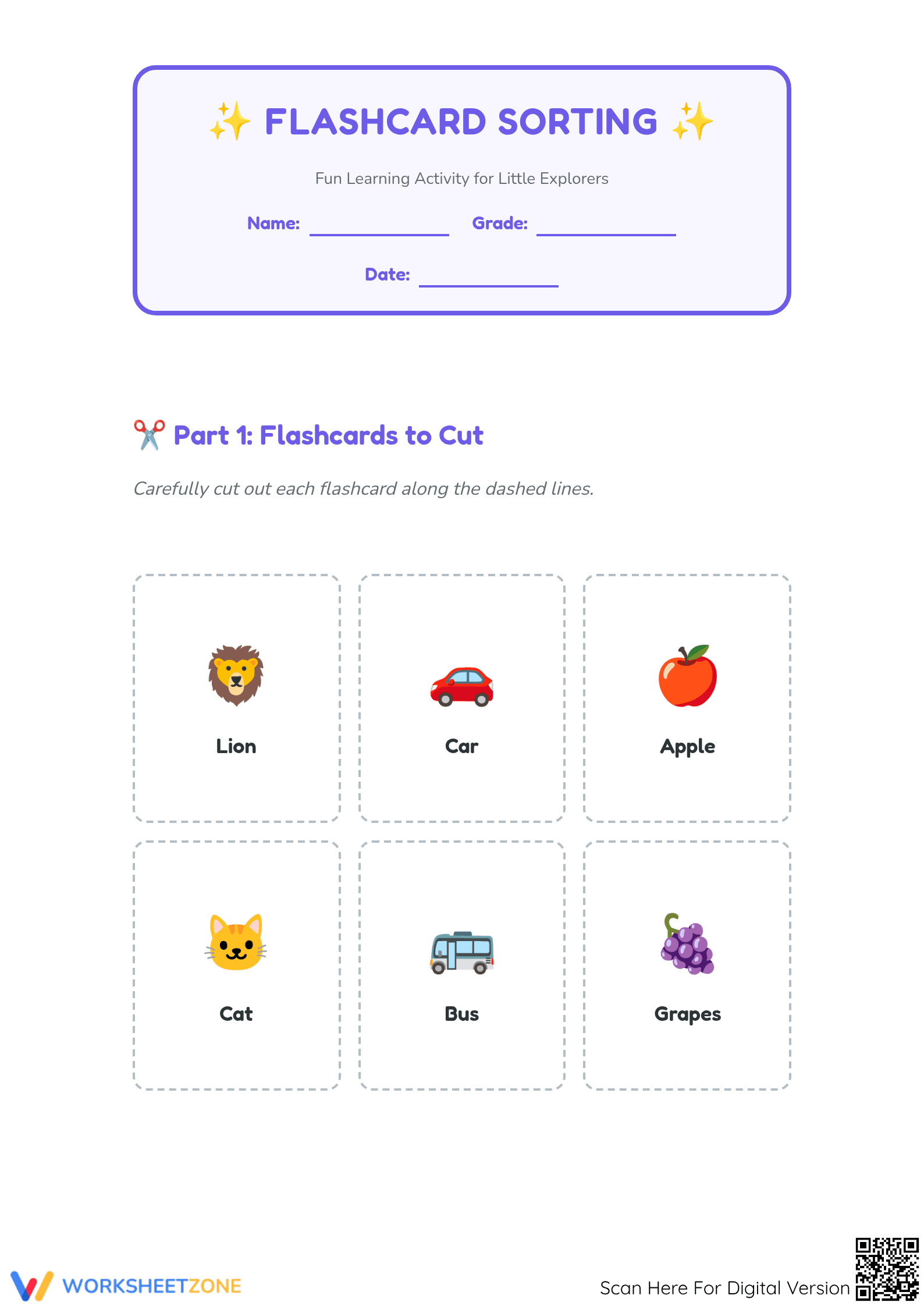
This printable Flashcard Sorting worksheet empowers Kindergarten students to master the essential skill of categorizing objects based on their shared attributes. By engaging in hands-on cutting and pasting, learners actively identify relationships between everyday items like animals, vehicles, and fruits. This activity ensures students build a strong foundational understanding of data organization and logical classification.
At a Glance
- Grade: Kindergarten · Subject: Math
- Standard:
K.MD.B.3— Classify objects into given categories and count the numbers of objects in each category- Skill Focus: Categorical Sorting & Classification
- Format: 4 pages · 13 problems · Answer key included · PDF
- Best For: Kindergarten Math Centers and Small Groups
- Time: 20–30 minutes
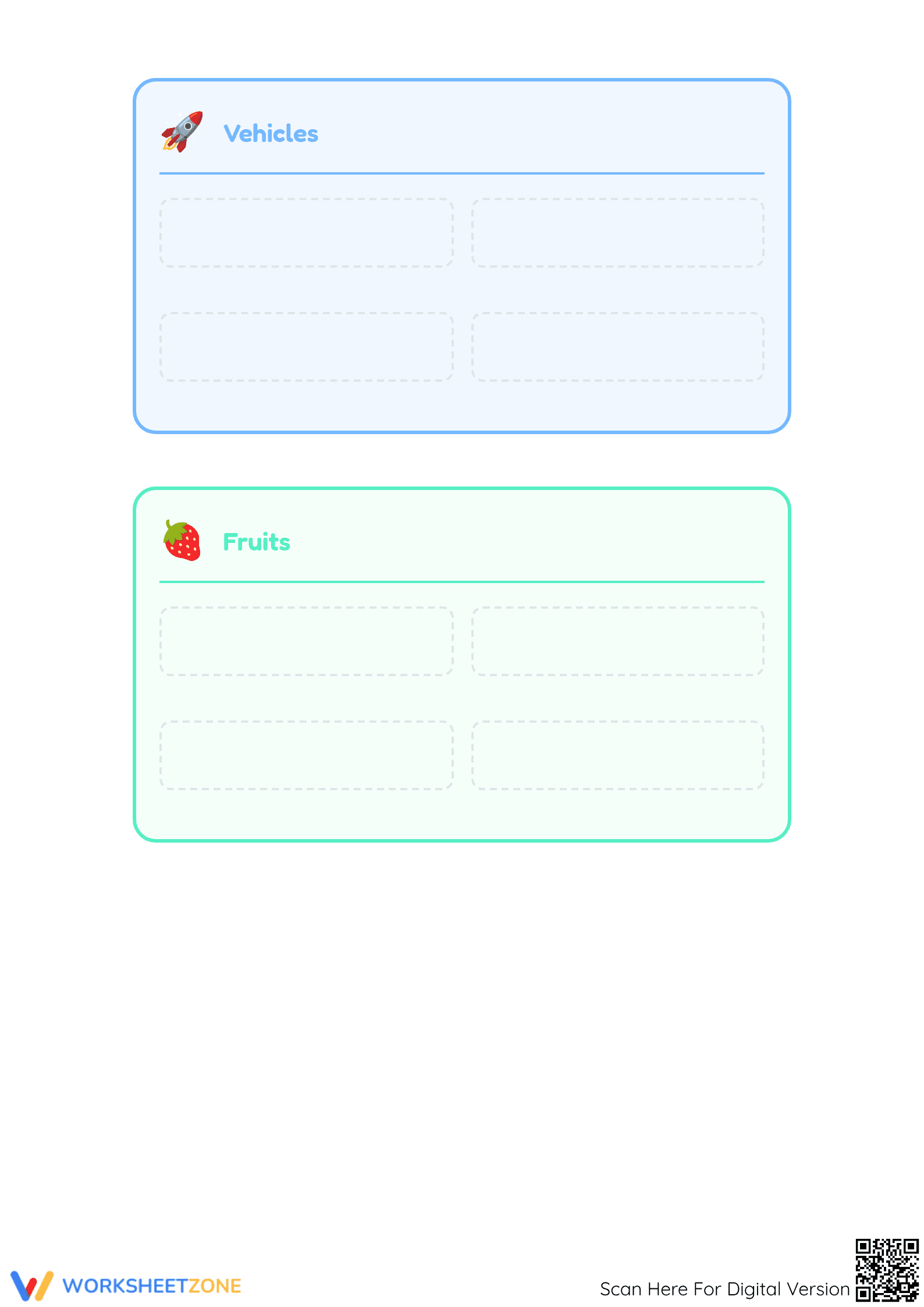
This 4-page PDF contains 12 high-quality flashcards featuring clear illustrations of animals, vehicles, and fruits. Students are provided with dedicated sorting boards for each category, allowing them to organize their cards systematically. The packet includes a bonus challenge to encourage creative thinking, along with a full answer key for easy checking.
Skill Progression
- Guided Practice: Students identify individual items on the flashcards, discussing shared characteristics under teacher supervision to establish clear categorical definitions and expectations.
- Supported Practice: Learners use the provided sorting boards to match 12 specific items to their respective groups, utilizing visual cues and headers to reinforce their decision-making process.
- Independent Practice: The bonus challenge invites students to generate their own examples for a category of their choice, demonstrating mastery through the application of classification rules to new data.
This gradual-release model moves students from simple recognition to independent application, ensuring long-term retention of sorting concepts.
Standards Alignment
This resource is directly aligned to `K.MD.B.3`, which requires students to classify objects into given categories, count the numbers of objects in each category, and sort the categories by count. By physically moving the flashcards into defined groups, students bridge the gap between concrete objects and abstract data sets. Both standard codes can be copied directly into lesson plans, IEP goals, or district curriculum mapping tools.
How to Use It
For Math Centers, place the printed pages and child-safe scissors in a dedicated station. Students can work in pairs to cut out the cards and debate which sorting board each item belongs to, promoting mathematical discourse. As a Formative Assessment, observe students as they complete the sorting boards to identify any misconceptions regarding category boundaries. This quick check provides immediate data on a student's ability to recognize shared attributes before moving to complex graphing.
Who It's For
This worksheet is designed for Kindergarten students, but is also suitable for Preschoolers ready for early math concepts or Grade 1 students needing a refresher. It is particularly effective when paired with a "Living and Non-living" science passage or a direct instruction lesson on attributes like color and shape.
The development of classification skills in early childhood is a critical precursor to advanced logical reasoning and mathematical literacy. According to Fisher & Frey (2014), the use of hands-on manipulatives like these interactive flashcards supports the gradual release of responsibility, allowing students to transition from teacher-led modeling to independent mastery of complex organizational tasks. By engaging with the 12 specific items in this set, learners practice the core requirements of the K.MD.B.3 standard, which emphasizes the ability to classify objects into given categories and count the results. This evidence-based approach ensures that students are not merely memorizing groups but are developing the cognitive frameworks necessary for data analysis and scientific observation. Educators can rely on this structured practice to meet rigorous curriculum demands while providing a developmentally appropriate, interactive learning experience that bridges the gap between play-based exploration and formal academic standards.


