


























Views
Downloads

Grade 2 Five Senses — Printable No-Prep Worksheet
Paste this activity's link or code into your existing LMS (Google Classroom, Canvas, Teams, Schoology, Moodle, etc.).
Students can open and work on the activity right away, with no student login required.
You'll still be able to track student progress and results from your teacher account.
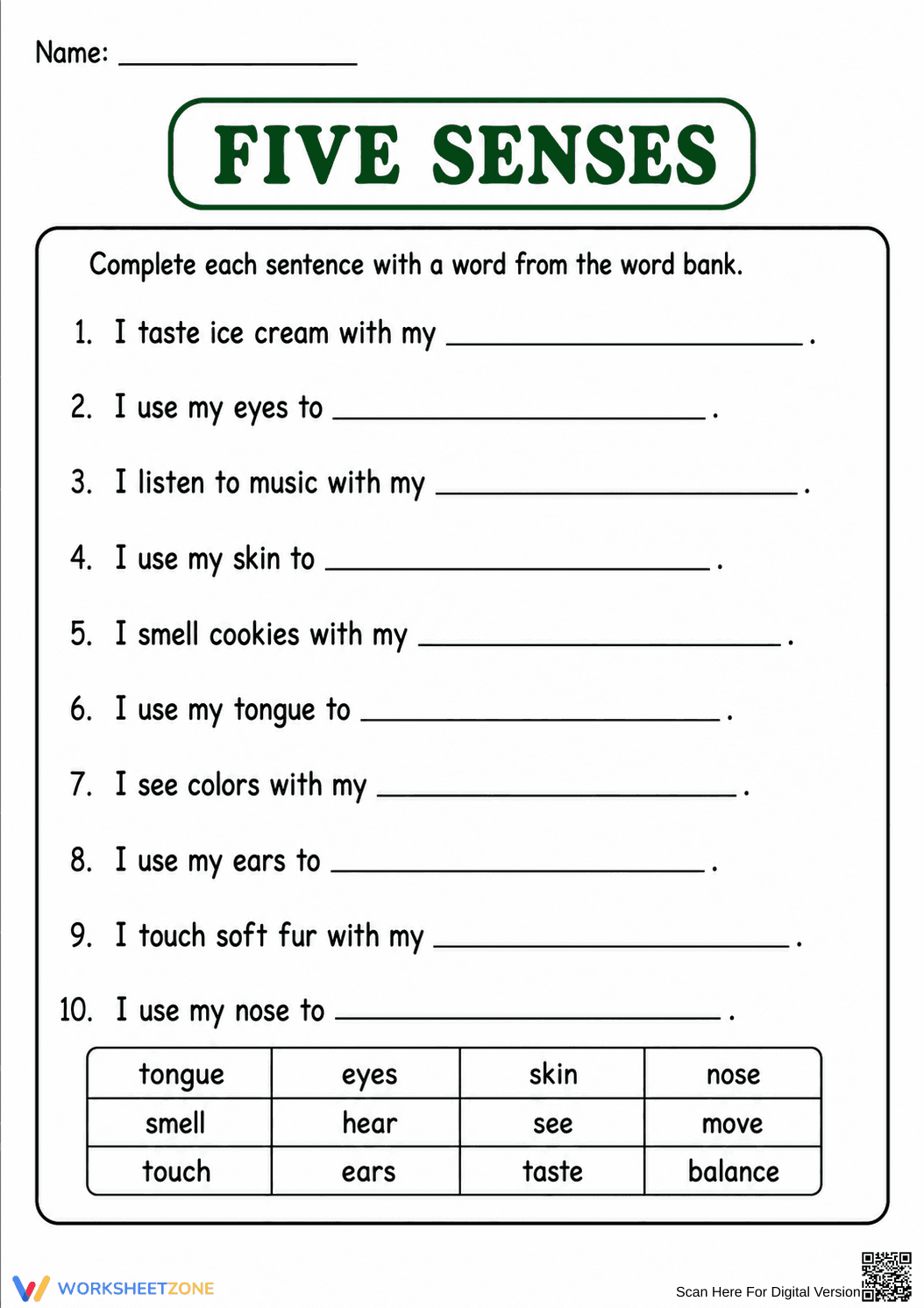
This Grade 2 Science worksheet helps students master the five senses by connecting body parts to their specific functions. By completing ten targeted sentences, learners demonstrate their understanding of how the eyes, ears, nose, tongue, and skin process environmental information. This resource ensures students can accurately identify sensory organs and the actions associated with each one.
At a Glance
- Grade: 2 · Subject: Science
- Standard:
2-PS1-1— Use senses to observe and describe materials by their physical properties- Skill Focus: Sensory Organ Identification
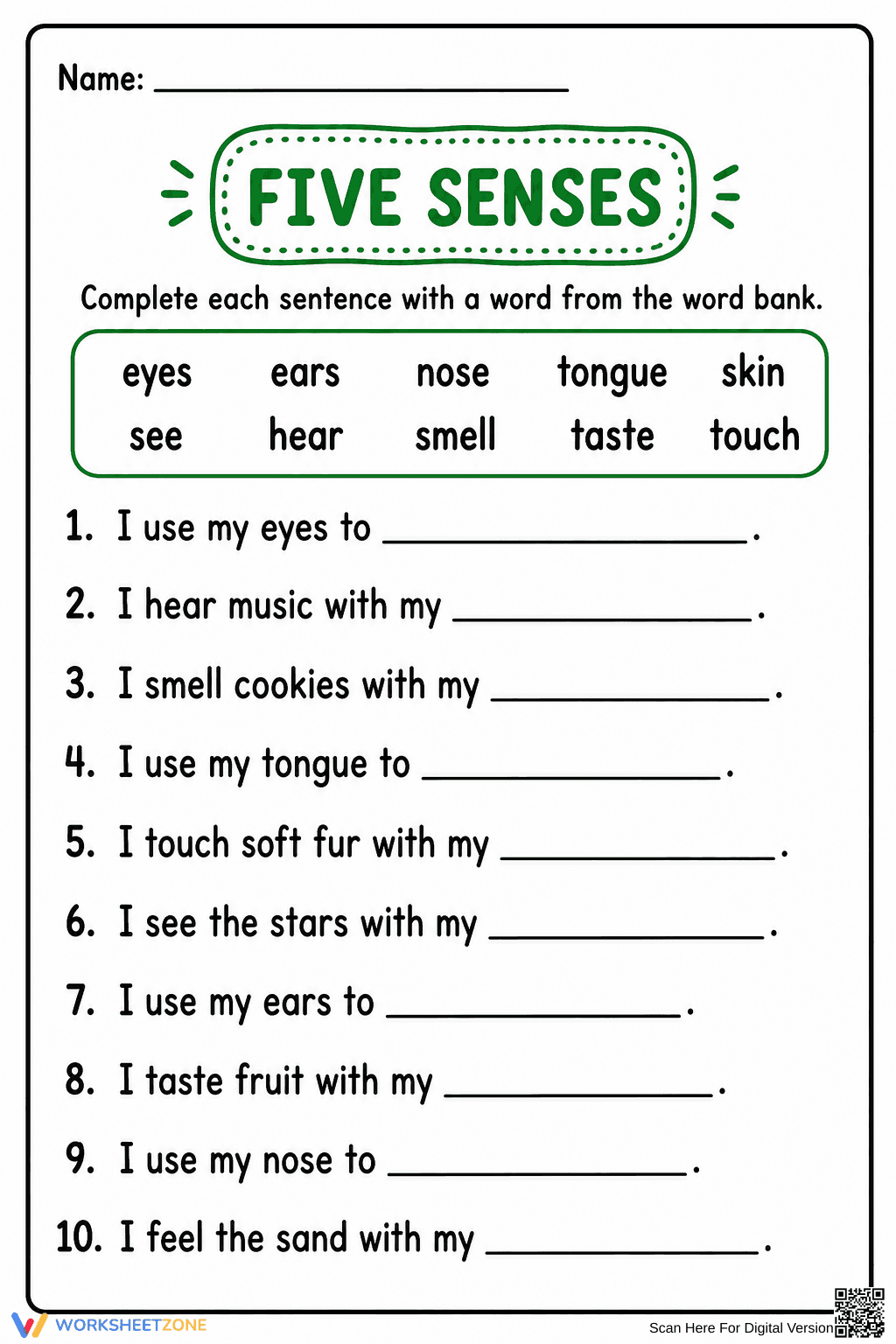
- Format: 2 pages · 10 problems · Answer key included · PDF
- Best For: Individual practice or science center rotations
- Time: 10–15 minutes
What's Inside
Inside this download, you will find a clean, professional student worksheet and a corresponding full-color answer key. The activity features ten fill-in-the-blank sentences supported by a structured word bank. This design allows for self-correction and helps students distinguish between nouns (organs) and verbs (sensory actions), providing a strong foundation for biological vocabulary development.
Zero-Prep Workflow
The zero-prep workflow is designed for maximum teacher efficiency. First, print the worksheet for your class, which takes less than one minute. Next, distribute the sheets and explain the word bank, taking about two minutes of instructional time. Finally, use the provided answer key for rapid review or peer-grading, ensuring a streamlined process that fits perfectly into any busy elementary classroom schedule.
Standards Alignment
Primary standard `2-PS1-1`: Plan and conduct an investigation to describe and classify different kinds of materials by their observable properties. Mastery of the five senses is a prerequisite for identifying these properties accurately. Both standard codes can be copied directly into lesson plans, IEP goals, or district curriculum mapping tools.
How to Use It
Use this worksheet as a summative assessment following a hands-on sensory exploration lesson. It works exceptionally well during the elaborate phase of a 5E lesson cycle. Teachers should observe students as they match organs like the tongue to actions like tasting, noting if any learners confuse the organ with the sense itself. Expected completion time is ten to fifteen minutes.
Who It's For
This activity is primarily designed for second-grade students but is also appropriate for first-grade learners ready for independent writing. It provides excellent support for English Language Learners through the included word bank. It pairs naturally with a classroom anchor chart showing the five senses or a direct instruction lesson about how animals use their senses to navigate their habitats.
Research conducted by RAND AIRS 2024 emphasizes that explicitly teaching sensory vocabulary in the early grades significantly improves a student's ability to describe scientific phenomena with precision. By connecting the physical anatomy of the eyes, ears, and skin to their functional roles, students build the cognitive frameworks necessary for more advanced life science concepts. This worksheet leverages the science of reading by using a word bank to scaffold sentence completion, reducing the cognitive load on spelling so students can focus on the conceptual mapping of the 2-PS1-1 standard. ScienceDirect TpT Analysis suggests that such structured vocabulary activities are highly effective for consolidating knowledge after active, inquiry-based learning. This self-contained resource provides the repeatable practice needed for students to move sensory identification into their long-term memory, ensuring they are prepared for more complex investigations involving material properties and environmental adaptations in later grades.


