


























Views
Plays
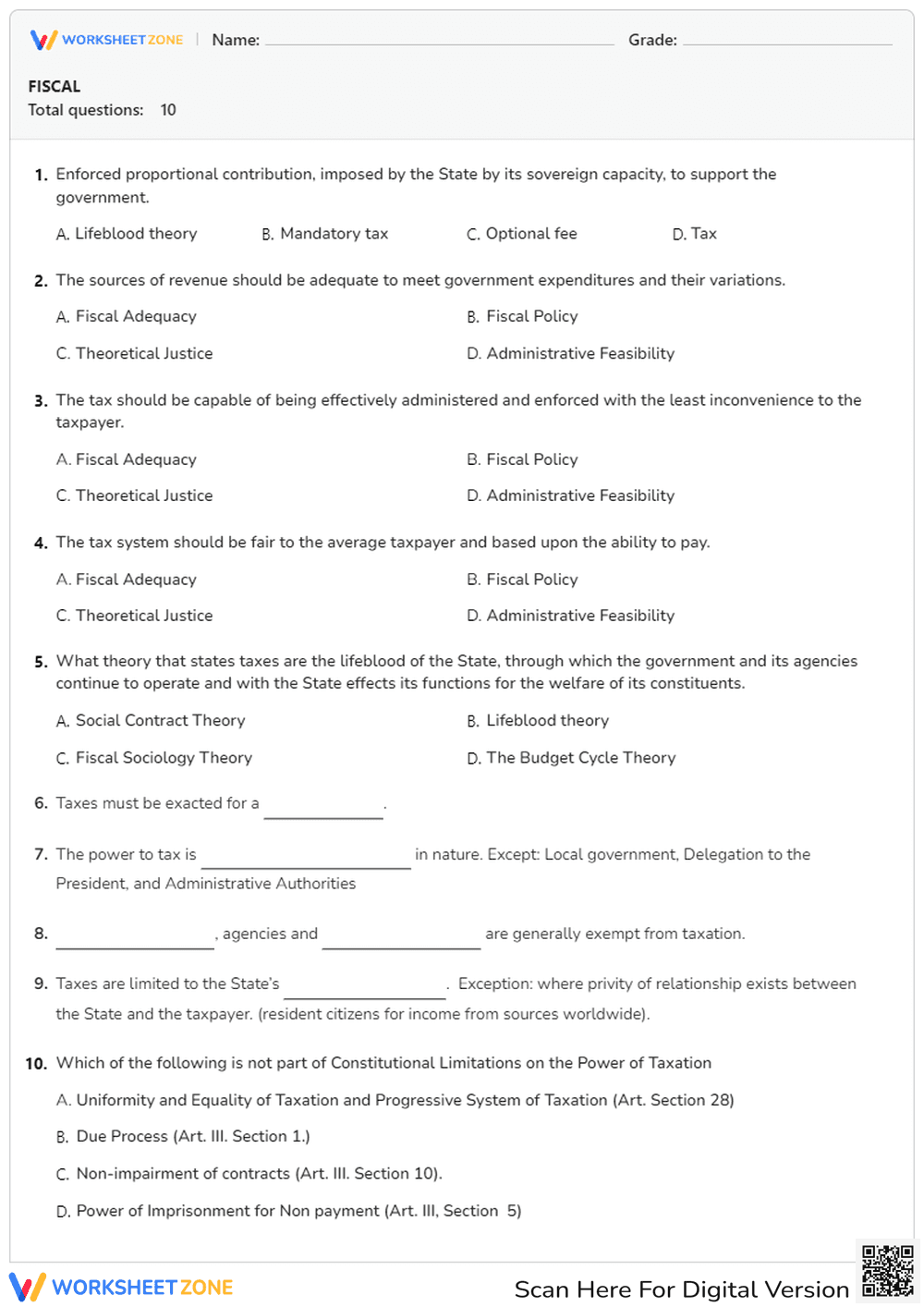

Fiscal Policy & Taxation Quiz | Essential College Guide
Paste this activity's link or code into your existing LMS (Google Classroom, Canvas, Teams, Schoology, Moodle, etc.).
Students can open and work on the activity right away, with no student login required.
You'll still be able to track student progress and results from your teacher account.
This College-level fiscal policy worksheet provides a comprehensive assessment of taxation principles and legal theories. Students demonstrate mastery by identifying core concepts like fiscal adequacy, administrative feasibility, and the lifeblood theory of taxation. It serves as a rigorous tool for evaluating understanding of how governments generate revenue and the constitutional limits on taxing power.
At a Glance
- Grade: College · Subject: Economics / Law
- Standard:
ECON.FISCAL.TAX— Analyze principles of taxation and government revenue systems- Skill Focus: Taxation Principles & Legal Theories
- Format: 1 page · 10 problems · Answer key included · PDF
- Best For: Formative assessment or lecture review
- Time: 15–20 minutes
What's Inside: The worksheet contains 10 targeted questions, including multiple-choice items and fill-in-the-blank prompts. It covers the four canons of taxation, the lifeblood theory, and specific constitutional limitations. The single-page layout is designed for clarity, featuring a clean header for student names and grades, ensuring a professional look for higher education settings.
This resource is designed for an immediate classroom workflow. First, print the single-page PDF (30 seconds). Second, distribute the quiz to students at the start or end of a lecture (1 minute). Finally, review the answers using the included key to provide instant feedback on student comprehension (5 minutes). Total teacher preparation time is under 2 minutes, making it an ideal sub plan or quick check for understanding.
While college-level curricula vary, this worksheet aligns with ECON.FISCAL.TAX, focusing on the economic and legal frameworks of public finance. It specifically addresses the criteria for a sound tax system and the sovereign capacity of the state to impose contributions. This standard code can be copied directly into lesson plans, IEP goals, or district curriculum mapping tools.
How to Use It: Use this worksheet as a "ticket out the door" after a lecture on public finance to gauge immediate retention. Alternatively, assign it as a pre-reading diagnostic to identify which taxation theories require more instructional depth. Completion typically takes 15 to 20 minutes. Observe if students struggle with the distinction between fiscal adequacy and administrative feasibility to guide your next lesson.
Who It's For: This resource is tailored for undergraduate students in economics, political science, or introductory law courses. It is particularly effective for students needing a structured review of technical terminology. Pair this worksheet with a primary source text on constitutional law or a standard macroeconomics textbook chapter on fiscal policy for a complete instructional unit.
According to the RAND AIRS 2024 report, structured assessments that combine multiple-choice and fill-in-the-blank tasks significantly improve the retrieval of complex legal and economic definitions in higher education. This worksheet targets the ECON.FISCAL.TAX standard, ensuring students can articulate the plain-English skill of analyzing government revenue systems and the principles of taxation. By focusing on the "lifeblood theory" and "fiscal adequacy," the material aligns with evidence-based practices for reinforcing academic vocabulary. Research from Fisher & Frey (2014) suggests that such focused practice helps bridge the gap between theoretical lectures and practical application. This 10-question set provides the necessary scaffolding for students to master the nuances of fiscal policy within a 20-minute instructional window, making it a reliable tool for both formative assessment and independent study in college-level environments. The inclusion of constitutional limitations ensures a multi-disciplinary approach to the subject matter.


