


























Views
Downloads

Grade K Pencil Control — Printable No-Prep Worksheet
Paste this activity's link or code into your existing LMS (Google Classroom, Canvas, Teams, Schoology, Moodle, etc.).
Students can open and work on the activity right away, with no student login required.
You'll still be able to track student progress and results from your teacher account.
This Grade K pencil control worksheet provides foundational tracing practice to help young learners develop the grip strength and coordination needed for legible handwriting. By following 10 distinct paths, students build the muscle memory required for letter formation and spatial awareness. This resource ensures students gain confidence before transitioning to formal alphabet practice.
At a Glance
- Grade: K · Subject: Writing
- Standard:
CCSS.ELA-LITERACY.L.K.1.A— Print many upper- and lowercase letters through foundational fine motor control- Skill Focus: Pencil control and line tracing
- Format: 2 pages · 10 problems · No answer key needed · PDF
- Best For: Morning work or writing centers
- Time: 10–15 minutes
What's Inside
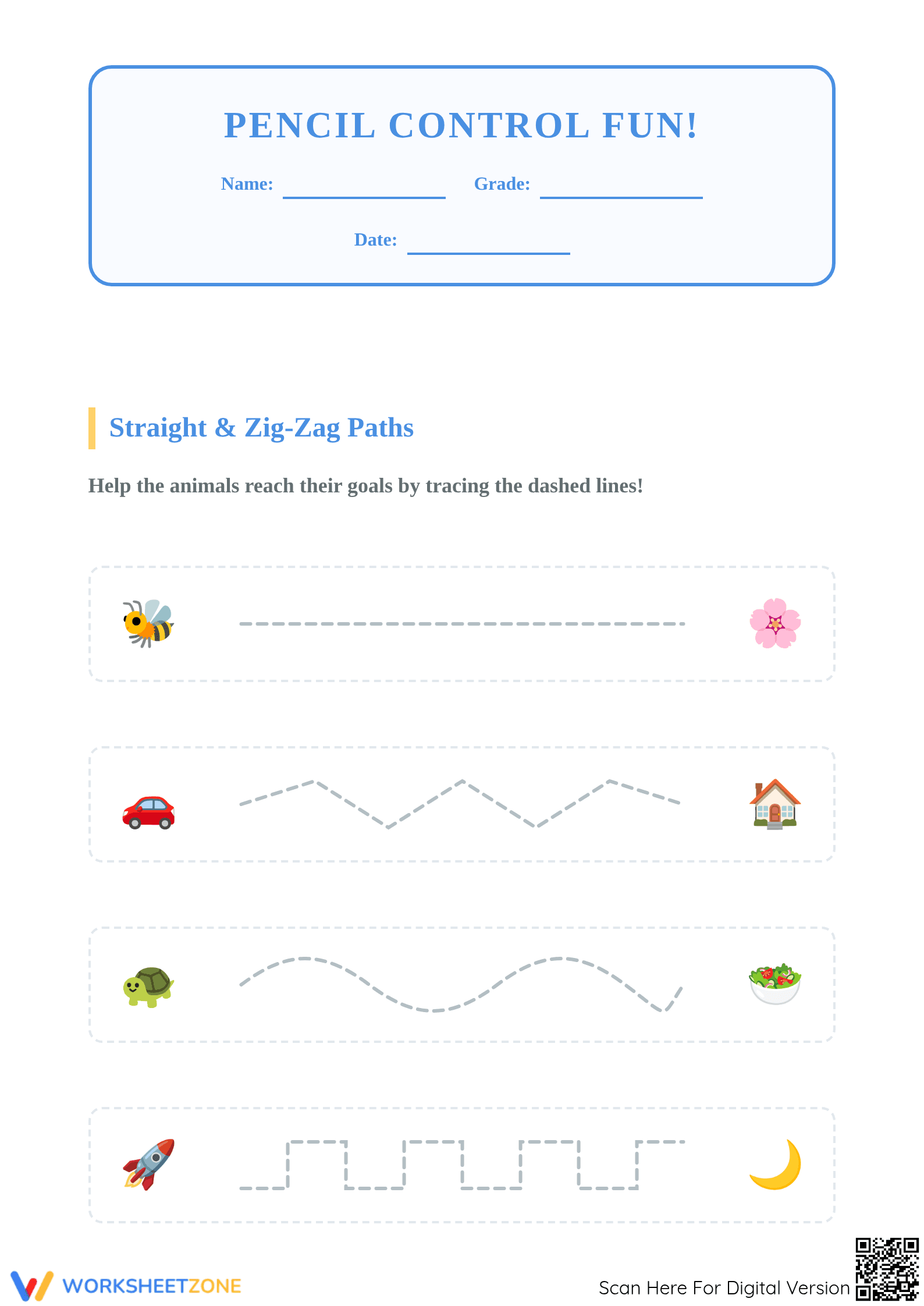
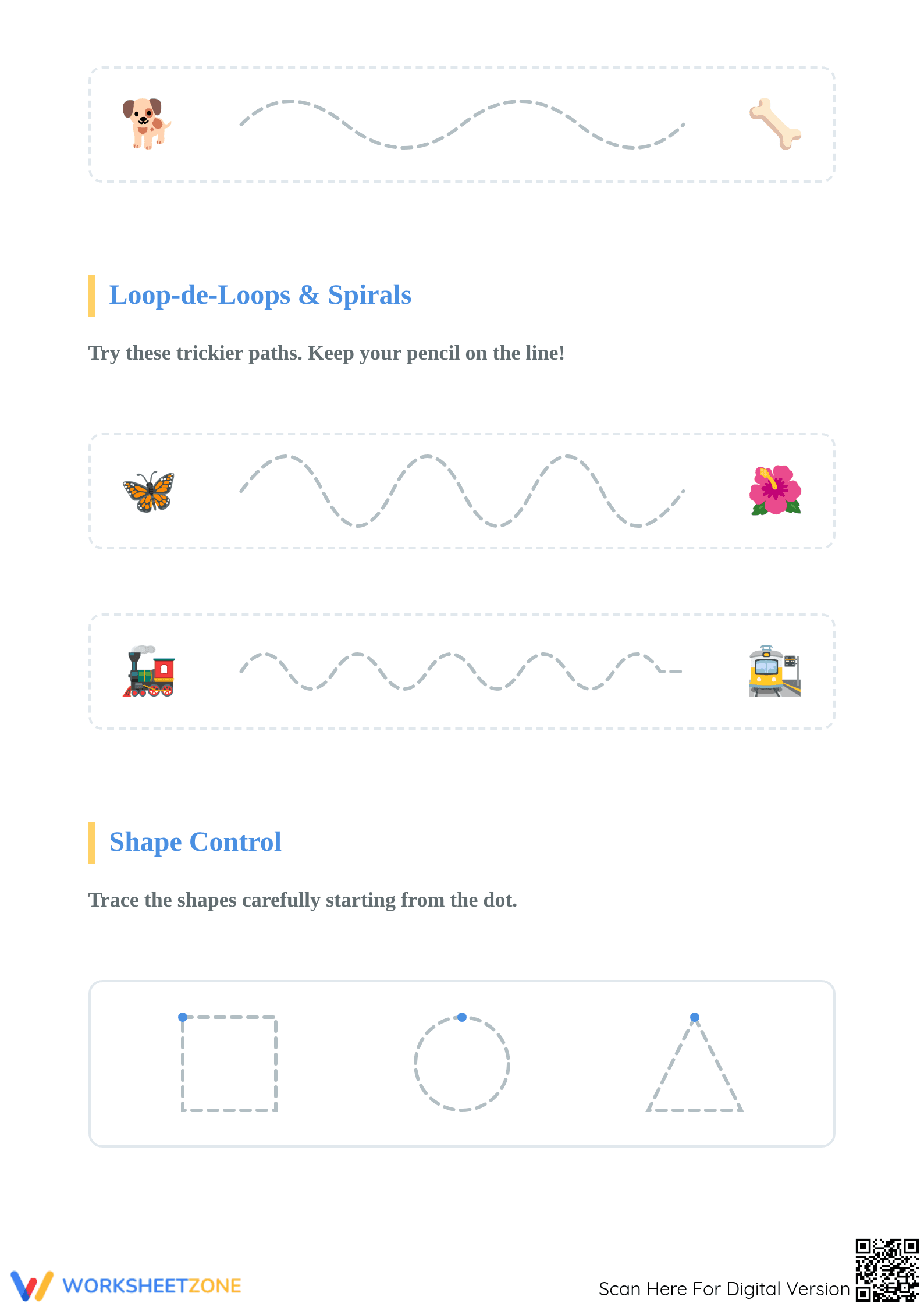
This two-page PDF features a variety of engaging tracing tasks designed to keep early learners focused. Page one includes four horizontal paths featuring animals like bees and turtles, moving from simple straight lines to complex zig-zags and waves. Page two introduces three advanced loop-de-loop paths and a dedicated shape control section where students trace a square, circle, and triangle starting from a specific anchor dot.
Zero-Prep Workflow
- Step 1: Print the two-page PDF document for your entire class or small group (30 seconds).
- Step 2: Distribute the sheets along with sharpened pencils, crayons, or markers to encourage different grip pressures (1 minute).
- Step 3: Review student progress by observing their ability to stay within the dashed lines and maintain a consistent pencil stroke (10 minutes).
Total teacher preparation time is under 2 minutes, making this an ideal solution for busy mornings, literacy centers, or emergency substitute plans.
Standards Alignment
This resource is aligned to CCSS.ELA-LITERACY.L.K.1.A, which requires students to print many upper- and lowercase letters. While this worksheet focuses on pre-writing paths, it directly supports the fine motor precision necessary to meet this standard. Additionally, it supports physical development goals related to hand-eye coordination. Both standard codes can be copied directly into lesson plans, IEP goals, or district curriculum mapping tools.
How to Use It
Use this worksheet during the first 15 minutes of the school day as a calming morning work activity. It also functions effectively as a station in a writing center where students can practice independently. For a formative assessment, observe if students are using a tripod grip and if they can complete the zig-zag paths without lifting their pencil. Expect most Kindergarten students to complete both pages within 15 minutes.
Who It's For
This resource is designed for Pre-K and Kindergarten students who are beginning their writing journey. It is also highly effective for students receiving Occupational Therapy (OT) services who need extra practice with line boundaries. Pair this worksheet with an alphabet anchor chart or a direct instruction lesson on proper pencil grip to maximize the instructional impact for your emerging writers.
Research by Fisher & Frey (2014) emphasizes the importance of scaffolded fine motor practice in early literacy development. This worksheet targets CCSS.ELA-LITERACY.L.K.1.A by building the muscular control necessary for letter formation. By engaging in 10 distinct tracing tasks, students develop the precision required for future academic success. Studies indicate that early pencil manipulation is a strong predictor of later writing fluency and cognitive processing speed in primary grades. This resource provides a structured environment for this development, ensuring students meet foundational benchmarks through repetitive, guided motion. The inclusion of varied path types—straight, curved, and angular—mirrors the strokes found in the English alphabet, bridging the gap between drawing and formal writing. Educators can use these 2 pages to document progress in fine motor intervention or as a standard part of a comprehensive Kindergarten writing curriculum.


