


























Views
Downloads


Pencil Control Tracing Worksheet | Pre-K & K Printable
Paste this activity's link or code into your existing LMS (Google Classroom, Canvas, Teams, Schoology, Moodle, etc.).
Students can open and work on the activity right away, with no student login required.
You'll still be able to track student progress and results from your teacher account.
This foundational fine motor skills worksheet helps early learners develop essential pencil control before they begin formal letter formation. By tracing various paths from left to right, students build the hand-eye coordination and grip strength required for successful handwriting and drawing.
At a Glance
- Grade: Pre-K & K · Subject: ELA
- Standard:
CCSS.ELA-LITERACY.L.K.1.A— Develop foundational fine motor skills to print letters- Skill Focus: Pencil control and line tracing
- Format: 2 pages · 8 problems · No answer key needed · PDF
- Best For: Morning work or literacy centers
- Time: 10–15 minutes
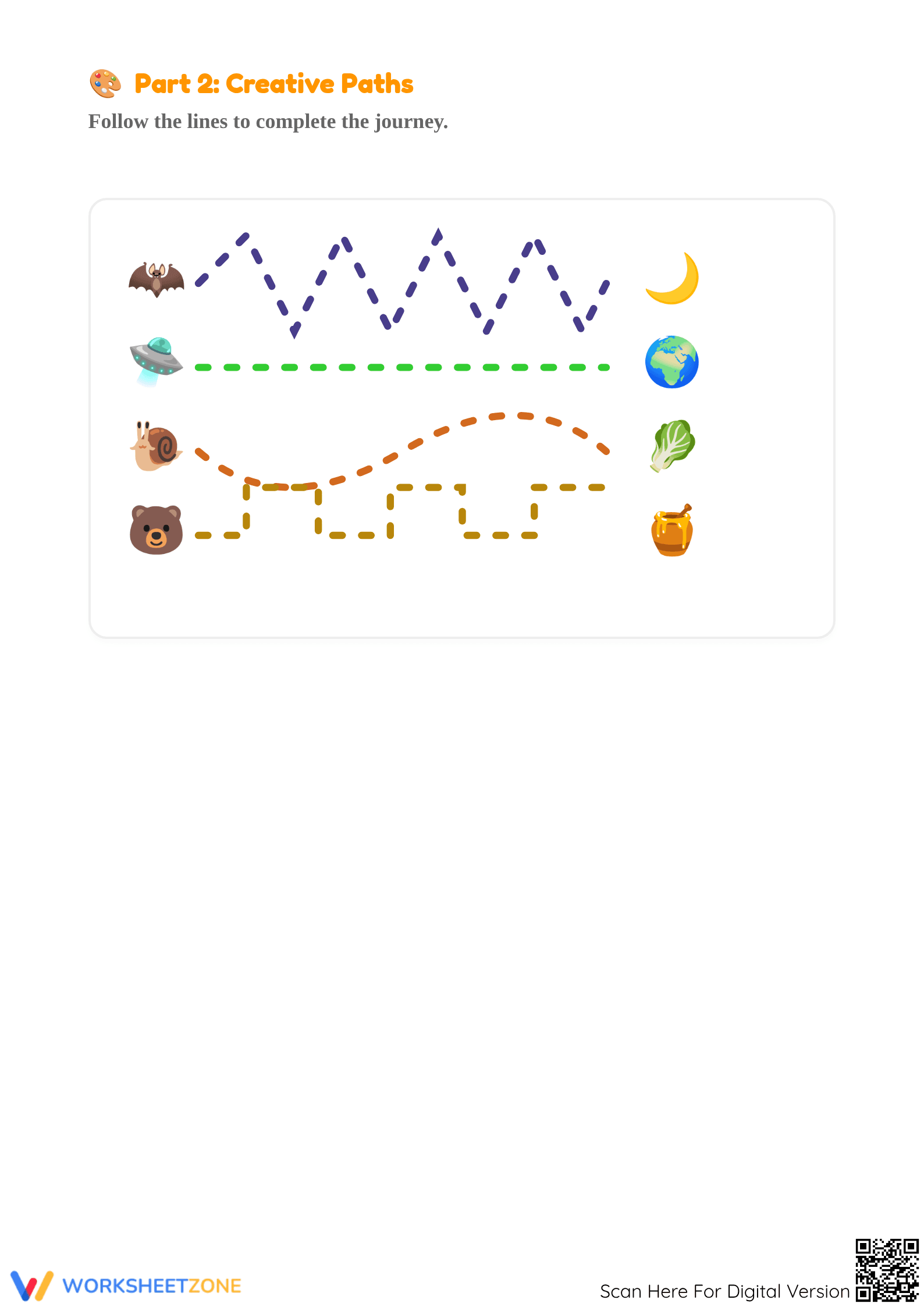
This two-page resource features eight distinct tracing activities designed to keep young learners engaged. Part 1, "Connect the Dots," includes four paths with gentle curves and zig-zags, guiding animals and objects to their destinations. Part 2, "Creative Paths," introduces four slightly more complex, varied line patterns. The visually appealing graphics provide clear start and end points, reinforcing left-to-right progression without requiring any teacher setup.
- Print (1 minute): Simply download the PDF and print the two pages. No special cutting or laminating is required for standard use.
- Distribute (1 minute): Hand out the worksheets along with pencils, crayons, or markers. The intuitive left-to-right design means students can begin immediately.
- Review (Ongoing): Monitor students as they work to ensure proper pencil grip and directional tracking. Total teacher prep time is under two minutes, making this an ideal activity for emergency sub plans or quick transitions.
Aligned to CCSS.ELA-LITERACY.L.K.1.A: Print many upper- and lowercase letters. While this standard focuses on letter formation, mastering pencil control through guided line tracing is the critical prerequisite step. Both standard codes can be copied directly into lesson plans, IEP goals, or district curriculum mapping tools.
Use this worksheet as a calming morning work activity as students arrive and settle into the classroom routine. It also functions perfectly as an independent literacy center station. While students are tracing, observe their pencil grip and posture—this serves as an excellent formative assessment to identify which children might need adaptive grips or additional fine motor interventions. Expected completion time is 10 to 15 minutes.
This resource is designed for Pre-K and Kindergarten students who are building their pre-writing skills. It is highly effective for occupational therapy sessions or special education students needing targeted fine motor practice. Pair this worksheet with hands-on activities like playdough shaping or bead stringing to further strengthen hand muscles before moving on to explicit letter tracing.
Developing strong pencil control is a vital precursor to fluent handwriting and overall academic success in early childhood education. Aligned with CCSS.ELA-LITERACY.L.K.1.A, this resource helps students develop foundational fine motor skills to print letters accurately. According to Fisher & Frey (2014), early interventions that target fine motor coordination significantly improve later writing legibility and stamina, which are essential components of effective communication. By providing structured, engaging tracing paths, educators can ensure young learners build the necessary muscle memory and hand-eye coordination required for complex literacy tasks. When children practice these fundamental movements, they are actively wiring their brains to understand spatial relationships, directional tracking, and the physical mechanics of writing. This deliberate practice reduces cognitive load during future writing assignments, allowing students to focus entirely on expressing their ideas rather than struggling with the physical act of holding a pencil. Ultimately, investing time in these foundational tracing exercises creates a supportive pathway toward lifelong literacy.


