


























Views
Downloads


Essential Pencil Control Worksheet | Kindergarten Writing
Paste this activity's link or code into your existing LMS (Google Classroom, Canvas, Teams, Schoology, Moodle, etc.).
Students can open and work on the activity right away, with no student login required.
You'll still be able to track student progress and results from your teacher account.
This Kindergarten pencil control worksheet provides foundational fine motor practice to help young learners develop the coordination necessary for legible handwriting. By tracing varied paths, students build the muscular memory required for letter formation. This resource ensures students transition from simple marks to controlled strokes, setting the stage for writing success.
At a Glance
- Grade: Kindergarten · Subject: ELA
- Standard:
CCSS.ELA-LITERACY.L.K.1.A— Demonstrate command of conventions by developing the fine motor control needed to print letters and lines accurately- Skill Focus: Pencil Control
- Format: 2 pages · 8 unique tracing paths · No answer key required · PDF
- Best For: Early morning work, writing centers, or occupational therapy sessions
- Time: 10–15 minutes
What's Inside
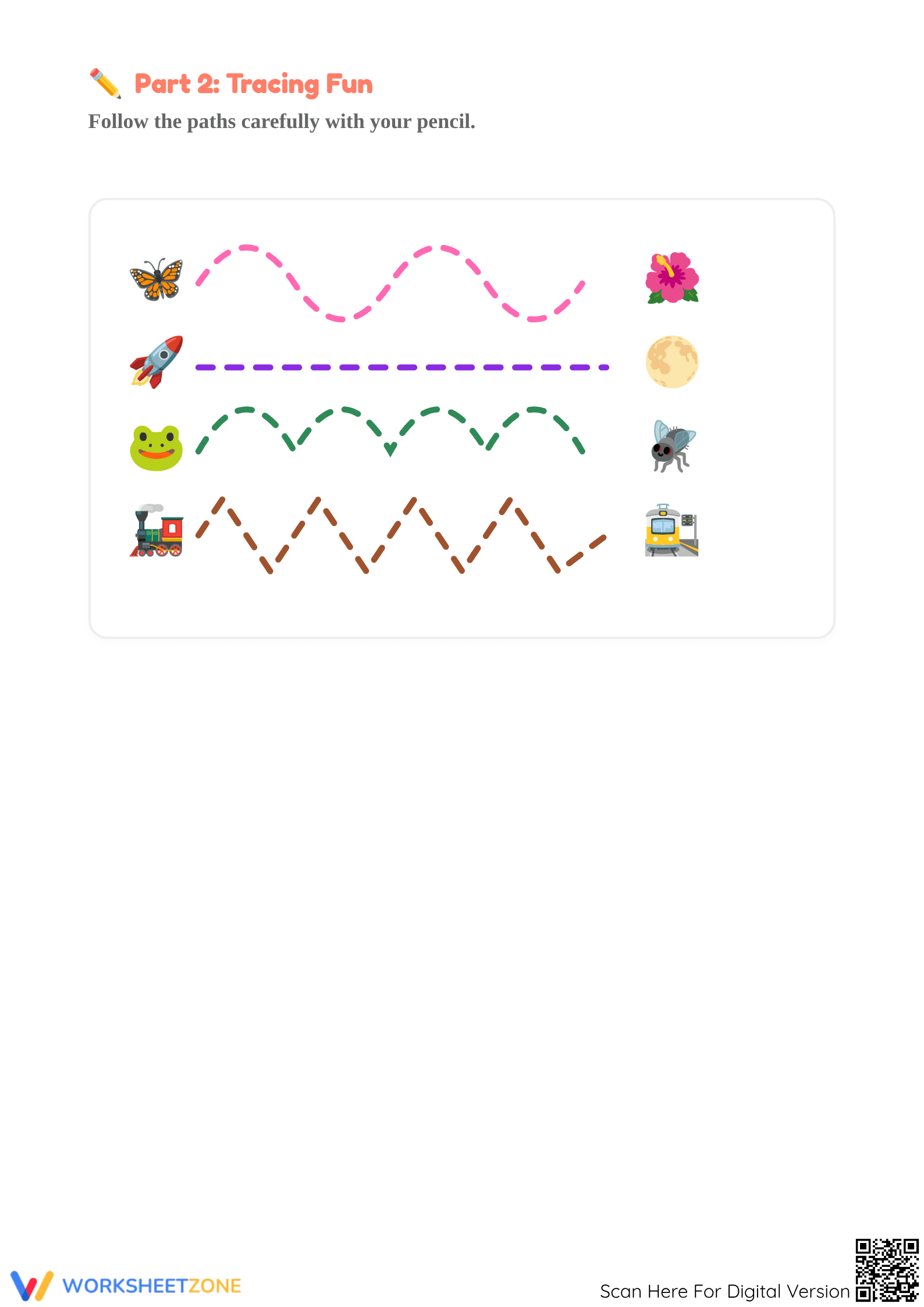
The resource consists of two full-color pages featuring eight distinct tracing challenges. Page one includes wavy, zigzag, and straight paths, while page two introduces scalloped and complex angular lines. Each path is anchored by engaging icons like bees and rockets to maintain student interest during repetitive practice.
Zero-Prep Workflow
The zero-prep workflow is designed for busy educators and sub plans. First, print the two-page PDF (30 seconds). Second, distribute to students during morning arrival (1 minute). Third, provide feedback by observing grip and path accuracy (ongoing). Total teacher preparation time is under two minutes, allowing you to focus on instruction rather than setup.
Standards Alignment
This resource is aligned to `CCSS.ELA-LITERACY.L.K.1.A`, which requires students to print many upper- and lowercase letters. While this worksheet focuses on pre-writing paths, it is the essential precursor to formal letter formation and handwriting mastery. Both standard codes can be copied directly into lesson plans, IEP goals, or district curriculum mapping tools.
How to Use It
Use this as a warm-up during your writing block or as a fine motor station. For formative assessment, observe if students move from left to right and maintain contact with the dashed lines. This observation helps identify students needing additional support. Expected completion time ranges from 10 to 15 minutes.
Who It's For
This resource is for Pre-K and Kindergarten students, including those requiring occupational therapy support. It pairs naturally with an alphabet anchor chart or tactile sand-tray activities. The clear visual cues make it accessible for English Language Learners and students with diverse learning needs who require high-interest tasks.
According to Fisher & Frey (2014), the gradual release of responsibility begins with foundational motor skills that allow students to focus on cognitive tasks rather than the mechanics of writing. Research indicates that early pencil control is a significant predictor of later academic success in literacy. This worksheet addresses CCSS.ELA-LITERACY.L.K.1.A by providing the structured repetition needed to master line formation. By engaging with 8 unique paths, students develop the dexterity required for the 'Print many upper- and lowercase letters' requirement of the Kindergarten standard. The use of visual anchors and dashed lines provides the necessary scaffolding for independent practice. This resource serves as a reliable tool for educators seeking to bridge the gap between gross motor play and formal academic writing, ensuring students are prepared for the rigors of the primary grade curriculum. It offers a practical application of fine motor development that is essential for early childhood education.


