




























Views
Downloads


Essential Pencil Control & Shape Tracing Worksheet | Grade K

Paste this activity's link or code into your existing LMS (Google Classroom, Canvas, Teams, Schoology, Moodle, etc.).
Students can open and work on the activity right away, with no student login required.
You'll still be able to track student progress and results from your teacher account.
This Grade K pencil control worksheet provides students with 7 structured tracing tasks to improve fine motor precision. By following dotted paths for geometric and organic shapes, learners develop the muscular endurance and grip stability necessary for legible letter formation and early writing success. State-aligned and ready for immediate classroom use.
At a Glance
- Grade: K · Subject: Writing
- Standard:
CCSS.ELA-LITERACY.L.K.1.A— Print many upper- and lowercase letters using proper pencil grip- Skill Focus: Fine motor pencil control
- Format: 3 pages · 7 problems · Answer key included · PDF
- Best For: Morning work or writing centers
- Time: 15–20 minutes
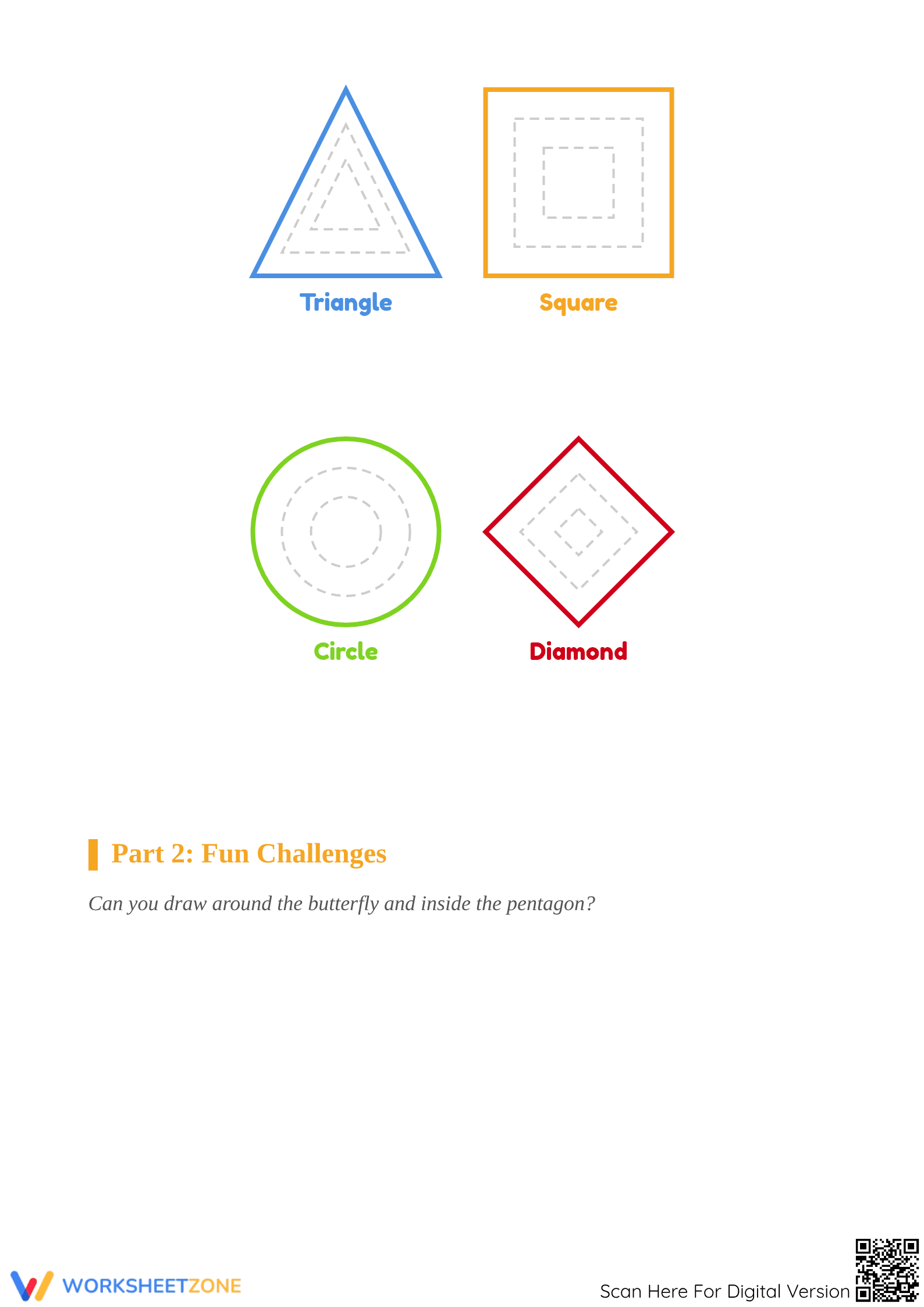
What's Inside: The 3-page PDF includes a dedicated notes section for teacher observations, four primary geometric shapes (triangle, square, circle, diamond), and two complex challenge figures. Each task encourages students to trace the outer boundary before attempting to draw a smaller version inside, promoting spatial awareness and internalizing shape properties through tactile movement.
Zero-Prep Workflow
- Print: Generate the 3-page PDF for your entire class or small group in under 30 seconds.
- Distribute: Hand out the sheets during morning work, writing centers, or as a quiet transition activity.
- Review: Monitor student grip and line accuracy as they complete the creative raindrop challenge at the end of the packet.
Total teacher preparation time is under 2 minutes, making this an ideal resource for substitute folders or emergency lesson plans.
Standards Alignment: The primary standard CCSS.ELA-LITERACY.L.K.1.A focuses on the ability to "Print many upper- and lowercase letters." While this worksheet uses shapes, it directly supports the fine motor foundations required for this standard by building the hand-eye coordination needed for letter strokes. Both standard codes can be copied directly into lesson plans, IEP goals, or district curriculum mapping tools.
How to Use It: Use this as a "warm-up" before a formal handwriting lesson to activate the small muscles in the hand. It also serves as an excellent formative assessment tool; observe if students are using a functional tripod grip or if they struggle with the directional changes in the diamond and pentagon shapes. Expect completion within a 15 to 20-minute window.
Who It's For: This resource is designed for Kindergarten students, preschool learners transitioning to formal writing, and students receiving Occupational Therapy (OT) support for fine motor delays. It pairs naturally with alphabet tracing charts, tactile sand trays, or direct instruction on pencil pressure.
According to Fisher & Frey (2014), the gradual release of responsibility begins with highly structured scaffolds that allow students to practice discrete motor movements before applying them to complex tasks like sentence writing. This worksheet utilizes dotted-line scaffolding to reduce cognitive load, allowing the learner to focus entirely on pencil pressure and path accuracy. Research from the 2024 NAEP highlights that early mastery of fine motor control is a significant predictor of later writing fluency and academic success in the primary grades. By providing 7 distinct opportunities for tracing and free-hand drawing, this resource ensures that students build the necessary muscle memory for standard CCSS.ELA-LITERACY.L.K.1.A. The inclusion of a creative prompt at the end encourages the transfer of these skills to non-templated drawing, a critical step in early childhood development.


