


























Views
Downloads




Essential Pencil Control Tracing Worksheet | Grade K
Paste this activity's link or code into your existing LMS (Google Classroom, Canvas, Teams, Schoology, Moodle, etc.).
Students can open and work on the activity right away, with no student login required.
You'll still be able to track student progress and results from your teacher account.
This Grade K pencil control worksheet provides students with 12 structured tracing paths to develop the fine motor strength required for handwriting. By following dotted lines from left to right, learners build the muscle memory and hand-eye coordination necessary for letter formation. The resource moves from simple straight lines to complex zig-zags and loops.
At a Glance
- Grade: Kindergarten · Subject: Writing
- Standard:
CCSS.ELA-LITERACY.L.K.1.A— Demonstrate command of the conventions of standard English grammar and usage when writing- Skill Focus: Fine motor pencil control
- Format: 4 pages · 12 problems · Answer key included · PDF
- Best For: Morning work or early writing centers
- Time: 15–20 minutes
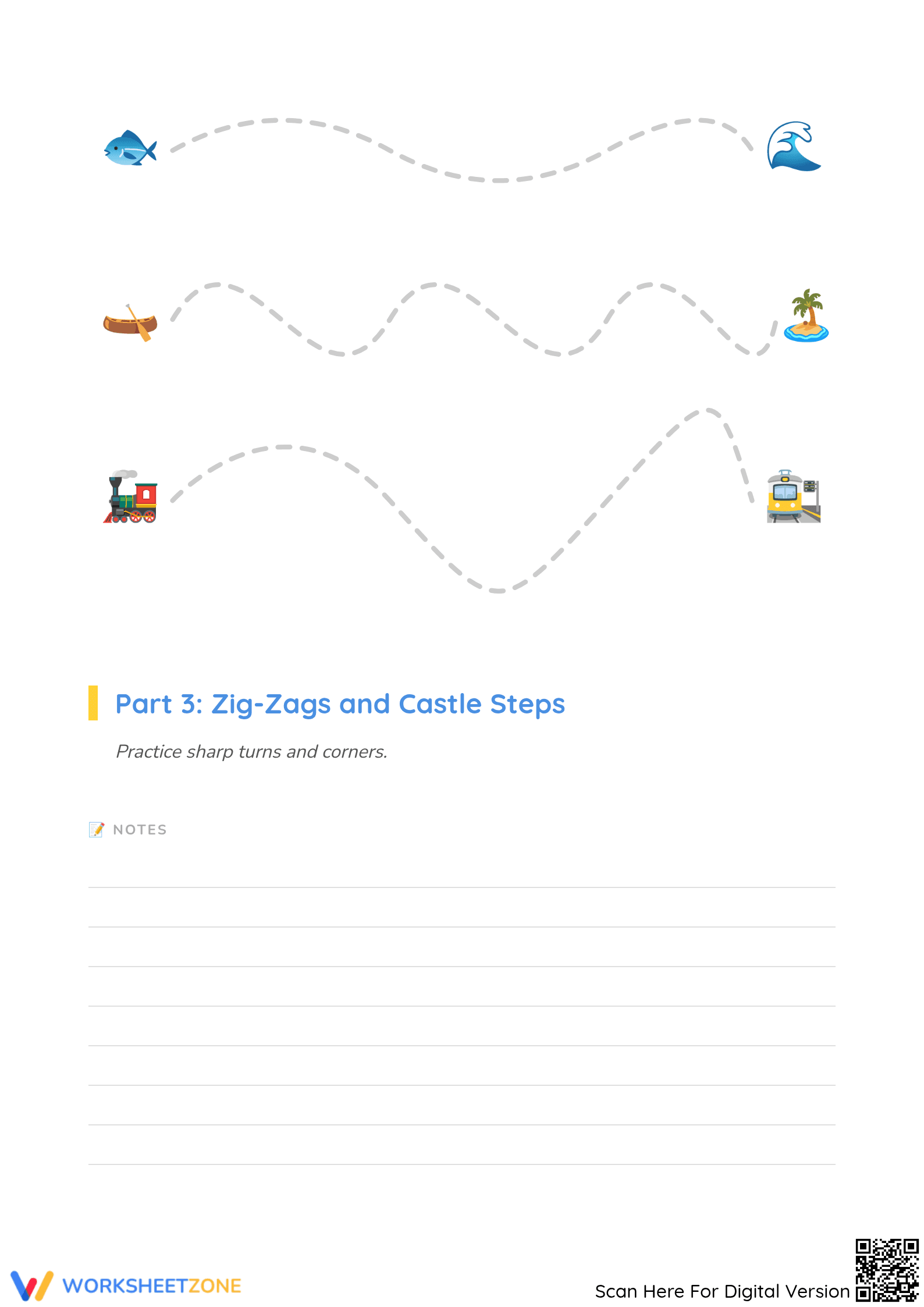
What's Inside: This 4-page PDF contains three distinct sections of increasing difficulty. Part 1 focuses on simple straight paths with 6 horizontal and diagonal tasks. Part 2 introduces wavy and curved lines to challenge wrist flexibility. Part 3 features 3 complex zig-zag and castle step patterns. Each page includes a dedicated notes section for teacher observations or student reflection on their progress.
Zero-Prep Workflow: This resource is designed for immediate classroom implementation. First, print the 4-page set (30 seconds). Second, distribute the packets to students during morning arrival or small group rotations (1 minute). Third, review student progress by checking for line adherence and proper pencil grip (1 minute). Total teacher preparation time is under 3 minutes, making it an ideal sub plan or emergency filler.
Standards Alignment: The primary focus is `CCSS.ELA-LITERACY.L.K.1.A`, which requires students to demonstrate command of the conventions of standard English grammar and usage when writing, specifically focusing on the physical act of pencil manipulation. This worksheet also supports early occupational therapy goals related to visual-motor integration. Both standard codes can be copied directly into lesson plans, IEP goals, or district curriculum mapping tools.
How to Use It: Use this worksheet during the first ten minutes of the school day as a calming morning work activity to settle students into a learning mindset. Alternatively, assign specific pages during a writing center rotation to provide targeted practice for students struggling with letter size or spacing. Observe if students are crossing the midline or rotating the paper excessively during the curved path tasks.
Who It's For: This resource is tailored for Kindergarten students, though it is highly effective for Pre-K learners and students in special education programs requiring fine motor intervention. It pairs naturally with alphabet tracing cards or a direct instruction lesson on proper tripod grip. The clear visual cues and engaging icons make it accessible for English Language Learners.
According to the Fisher & Frey (2014) framework for gradual release of responsibility, foundational motor skills like pencil control are essential precursors to cognitive writing tasks. This worksheet addresses CCSS.ELA-LITERACY.L.K.1.A by providing 12 high-repetition tracing paths that transition from simple horizontal movements to complex multi-directional curves. Research from the RAND AIRS 2024 report suggests that consistent, low-stakes fine motor practice significantly correlates with improved letter legibility and writing stamina in early elementary grades. By isolating the physical mechanics of writing from the cognitive load of spelling, students can focus entirely on hand-eye coordination and spatial awareness. This 4-page resource serves as a structured intervention tool for educators seeking to bridge the gap between gross motor play and formal handwriting instruction. It is a reliable asset for any evidence-based early literacy curriculum.


