


























Views
Downloads
Essential Grade 9-12 Math: Finding Missing Measurements Worksheet
Paste this activity's link or code into your existing LMS (Google Classroom, Canvas, Teams, Schoology, Moodle, etc.).
Students can open and work on the activity right away, with no student login required.
You'll still be able to track student progress and results from your teacher account.
This comprehensive geometry resource challenges high school students to apply area formulas in reverse. By solving for unknown dimensions in plane figures, learners bridge the gap between basic calculation and algebraic reasoning. It solidifies spatial awareness while reinforcing the fundamental relationship between area and its linear components.
At a Glance
- Grade: 9–12 · Subject: Math
- Standard:
HSG.MG.A.1— Apply geometric properties and area formulas to solve for unknown dimensions in plane figures.- Skill Focus: Inverse Area Calculations
- Format: 4 pages · 24 problems · Answer key included · PDF
- Best For: Geometry review, sub plans, or formative assessment
- Time: 45–60 minutes
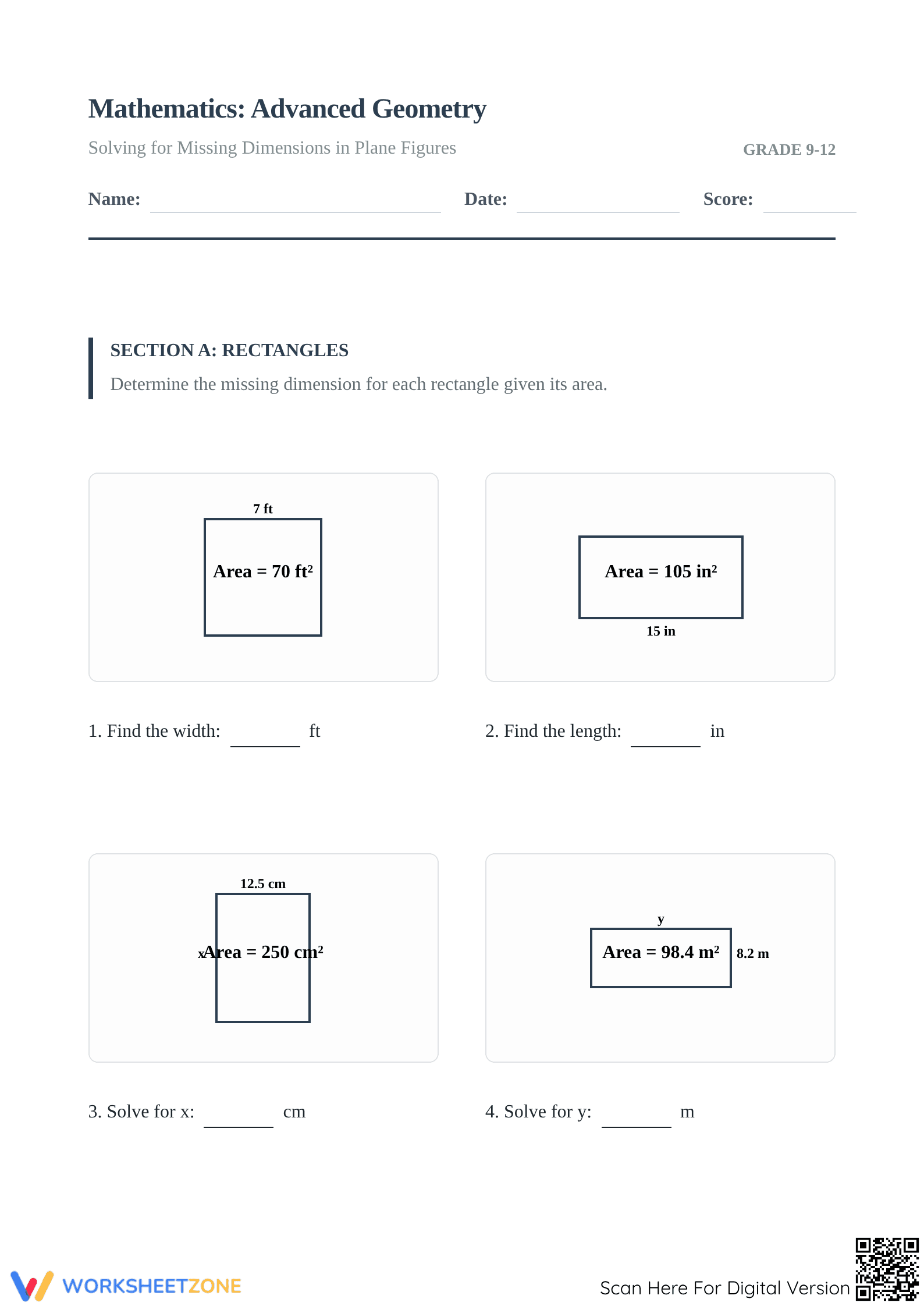
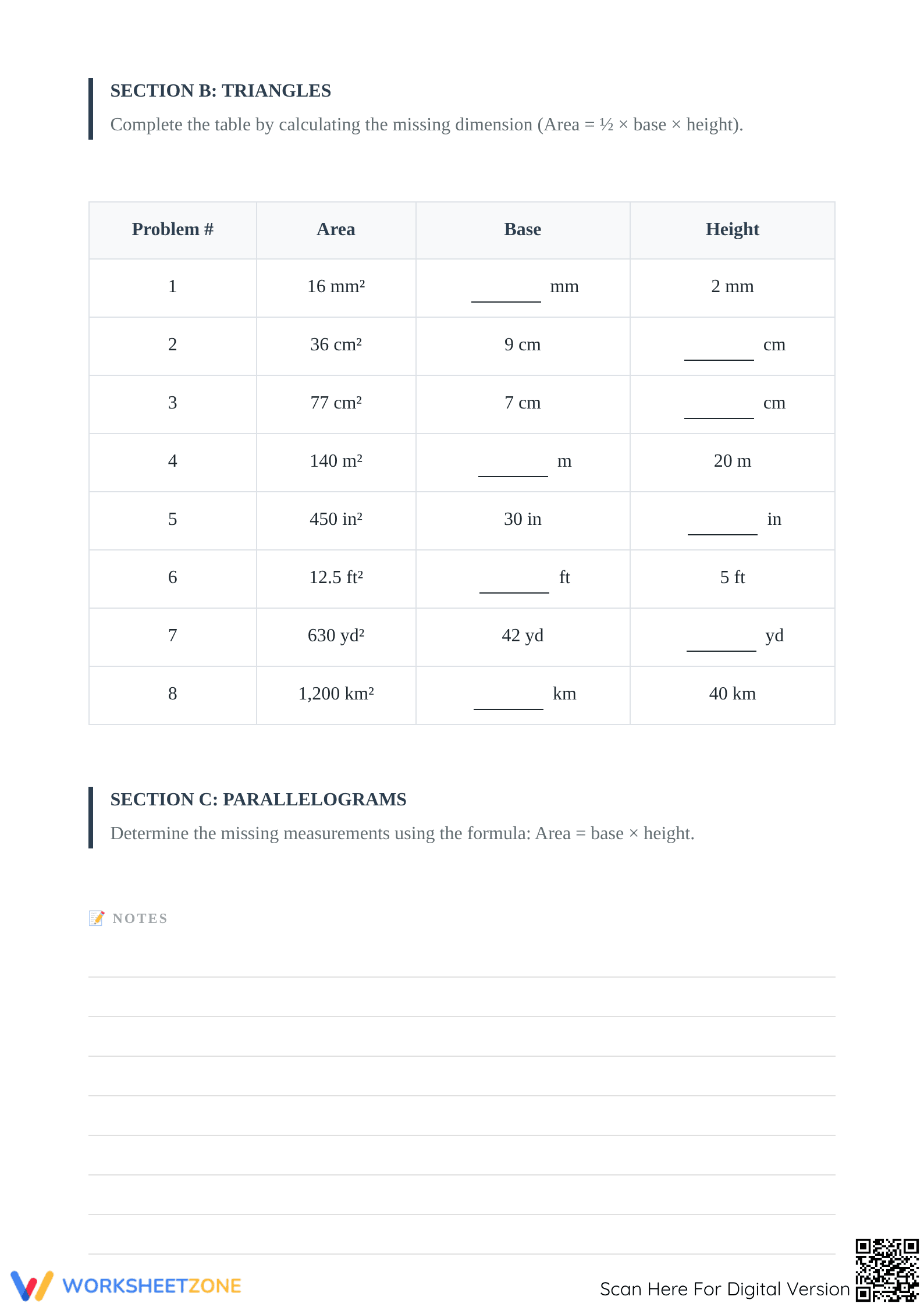
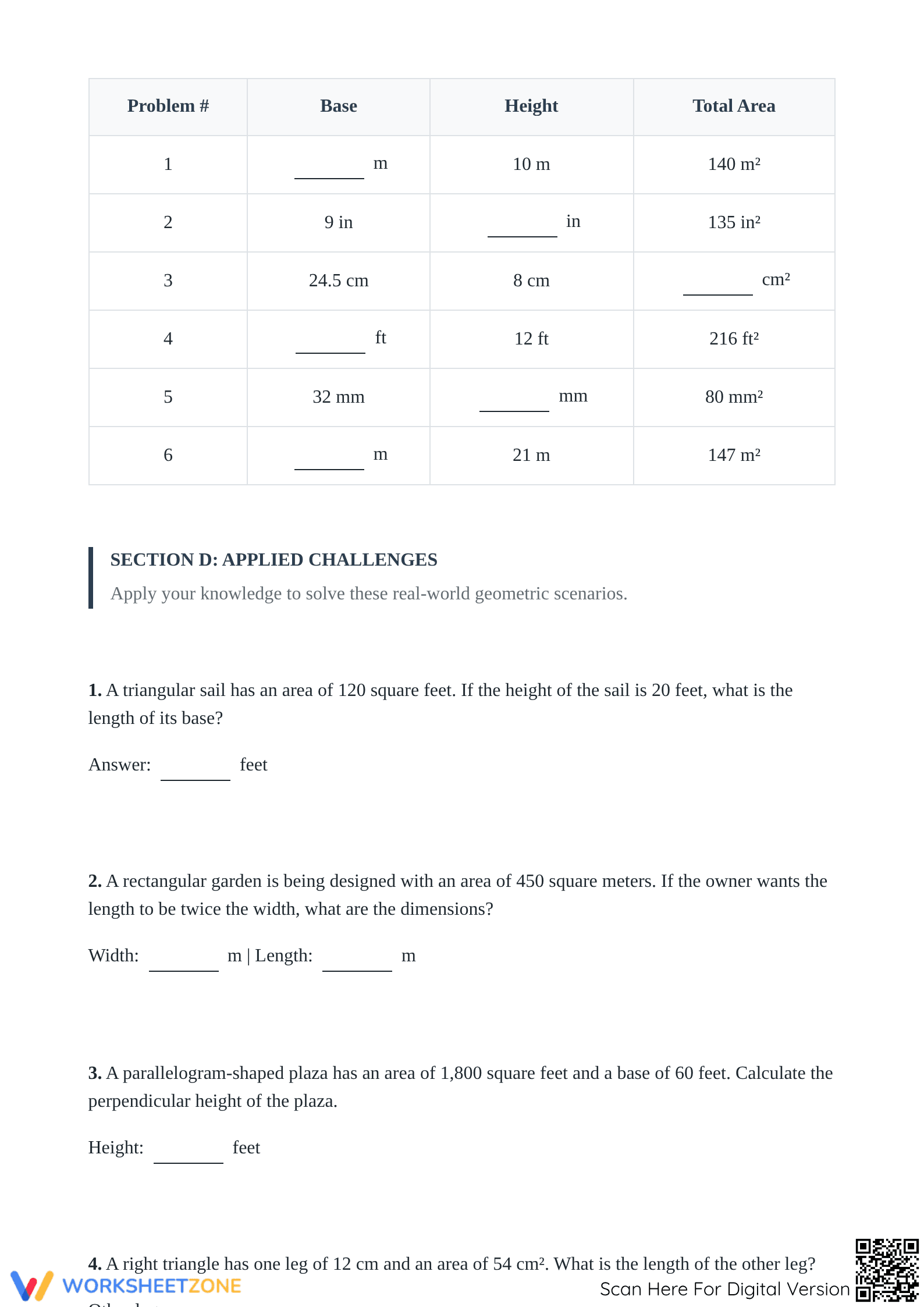
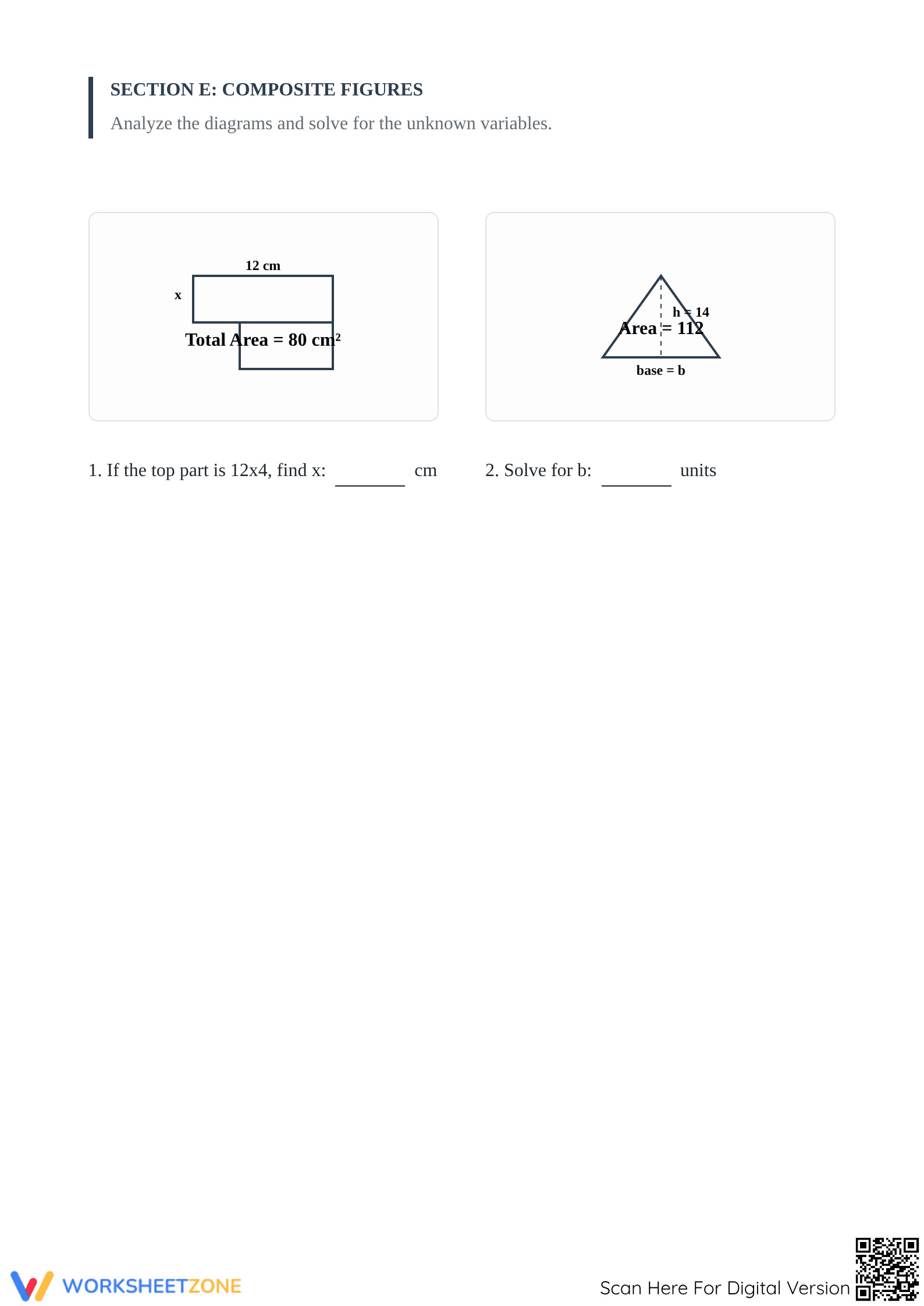
This 4-page packet features 24 structured tasks across five distinct sections. Students begin with basic rectangles before progressing to triangles and parallelograms presented in tabular formats. The worksheet then moves to real-world applied challenges and concludes with complex composite figures requiring multi-step variable solving. A full answer key provides immediate feedback and simplifies the grading process for educators.
The teacher-friendly design ensures this resource is ready for immediate use. 1. Print the four-page PDF in seconds. 2. Distribute copies to students; the layout is self-explanatory. 3. Review answers using the provided key in under five minutes. Total teacher preparation time is under 2 minutes, making it ideal for emergency sub plans or review sessions.
Standards Alignment
Primary focus is on `HSG.MG.A.1`, which requires students to use geometric shapes, their measures, and their properties to describe objects and solve mathematical problems. This worksheet supports that standard by forcing students to manipulate formulas rather than simply plugging in numbers. Both standard codes can be copied directly into lesson plans, IEP goals, or district curriculum mapping tools.
How to Use It
Use this as a summative review after introducing the area of polygons to ensure students can manipulate variables algebraically. During the session, observe how students handle the composite figures in Section E; if they struggle to decompose the shapes, it indicates a need for further instruction on spatial visualization. The expected completion time for high school students ranges from 45 to 60 minutes depending on their algebraic proficiency.
Who It's For
This resource is ideal for Grade 9 through 12 students enrolled in Geometry or Algebra-integrated math courses. It provides sufficient rigor for honors-level review while remaining accessible for standard-level learners through the structured tables. Naturally pair this worksheet with a reference anchor chart of area formulas or a short introductory passage on the history of geometric measurement.
The instructional design of this geometry resource aligns with the principles of algebraic integration within spatial reasoning tasks, as emphasized in Fisher & Frey (2014). By requiring students to solve for unknown dimensions, the worksheet promotes higher-order thinking beyond rote memorization of formulas. Research suggests that "backward" problems—where the outcome is known and the inputs are missing—significantly improve a student's ability to generalize mathematical concepts to real-world scenarios. Specifically, the inclusion of 24 problems across 4 pages ensures enough deliberate practice to achieve procedural fluency without cognitive overload. The standard code `HSG.MG.A.1` reflects the expectation that high school students can use geometric properties to solve for missing measurements in complex plane figures. This approach is validated by NAEP data which shows a strong correlation between multi-step geometric problem solving and overall proficiency in secondary mathematics.


