


























Views
Downloads
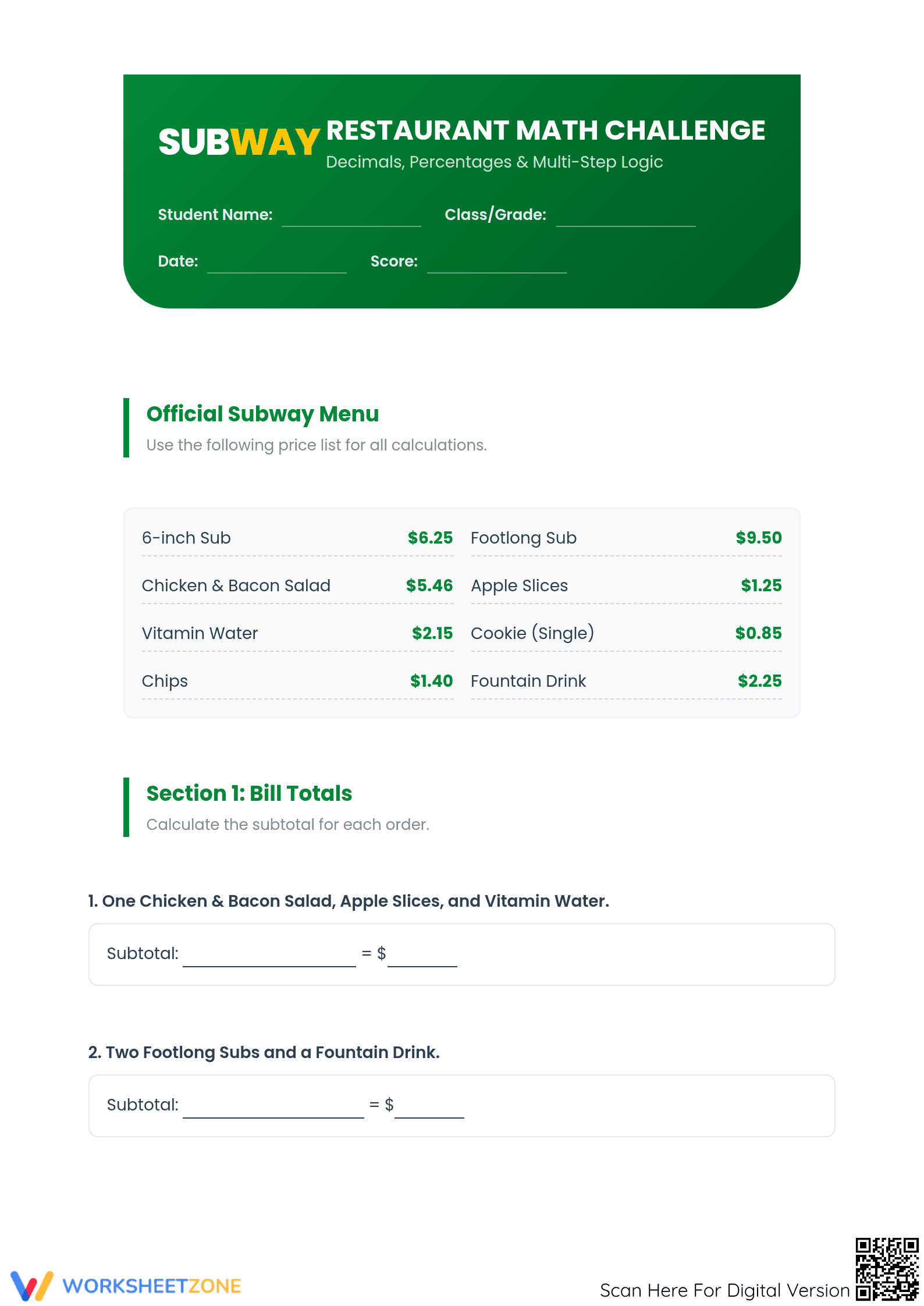
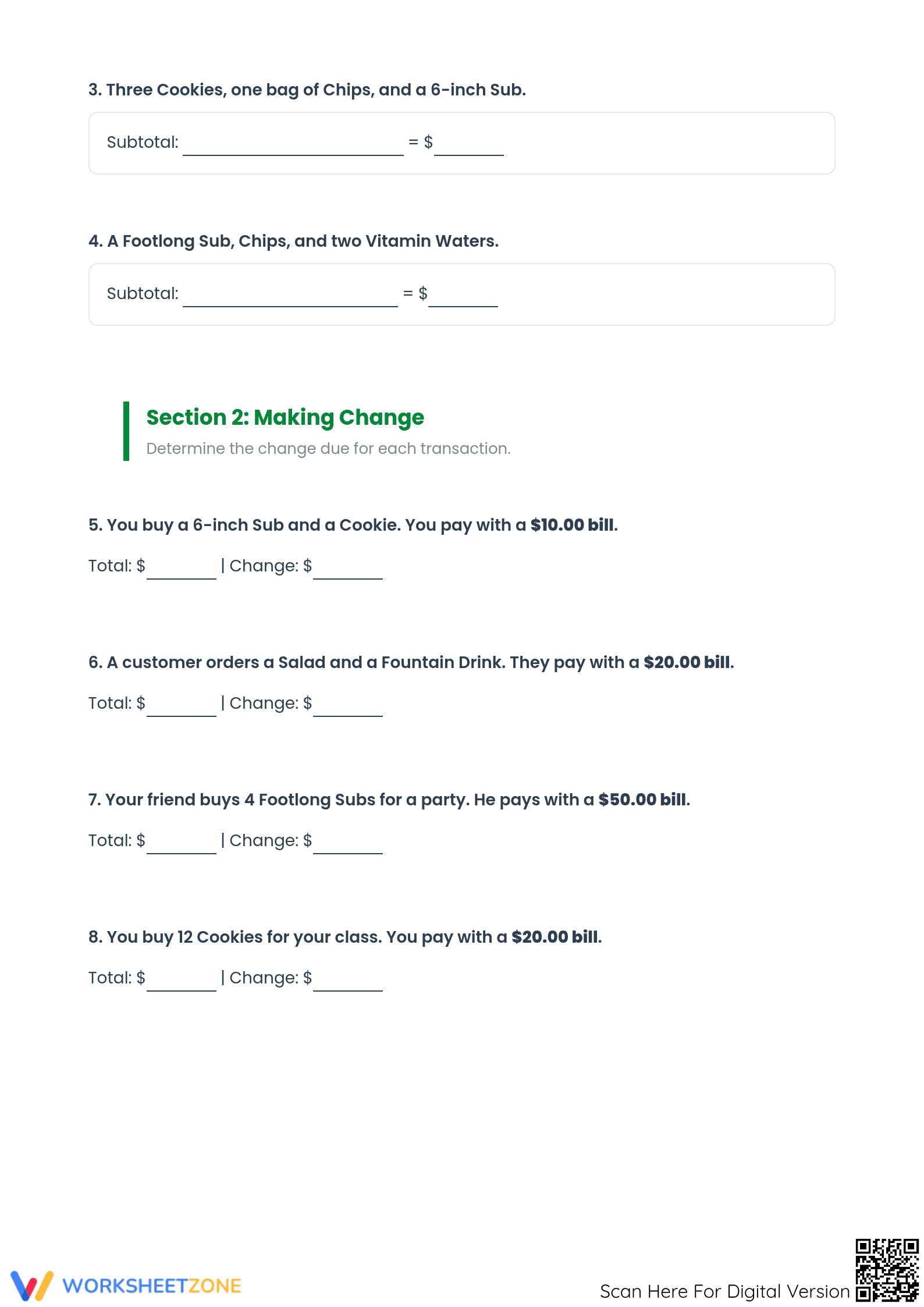
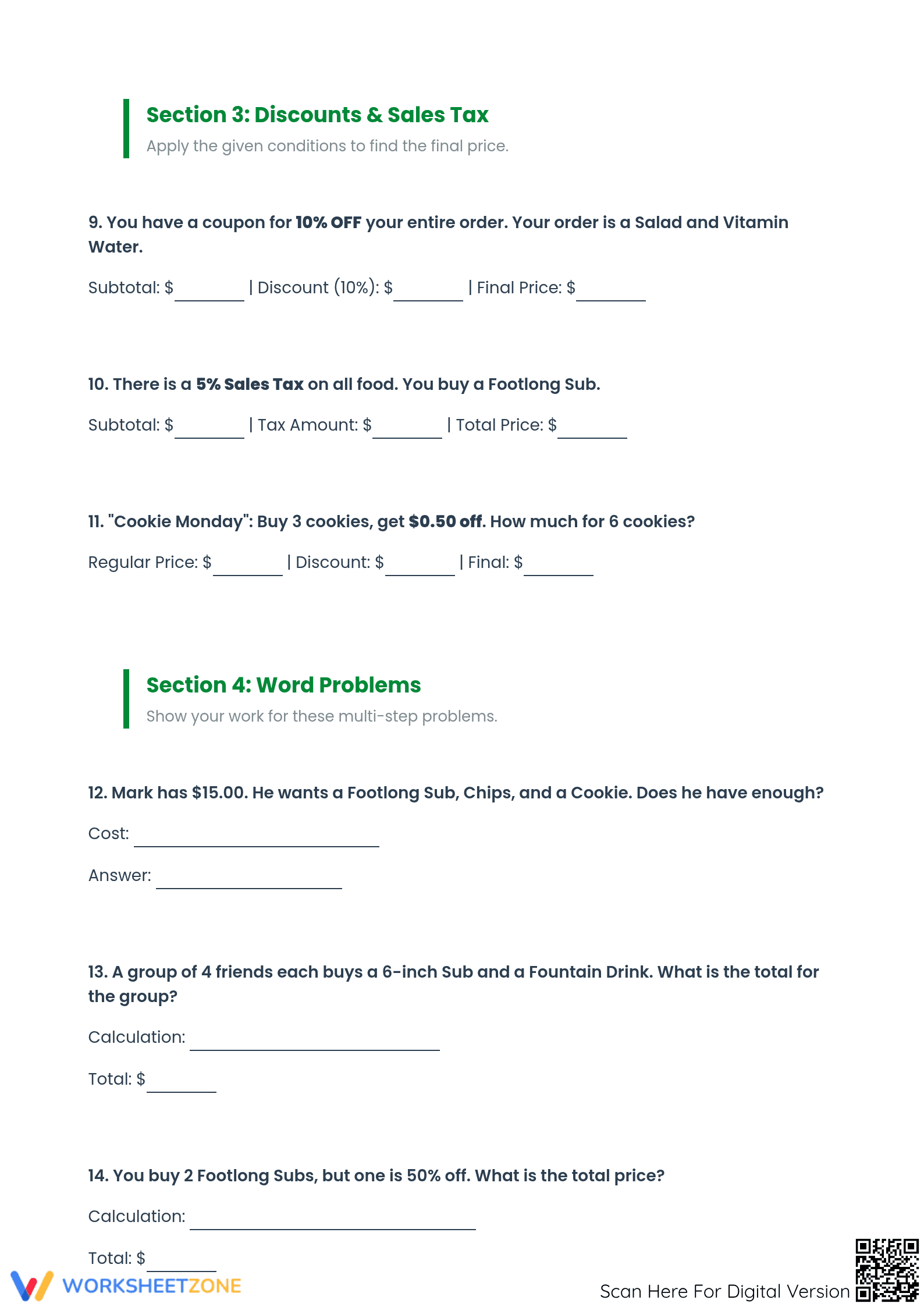
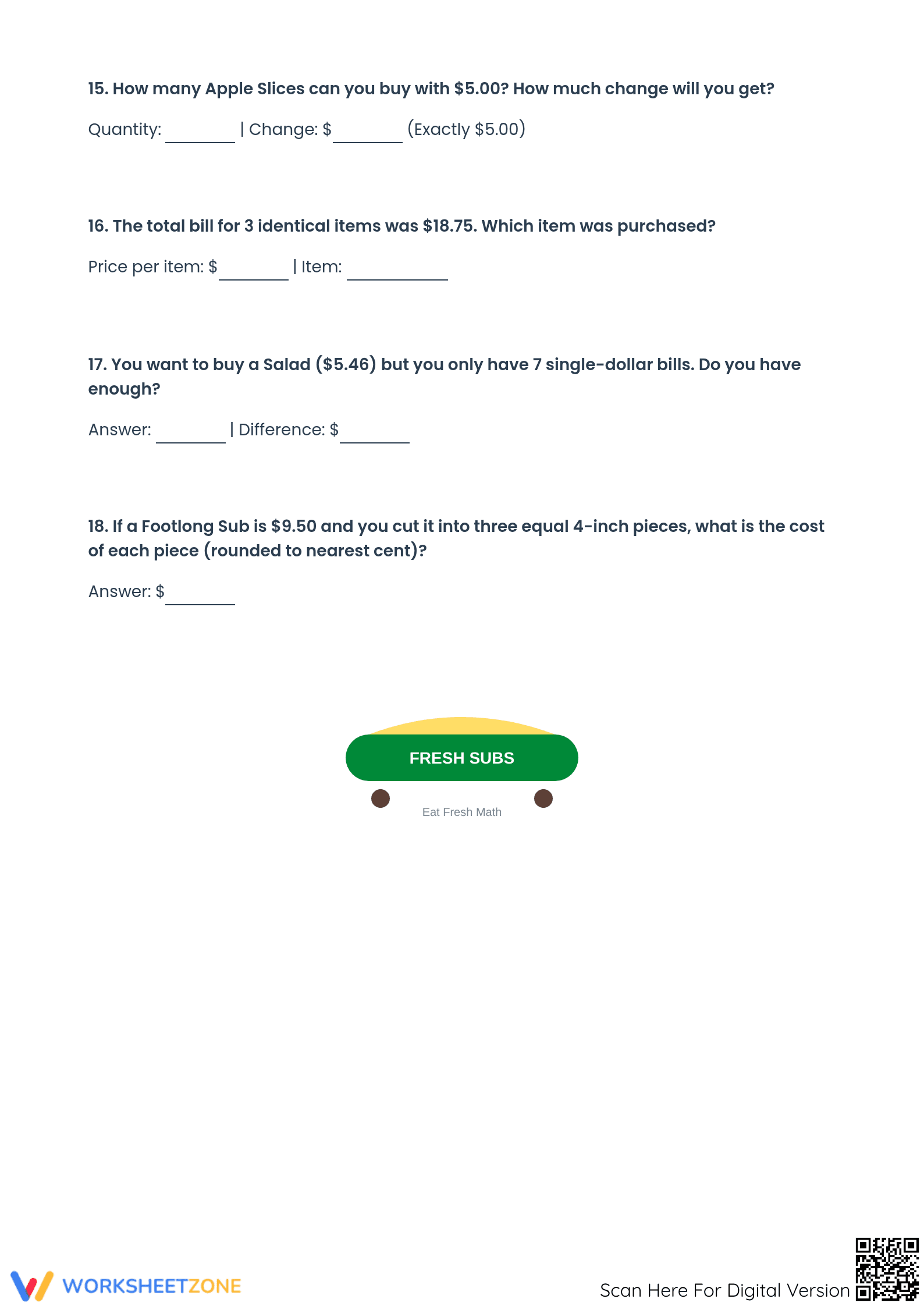

Grade 6 Money Math — Printable No-Prep Worksheet
Paste this activity's link or code into your existing LMS (Google Classroom, Canvas, Teams, Schoology, Moodle, etc.).
Students can open and work on the activity right away, with no student login required.
You'll still be able to track student progress and results from your teacher account.
This practical math worksheet helps middle school students practice essential money skills. By calculating the total cost of food orders from a menu, learners apply decimal addition and multiplication in a real-world context. This resource provides focused, no-prep practice for students in grades 5 through 8 to build confidence with multi-step word problems involving money.
At a Glance
- Grade: 5–8 · Subject: Math
- Standard:
CCSS.MATH.CONTENT.6.NS.B.3— Fluently operate with multi-digit decimals using standard algorithms.- Skill Focus: Calculating costs, decimal addition, and multiplication
- Format: 4 pages · 12 problems · Answer key included · PDF
- Best For: Life skills practice, decimal operations review, independent work
- Time: 20–30 minutes
What's Inside
This PDF download contains a three-page worksheet with 12 unique problems and a full one-page answer key. The activity is centered around a restaurant menu, from which students must calculate the total cost for different orders. This requires both decimal addition and multiplication in a clear, straightforward layout that lets students focus on the math.
A Zero-Prep Workflow
Designed for immediate use, this resource simplifies your planning. It's an effective, ready-to-go activity:
- Print (1 min): The entire PDF packet is ready to print.
- Distribute (1 min): The instructions are self-contained, so students can begin work immediately.
- Review (10 mins): Use the included answer key to review answers with the class or for self-checking.
Its efficiency makes it perfect for a warm-up, substitute plan, or homework assignment.
Standards-Aligned Practice
This worksheet directly supports the Common Core standard CCSS.MATH.CONTENT.6.NS.B.3, where students learn to "Fluently add, subtract, multiply, and divide multi-digit decimals using the standard algorithm." While focused on Grade 6, its practical application is excellent for review in grades 5, 7, and 8. The standard code can be copied directly into lesson plans or curriculum maps.
Classroom Application
Use this versatile worksheet after a lesson on decimal operations for independent practice. It serves as an excellent formative assessment tool, allowing you to quickly see which students can apply the skill. Observe who correctly aligns decimals and handles multi-step problems. It can also be used for homework or station work. Most students will complete the tasks in 20-30 minutes.
Who It's For
This activity is designed for middle-grade students practicing decimal arithmetic. It is especially helpful for learners who connect with math through real-world scenarios. The familiar menu theme is engaging and provides a concrete reason for the calculations. Pair it with an anchor chart on decimal rules or a lesson on financial literacy to deepen understanding.
Applying mathematical concepts to real-world scenarios is a proven method for increasing student engagement and long-term retention. This worksheet, which targets standard CCSS.MATH.CONTENT.6.NS.B.3, aligns with findings from the RAND AIRS 2024 report on the importance of contextualized problem-solving in mathematics education. By asking students to calculate costs from a menu, they practice fluent computation with multi-digit decimals, a critical skill for both academic success and everyday life. The structure of the task provides repeated, varied practice, which Fisher & Frey (2014) identify as essential for moving skills from initial acquisition to independent application. The worksheet serves as a practical tool for teachers to build procedural fluency grounded in a recognizable, motivating context, helping bridge the gap between abstract algorithms and their practical use outside the classroom.


