


























Views
Downloads
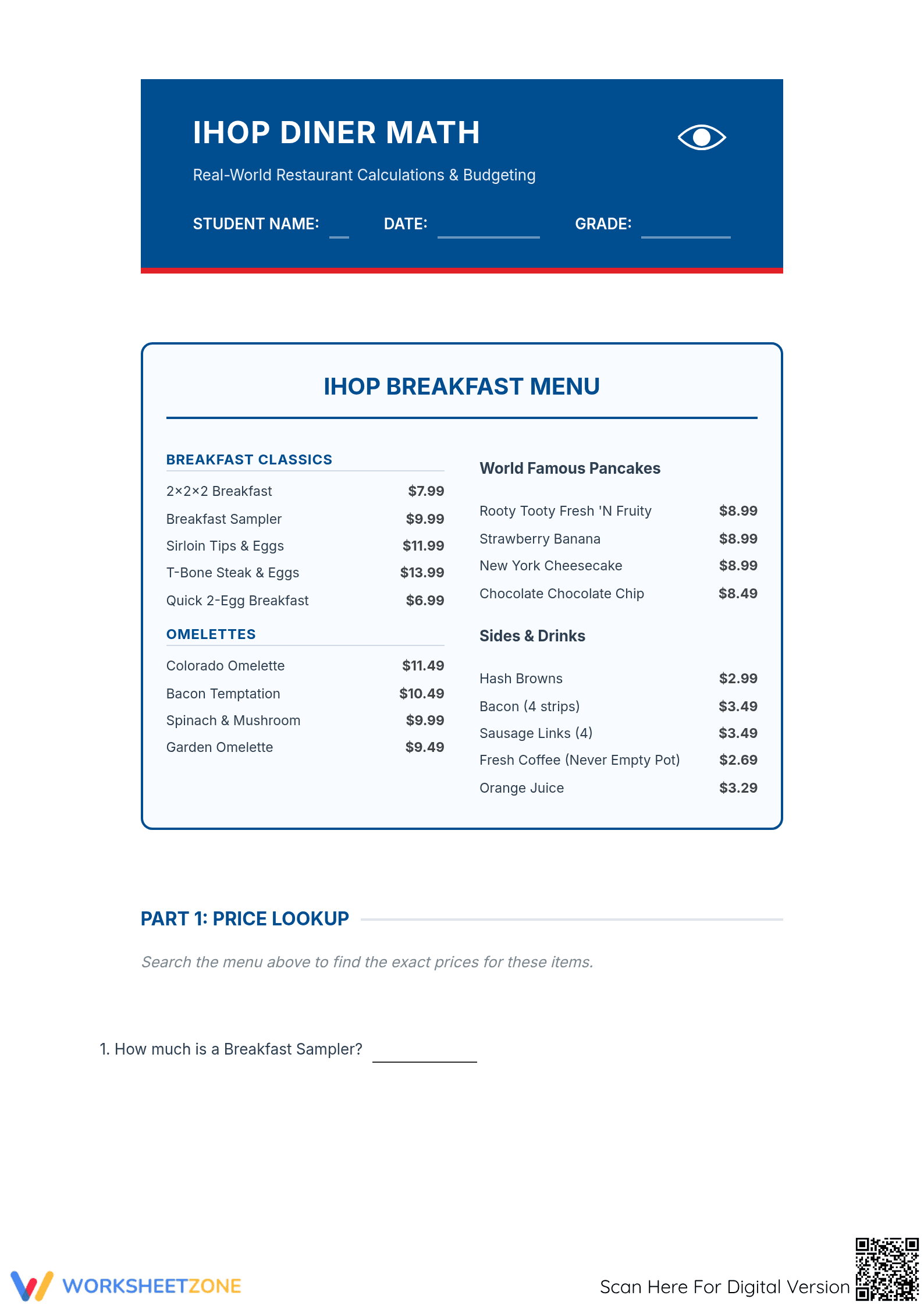
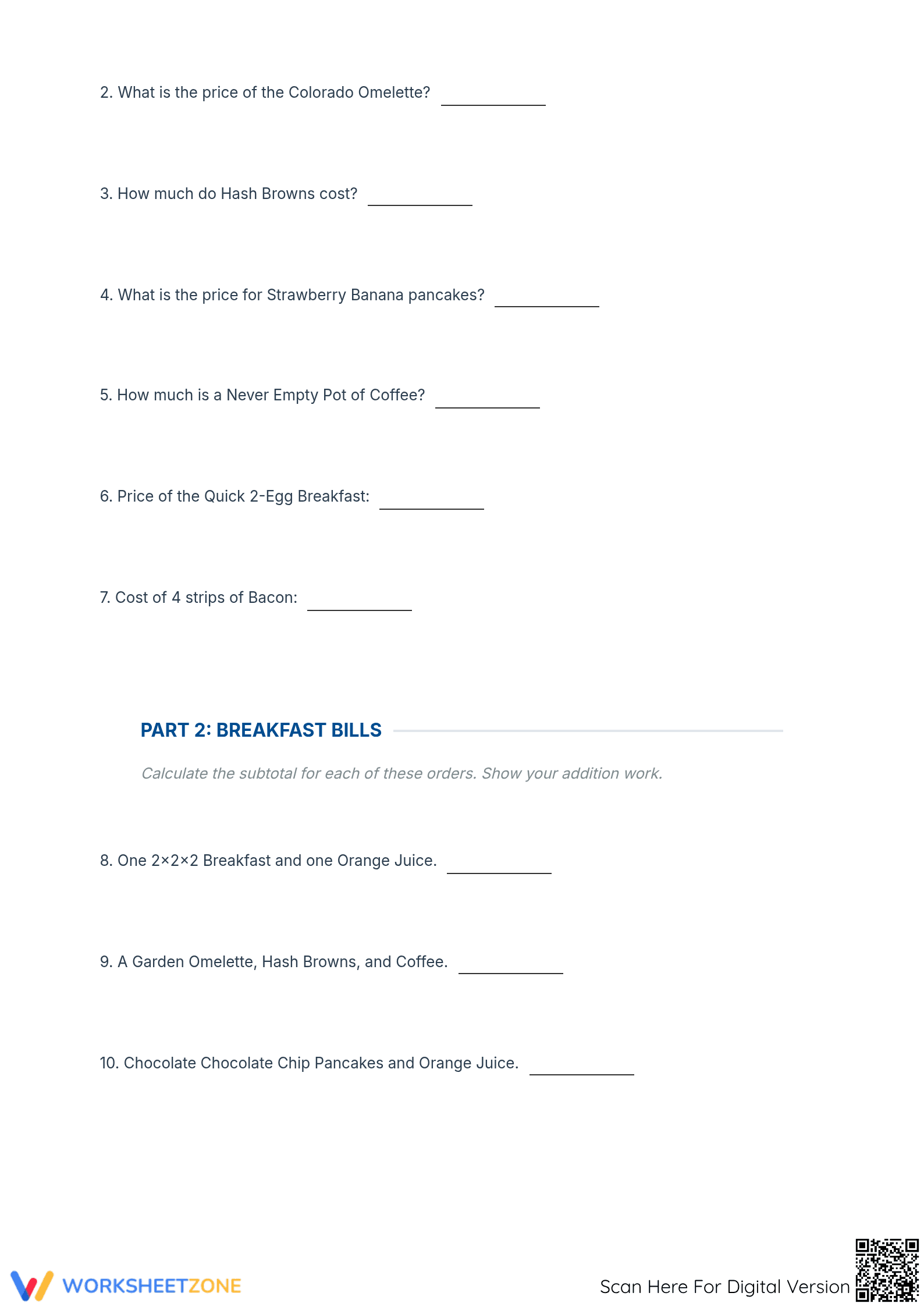
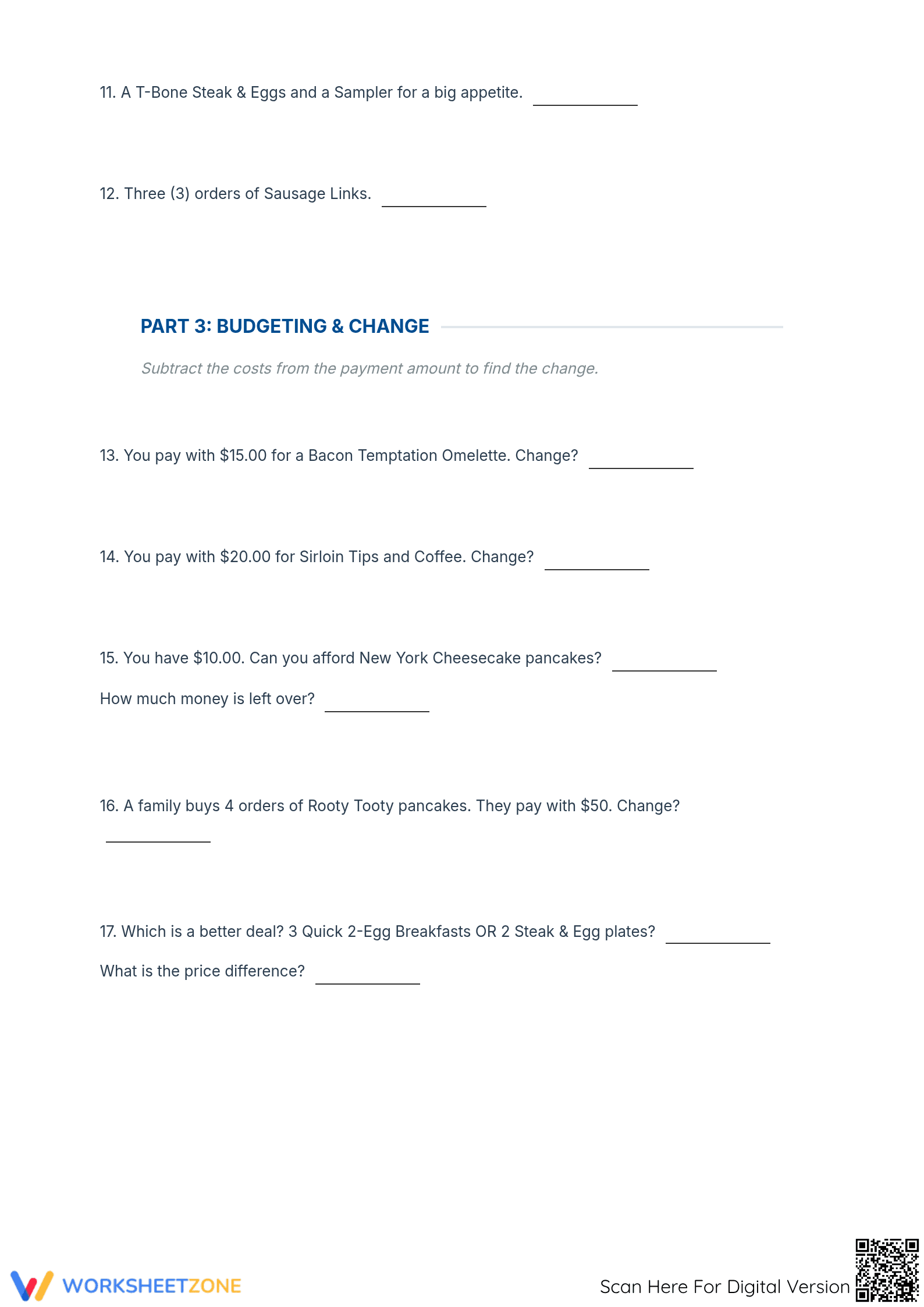
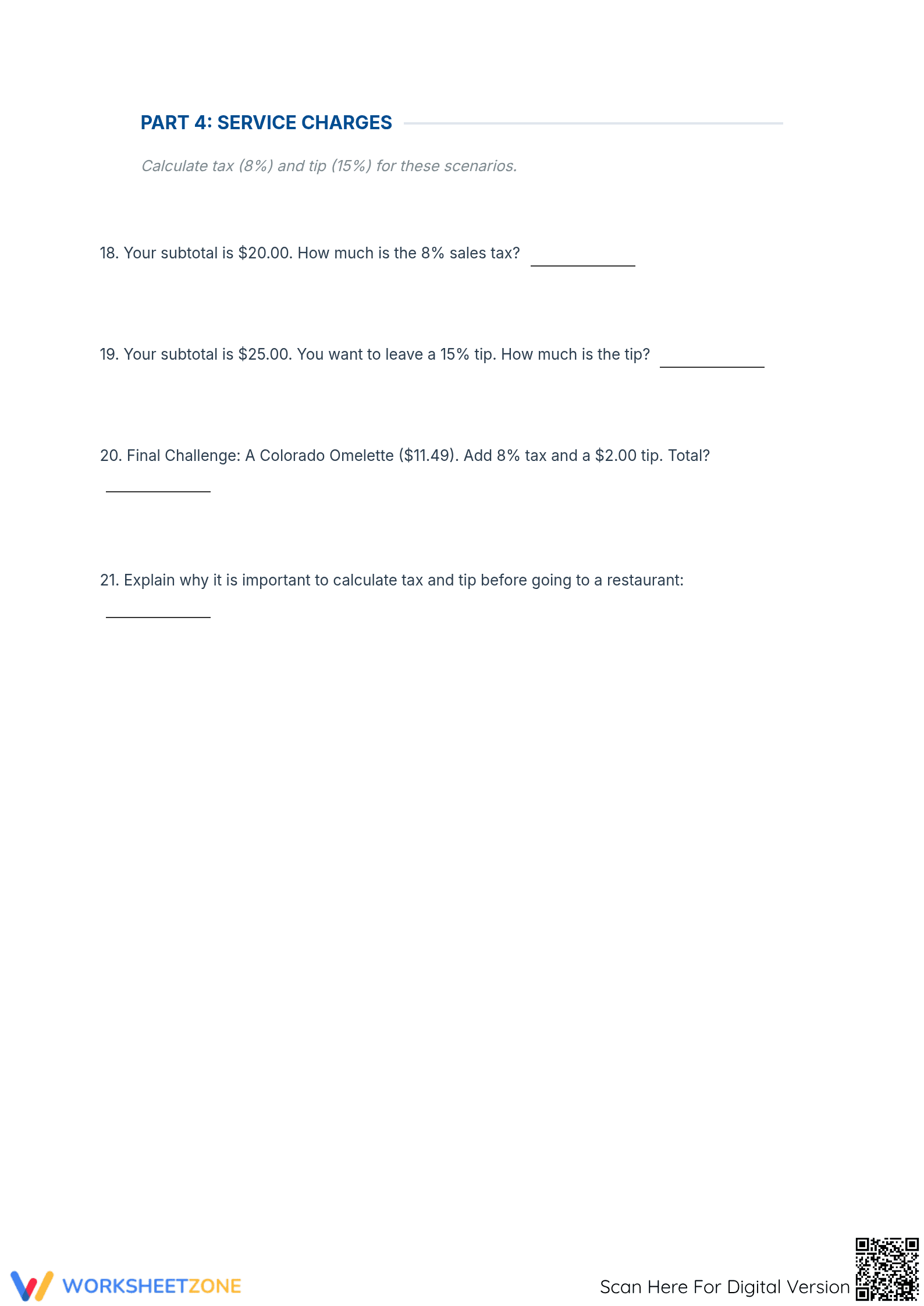

Grade 7 Menu Math — Printable No-Prep Worksheet
Paste this activity's link or code into your existing LMS (Google Classroom, Canvas, Teams, Schoology, Moodle, etc.).
Students can open and work on the activity right away, with no student login required.
You'll still be able to track student progress and results from your teacher account.
This worksheet offers essential practice for Grade 5-8 students in solving multi-step money problems. Using a realistic menu, students calculate the total cost for 12 meal orders, reinforcing decimal computation in a functional life skills context. This resource is ready to print and use immediately in your classroom.
At a Glance
- Grade: 5–8 · Subject: Math (Life Skills)
- Standard:
CCSS.MATH.CONTENT.7.EE.B.3— Solve multi-step, real-life problems with decimals using tools.- Skill Focus: Menu Math (Decimal Addition & Multiplication)
- Format: 4 pages · 12 problems · Answer key included · PDF
- Best For: Functional math practice, life skills class
- Time: 20–30 minutes
What's Inside
This resource includes a three-page worksheet and a one-page answer key. An easy-to-read IHOP menu is followed by 12 structured problems requiring students to find prices and calculate totals. The clean layout provides work space, and the answer key allows for quick, simple grading.
A True Time-Saver
Designed for the busy teacher, this worksheet is a genuine print-and-go resource.
- Print (1 minute): The entire four-page PDF is ready to print.
- Distribute (1 minute): The tasks are self-explanatory, requiring no complex instructions.
- Review (5 minutes): Use the clear, one-page answer key for whole-class review or student self-checking.
With minimal prep time, this worksheet is an efficient tool for focused practice and an ideal activity for a substitute teacher.
Standards-Aligned for Confidence
This worksheet directly aligns with CCSS Math standard CCSS.MATH.CONTENT.7.EE.B.3, where students "solve multi-step real-life...mathematical problems posed with...rational numbers...using tools strategically." Students practice this by interpreting menu data and calculating decimal totals. While targeting Grade 7, this skill applies to Grades 5-8. The standard code can be copied into lesson plans or IEP goals.
How to Use It
Use this resource as a formative assessment after a lesson on decimal operations to check understanding in a real-world context. For independent practice, it serves as excellent in-class work or homework. The 12 distinct problems allow you to observe student accuracy in finding data and calculating sums. Most students can complete it in 20-30 minutes.
Built for All Learners
This worksheet is primarily for middle schoolers (Grades 5-8) working on functional math and life skills. Its real-world scenario engages students who benefit from seeing practical applications of math. It's particularly effective in special education for building consumer math competency. Pair this with a lesson on calculating a tip for a simple extension.
Applying mathematical concepts to real-world scenarios is critical for student engagement and long-term retention. This "menu math" activity directly supports the instructional core of CCSS.MATH.CONTENT.7.EE.B.3, which emphasizes solving multi-step, real-life problems with rational numbers. Research from the RAND AIRS (2024) study highlights the positive impact of contextualized learning on student motivation and achievement in mathematics. By asking students to calculate the cost of a meal from an actual menu, this worksheet moves beyond abstract computation and builds functional, transferable skills necessary for independent living. The task requires students to locate relevant information, perform accurate decimal addition and multiplication, and arrive at a precise total. This sequence of cognitive tasks mirrors everyday consumer transactions, strengthens numerical proficiency in a meaningful way, and prepares students for financial literacy challenges they will face outside the classroom.


