


























Views
Downloads
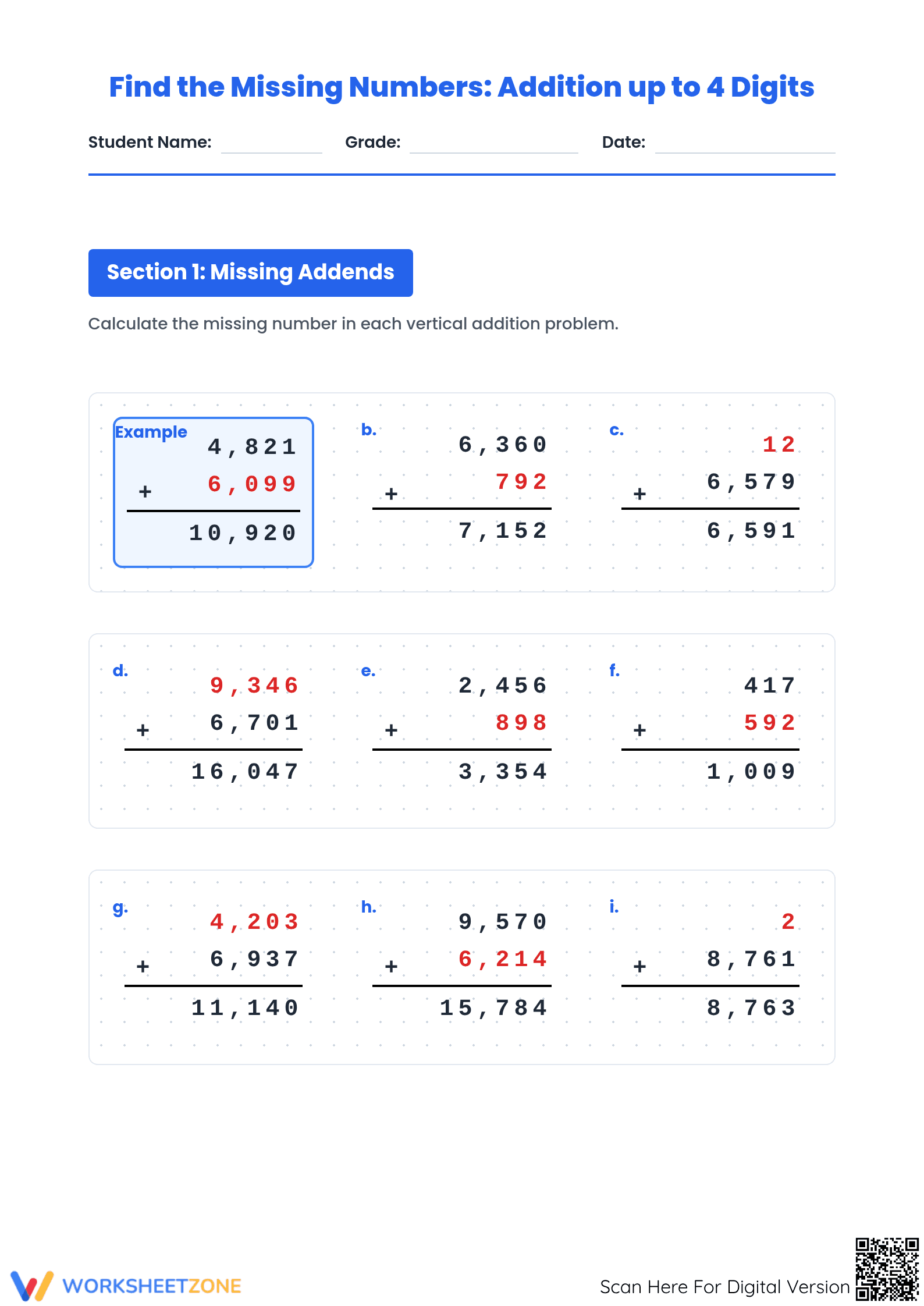
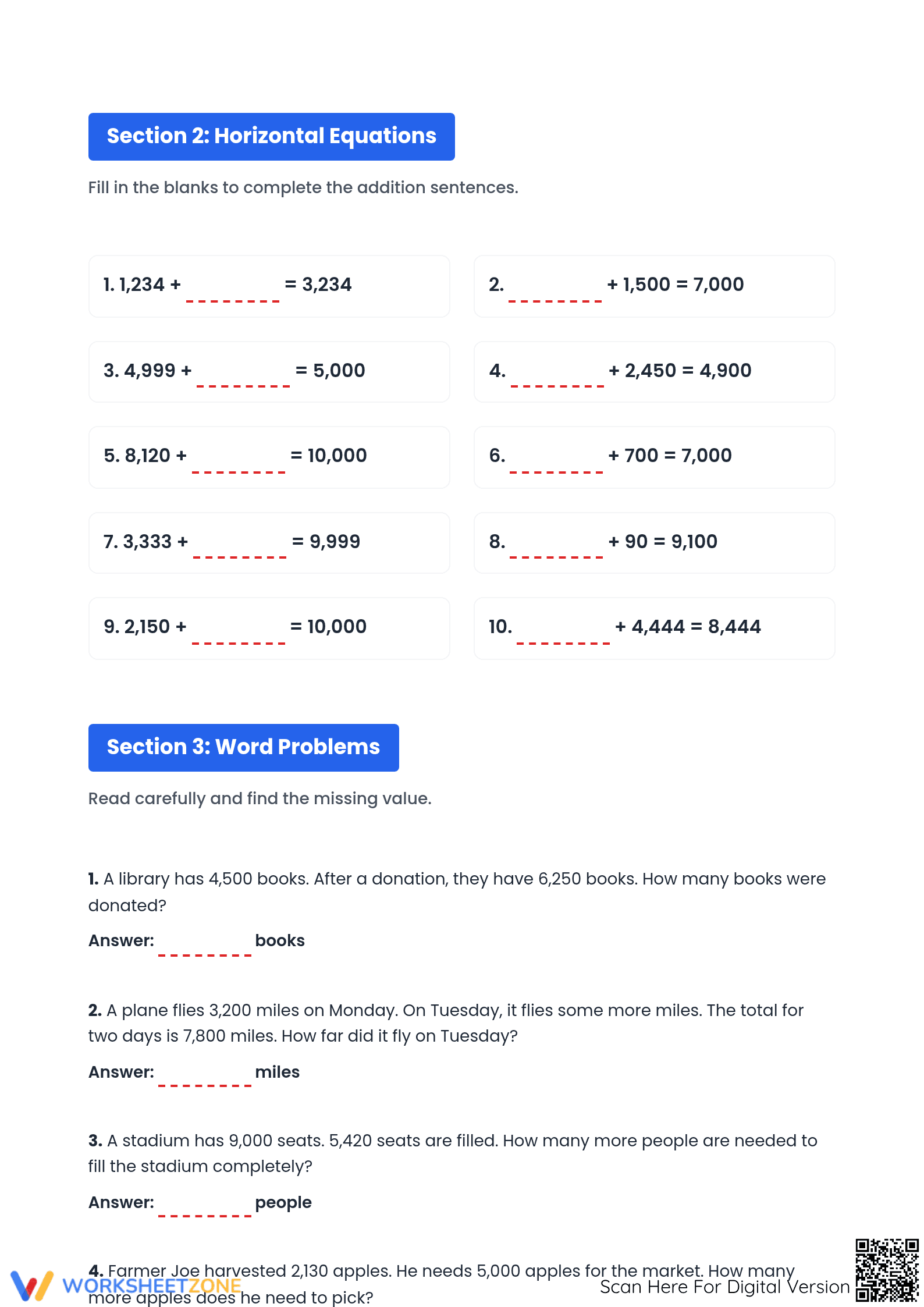


Grade 4 Missing Numbers — Printable No-Prep Worksheet
Paste this activity's link or code into your existing LMS (Google Classroom, Canvas, Teams, Schoology, Moodle, etc.).
Students can open and work on the activity right away, with no student login required.
You'll still be able to track student progress and results from your teacher account.
Mastering Missing Addends in Grade 4
This worksheet provides practice for Grade 4 students in solving for unknown numbers within 4-digit addition problems. Through 24 exercises, learners strengthen their understanding of number relationships and build fluency with multi-digit arithmetic, preparing them for more complex algebraic concepts.
At a Glance
- Grade: 4 · Subject: Math
- Standard:
CCSS.MATH.CONTENT.4.NBT.B.4— Fluently add and subtract multi-digit whole numbers using the standard algorithm.- Skill Focus: Finding missing addends in 4-digit addition sentences
- Format: 3 pages · 24 problems · Answer key included · PDF
- Best For: Independent practice, homework, or formative assessment
- Time: 15–25 minutes
What's Inside
This resource is a two-page printable worksheet with 24 unique problems where students find a missing 4-digit addend. A complete, one-page answer key is included for quick grading. The layout is clean and organized, ensuring students can focus on the calculations.
A Zero-Prep Workflow for Teachers
Designed for the busy classroom, this worksheet follows a simple three-step workflow that minimizes teacher effort.
- Print (1 min): The entire packet, including the two student pages and the answer key, can be printed in under a minute.
- Distribute (1 min): Hand out the two-page worksheet to students for immediate use. No additional materials are needed.
- Review (5 mins): Use the provided answer key to review answers with the class or for rapid individual grading.
With a total prep time under two minutes, it's an ideal choice for a math center, sub plan, or homework.
Standards Alignment
This worksheet is aligned with CCSS.MATH.CONTENT.4.NBT.B.4, where students "Fluently add and subtract multi-digit whole numbers using the standard algorithm." Students use subtraction to find the missing number, reinforcing the inverse relationship between operations. This supports foundational algebraic thinking. The standard code can be copied directly into lesson plans or curriculum maps.
How to Use It
Use this as independent practice after a lesson on multi-digit arithmetic. It's also an effective tool for formative assessment; a quick scan of completed worksheets reveals which students are struggling with the concept versus simple calculation errors. Expect students to take 15-25 minutes.
Who It's For
Designed for Grade 3-5 students working on multi-digit operations. For 4th graders, it's on-level practice. For 3rd graders, it can be an extension, while for 5th graders, it's a useful review or intervention tool. It pairs well with a part-part-whole anchor chart.
Procedural fluency with multi-digit operations is a critical predictor of success in algebra. This worksheet provides targeted practice aligned with CCSS.MATH.CONTENT.4.NBT.B.4, helping students master the standard algorithm for addition and subtraction. Research highlighted by the RAND AIRS (2024) report emphasizes the need for practice that builds both conceptual understanding and procedural skill. The 24 problems require students to apply the inverse relationship between addition and subtraction, a key concept for solving equations. By engaging with these tasks, students move beyond rote memorization to a more flexible understanding of how numbers work. This skill is foundational for meeting grade-level expectations and for developing the algebraic thinking necessary for middle school math and beyond, serving as a core component of a student's mathematical toolkit.


