


























Views
Downloads
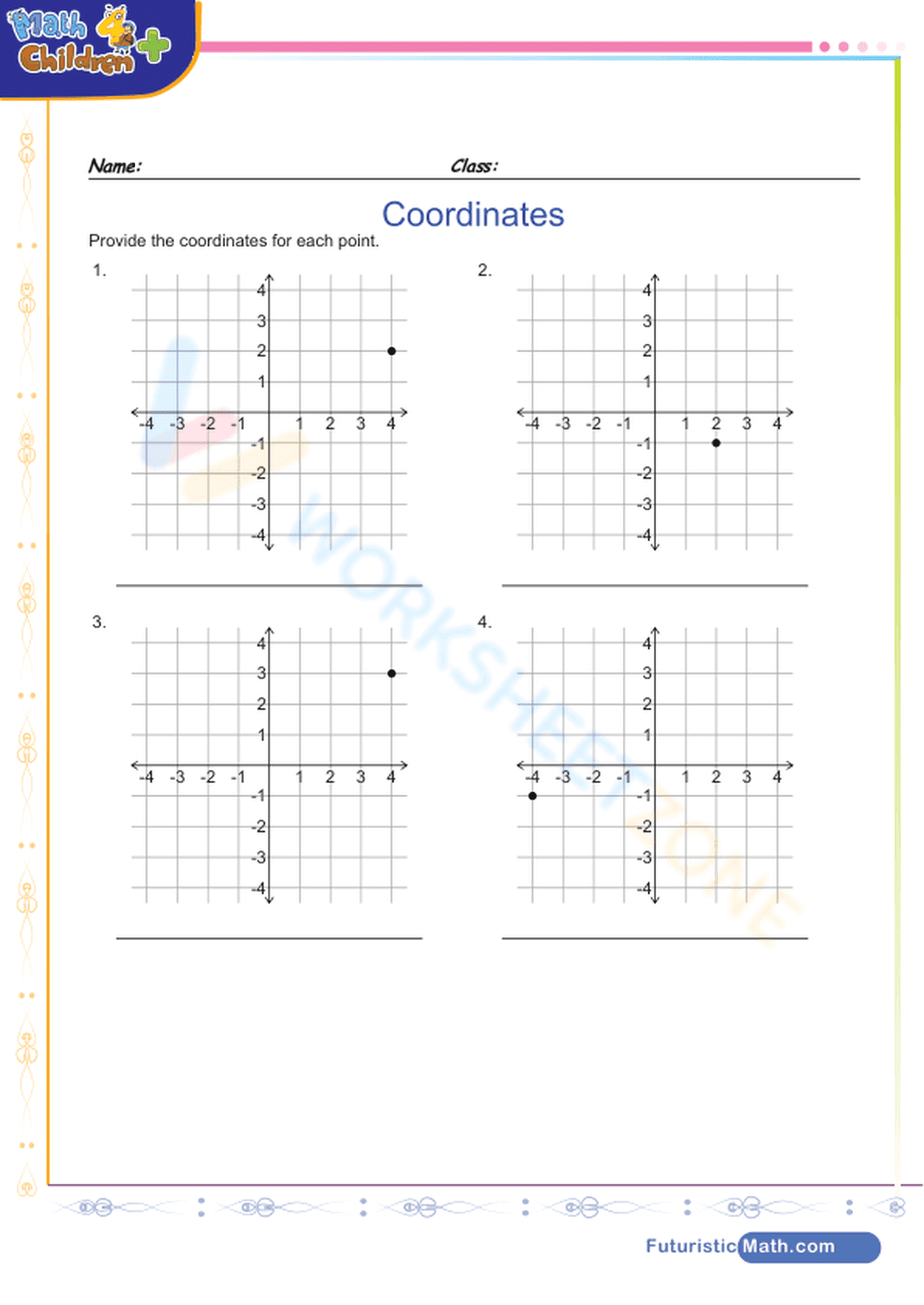


Grade 5 Coordinates — Printable No-Prep Worksheet
Paste this activity's link or code into your existing LMS (Google Classroom, Canvas, Teams, Schoology, Moodle, etc.).
Students can open and work on the activity right away, with no student login required.
You'll still be able to track student progress and results from your teacher account.
A Foundation in Geometry: Four-Quadrant Coordinate Practice
This ready-to-use worksheet provides focused practice for Grade 5 students on identifying coordinates in all four quadrants. Students will analyze four different points on a coordinate plane and write the correct ordered pairs. It's an essential resource for building foundational geometry skills and ensuring students can accurately locate points on a grid, preparing them for more advanced mathematical concepts.
At a Glance
- Grade: 5 · Subject: Math
- Standard:
CCSS.MATH.CONTENT.5.G.A.1— Graph points on the coordinate plane to solve problems.- Skill Focus: Identifying coordinates in four quadrants
- Format: 2 pages · 4 problems · Answer key included · PDF
- Best For: Independent practice or quick formative assessment
- Time: 5–10 minutes
What's Inside
This resource includes a single-page worksheet with four distinct problems. Each problem displays a point plotted on a four-quadrant coordinate grid. A separate, second page provides a complete answer key with the correct ordered pair for each problem, making review quick and easy for teachers or students. The clean layout minimizes distractions and focuses students on the core task.
Zero-Prep, Maximum Impact
Designed for the busy classroom, this worksheet can be deployed in under two minutes. Simply print the single page, distribute for independent work or an exit ticket, and review using the included key. Its straightforward design and clear instructions make it an ideal, self-contained resource for a substitute teacher plan or any time you need a standards-aligned activity without the setup time.
Standards-Aligned for Core Instruction
This worksheet is directly aligned with the Common Core State Standard for Grade 5 Geometry, providing essential practice for this critical skill:
CCSS.MATH.CONTENT.5.G.A.1: Use a pair of perpendicular number lines, called axes, to define a coordinate system, with the intersection of the lines (the origin) arranged to coincide with the 0 on each line and a given point in the plane located by using an ordered pair of numbers, called its coordinates.
Both the standard code and its description can be copied directly into lesson plans, IEP goals, or district curriculum mapping tools.
How to Use It
Use this versatile worksheet as a warm-up, short homework task, or an exit ticket after a lesson on plotting points. It’s a fast way to gauge student understanding. As a formative check, circulate and observe if students correctly identify the x-coordinate before the y-coordinate, a common early misconception. Most students will finish the four problems in 5 to 10 minutes, providing a quick, targeted data point on their progress.
Who It's For
Primarily for fifth-grade students, this sheet also serves as an excellent review for sixth graders who need to reinforce their understanding of the four-quadrant grid. The clear layout is accessible for most learners. For students needing support, pair it with a classroom anchor chart that labels the axes and quadrants. It’s a perfect independent task following a direct instruction lesson on coordinate graphing.
This worksheet offers targeted practice for CCSS.MATH.CONTENT.5.G.A.1, helping students master locating points with ordered pairs. This foundational skill is crucial for future success in algebra, data visualization, and higher-level mathematics. Procedural fluency is built through focused exercises like this one, which is essential for mathematical proficiency. By providing a clear and unambiguous task, this resource solidifies a student's understanding of how the x and y axes work together to define a unique location—a core concept for all future graphing applications.


