


























Views
Downloads




Find the Average Worksheet | Essential Grade 6-8 Math
Paste this activity's link or code into your existing LMS (Google Classroom, Canvas, Teams, Schoology, Moodle, etc.).
Students can open and work on the activity right away, with no student login required.
You'll still be able to track student progress and results from your teacher account.
This comprehensive math worksheet guides students through the complete process of finding the average, from foundational vocabulary to complex word problems. By engaging with 20 structured tasks, learners develop a deep conceptual understanding of the mean as a measure of center, ensuring they can apply these calculations in real-world contexts.
At a Glance
- Grade: 6 · Subject: Math
- Standard:
CCSS.MATH.CONTENT.6.SP.B.5.C— Summarize numerical data sets by giving quantitative measures of center like the mean- Skill Focus: Calculating averages and solving for unknowns
- Format: 5 pages · 20 problems · Answer key included · PDF
- Best For: Middle school math centers and homework
- Time: 30–45 minutes
What's Inside
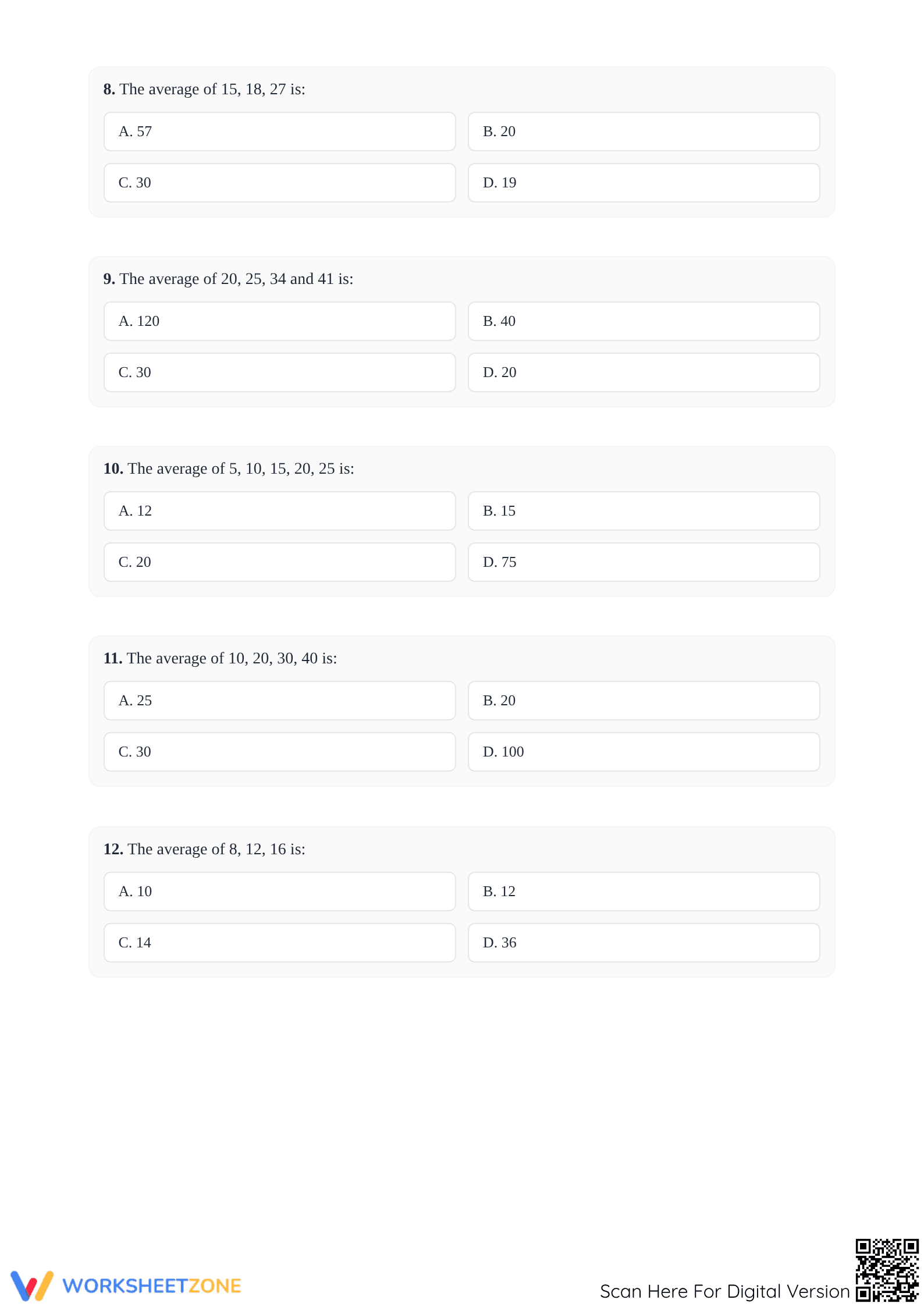
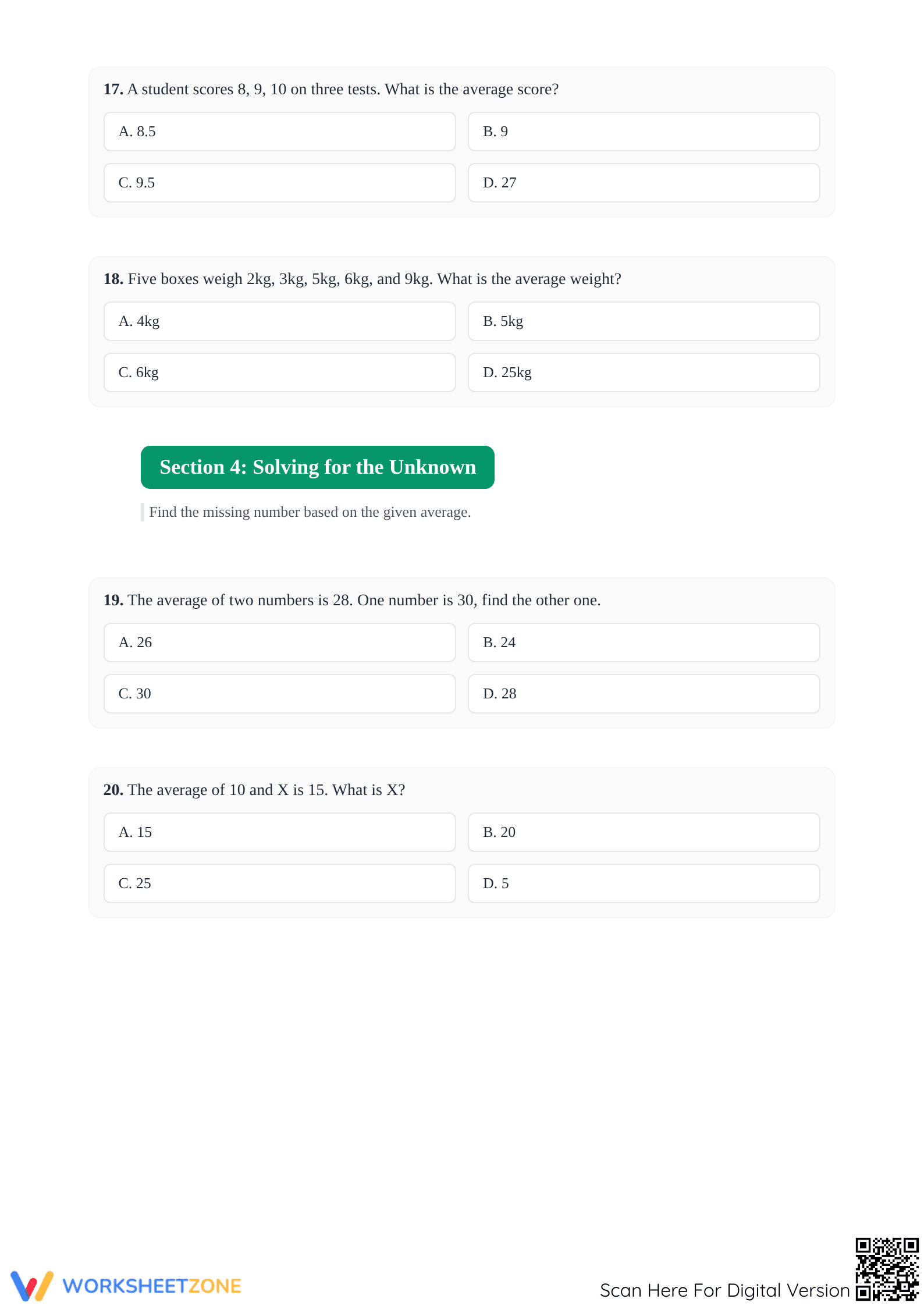
The 5-page PDF is organized into four distinct sections to scaffold learning. It begins with a vocabulary check to ensure students understand terms like "sum" and "mean," followed by 8 basic calculation problems. The third section features 5 real-world word problems involving speed, weight, and height, while the final section challenges students to solve for unknown values when the average is already provided. A full answer key is included for rapid grading.
Zero-Prep Workflow
- Print: Generate the 5-page packet in under 1 minute.
- Distribute: Hand out to students with zero additional setup or manipulatives required.
- Review: Use the provided answer key to grade or peer-review results in less than 5 minutes.
Its self-explanatory section headers make it an ideal candidate for emergency sub plans or independent study modules.
Standards Alignment
The primary focus is `CCSS.MATH.CONTENT.6.SP.B.5.C`, which requires students to summarize numerical data sets in relation to their context, specifically by giving quantitative measures of center. The worksheet also supports 5th-grade foundational skills and 7th-grade statistics review. Both standard codes can be copied directly into lesson plans, IEP goals, or district curriculum mapping tools.
How to Use It
Assign Section 1 and 2 during the "We Do" phase of direct instruction to check for initial comprehension. Use Sections 3 and 4 as a formative assessment at the end of the week to gauge mastery of application. Completion typically takes 30 to 45 minutes depending on the student's calculation speed. Teachers should observe if students are correctly summing all values before dividing by the count.
Who It's For
This resource is tailored for Grade 6 students but serves as an excellent extension for Grade 5 or a necessary intervention for Grade 7 and 8 learners. It pairs naturally with a data sets anchor chart or a direct instruction lesson on measures of central tendency.
According to Fisher & Frey (2014), the gradual release of responsibility is most effective when students move from scaffolded vocabulary and basic computation to independent problem-solving in varied contexts. This worksheet mirrors that research-backed progression by transitioning from simple sets of numbers to multi-step word problems and algebraic thinking. By requiring students to calculate the mean (CCSS.MATH.CONTENT.6.SP.B.5.C) across 20 distinct tasks, the resource provides the high-repetition practice necessary for long-term retention. The inclusion of "solving for the unknown" tasks ensures that students are not merely performing rote arithmetic but are instead developing a flexible understanding of how averages function as mathematical balances. This alignment with evidence-based instructional design makes it a reliable tool for achieving measurable growth in middle school statistics and probability domains.


