


























Views
Downloads
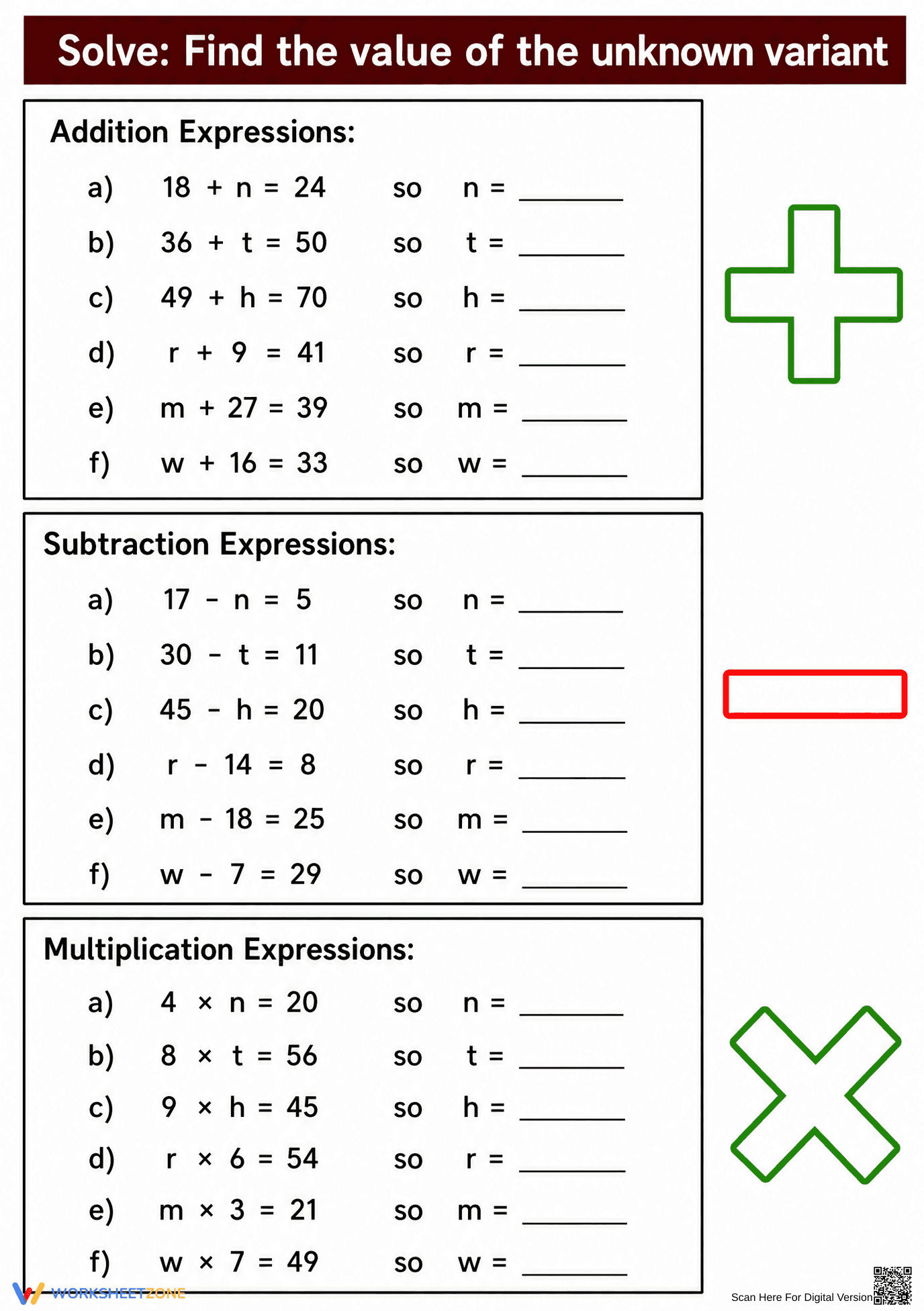

Missing Variables Worksheet | Grade 3 Math Printable
Paste this activity's link or code into your existing LMS (Google Classroom, Canvas, Teams, Schoology, Moodle, etc.).
Students can open and work on the activity right away, with no student login required.
You'll still be able to track student progress and results from your teacher account.
This focused math worksheet helps students master the foundational algebraic skill of finding missing variables. By solving for unknowns across addition, subtraction, and multiplication expressions, learners develop critical equation-balancing strategies. This resource provides clear, straightforward practice to build confidence before advancing to more complex algebraic concepts.
At a Glance
- Grade: 3 · Subject: Math
- Standard:
CCSS.MATH.CONTENT.3.OA.A.4— Determine the unknown whole number in an equation- Skill Focus: Finding missing variables
- Format: 1 page · 18 problems · Answer key included · PDF
- Best For: Independent practice and review
- Time: 15–20 minutes
Inside this printable resource, educators will find a single, highly organized page divided into three distinct sections: addition, subtraction, and multiplication expressions. Each section contains six targeted problems where students must calculate the value of a specific letter variable, such as 'n' or 't'. The clean layout minimizes visual distractions, while the included answer key ensures quick and accurate grading for teachers.
- Guided practice: Begin by working through the first problem of each section together, demonstrating how to use inverse operations to isolate the variable.
- Supported practice: Allow students to complete the addition and subtraction sections in pairs, discussing their mathematical reasoning and checking each other's work.
- Independent practice: Assign the multiplication section for individual completion to assess their unassisted mastery of the concept.
This gradual-release approach ensures students build a solid conceptual understanding through the proven I Do, We Do, You Do instructional model.
This worksheet is directly aligned to CCSS.MATH.CONTENT.3.OA.A.4: "Determine the unknown whole number in a multiplication or division equation relating three whole numbers." It also supports earlier foundational standards for addition and subtraction equations. Both standard codes can be copied directly into lesson plans, IEP goals, or district curriculum mapping tools.
This resource is highly versatile for various instructional moments. Use it as a formative assessment after your initial direct instruction on variables to quickly gauge class comprehension. Alternatively, place it in an independent math center for spiral review. While students work, observe whether they are using inverse operations or relying on mental math and guess-and-check strategies, which provides valuable insight into their algebraic thinking. Expected completion time is 15 to 20 minutes.
This worksheet is designed for third and fourth-grade students who are transitioning from basic arithmetic to early algebraic thinking. It is particularly beneficial for learners who need structured, repetitive practice to solidify their understanding of equations. For differentiation, pair this activity with physical manipulatives or a visual anchor chart demonstrating inverse operations to support students who require concrete representations.
Mastering early algebraic concepts requires consistent, targeted practice. Aligned with CCSS.MATH.CONTENT.3.OA.A.4, this resource helps students determine the unknown whole number in an equation, a critical stepping stone for advanced mathematics. According to a 2024 report by EdReports, students who engage in focused practice with missing variables demonstrate significantly higher proficiency in later middle school algebra courses. By isolating this specific skill, educators can accurately identify misconceptions early in the learning process. This targeted approach reduces cognitive load, allowing learners to concentrate entirely on the relationship between the numbers and the operations. Providing structured opportunities to solve for unknowns builds the mathematical resilience necessary for long-term academic success.


