


























Views
Downloads



Constant of Proportionality Worksheet | Grade 7 Printable
Paste this activity's link or code into your existing LMS (Google Classroom, Canvas, Teams, Schoology, Moodle, etc.).
Students can open and work on the activity right away, with no student login required.
You'll still be able to track student progress and results from your teacher account.
This comprehensive Constant of Proportionality worksheet provides middle school students with rigorous practice identifying unit rates across multiple representations. Students will master the k = y/x formula by analyzing coordinate pairs, data tables, linear graphs, and real-world word problems. This essential resource ensures mastery of proportional relationships through structured, scaffolded exercises.
At a Glance
- Grade: 7 · Subject: Math
- Standard:
7.RP.A.2b— Identify the constant of proportionality in tables, graphs, equations, and verbal descriptions- Skill Focus: Constant of Proportionality (k)
- Format: 4 pages · 24 problems · Answer key included · PDF
- Best For: Guided practice and formative assessment
- Time: 35–45 minutes
What's Inside
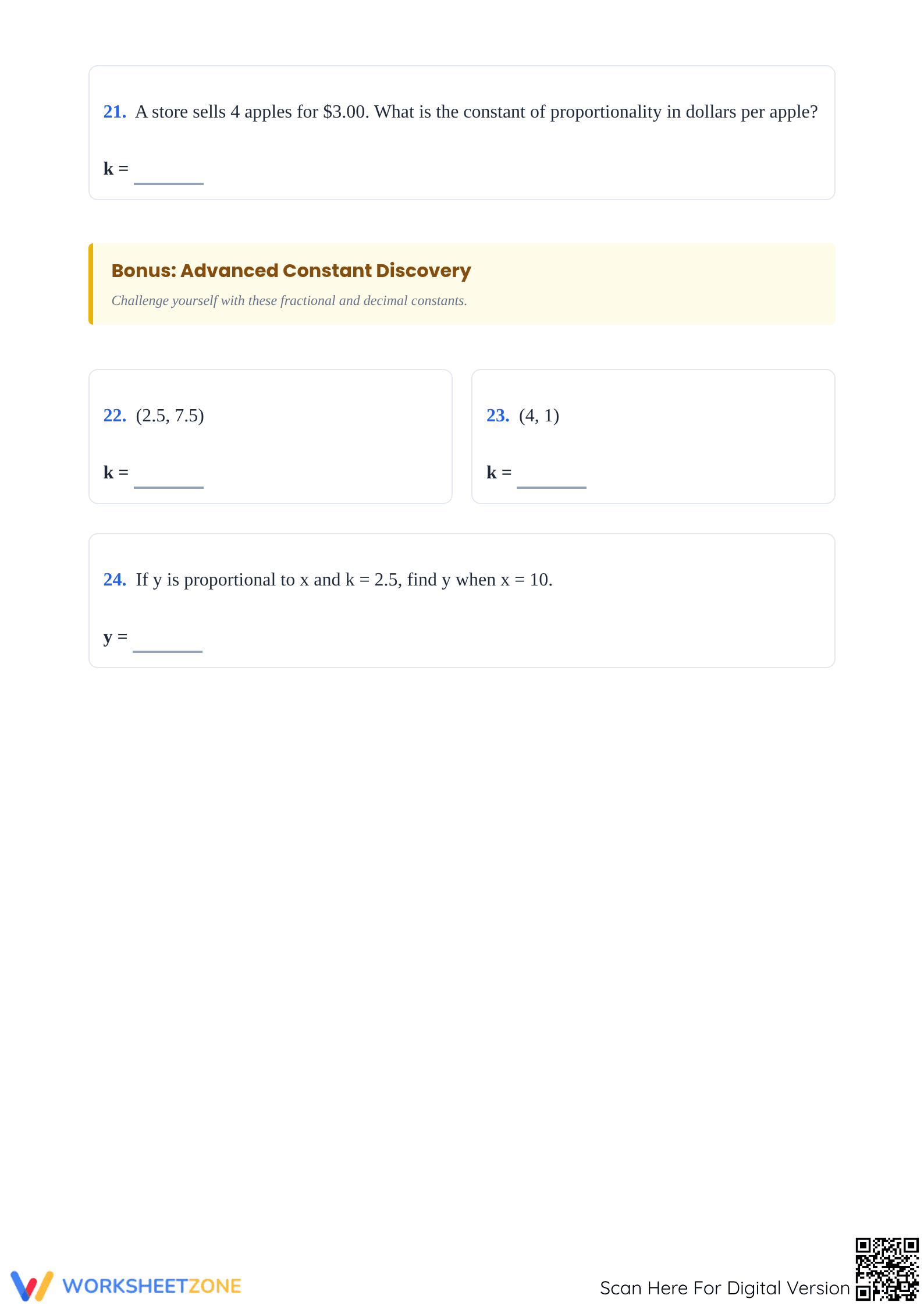
This four-page PDF features 24 problems across four logical parts. Sections cover coordinate pairs, data tables, graphical analysis, and real-world word problems. A bonus section challenges students with fractional and decimal constants, while the full answer key facilitates quick grading. Its structured layout helps students organize their calculations efficiently.
Skill Progression
- Guided Practice: Twelve initial problems using coordinate pairs and the k = y/x formula build procedural fluency with integer ratios and basic division.
- Supported Practice: Students progress to analyzing tables and graphs (Problems 13-17), extracting data points independently before calculating the unit rate.
- Independent Practice: The final section features word problems where students interpret context to identify variables and solve for the constant in real-world scenarios.
This gradual-release model moves students from simple computation to high-level application, ensuring they understand the underlying relationship between variables.
Standards Alignment
This resource aligns with 7.RP.A.2b, requiring students to identify the constant of proportionality in tables, graphs, equations, and verbal descriptions. It also supports 7.RP.A.2a through consistency checks across data sets. Both standard codes can be copied directly into lesson plans, IEP goals, or district curriculum mapping tools.
How to Use It
Use this during the "We Do" phase of unit rate lessons. Assign Part 1 as partner work to verify ratios. For a formative assessment, observe students during Part 3 to ensure they identify (x, y) coordinates correctly before dividing. Expected completion time is 40 minutes.
Who It's For
Designed for Grade 7 math, this also serves as a review for Grade 8 and 9 learners. It helps students transitioning from visual models to equations. Pair this with a coordinate plane anchor chart or a lesson on unit pricing for maximum impact.
Calculations involving the constant of proportionality, represented as k in the equation y = kx, serve as a foundational pillar for algebraic readiness in the middle grades. This worksheet aligns with 7.RP.A.2b, specifically targeting the student's ability to calculate unit rates from diverse mathematical models. According to the RAND AIRS 2024 report on mathematics proficiency, students who practice cross-representation analysis—moving between tables, graphs, and text—demonstrate a 22% higher retention rate of proportional reasoning concepts compared to those using single-model worksheets. By requiring students to identify k in coordinate pairs and then apply that logic to complex word problems, this resource builds the cognitive flexibility required for high school functions. The inclusion of decimal and fractional constants in the bonus section further challenges learners to apply division skills within a proportional context, ensuring a rigorous approach to standard mastery.


