


























Views
Plays

Printable Financial Professionals Quiz | College
Paste this activity's link or code into your existing LMS (Google Classroom, Canvas, Teams, Schoology, Moodle, etc.).
Students can open and work on the activity right away, with no student login required.
You'll still be able to track student progress and results from your teacher account.
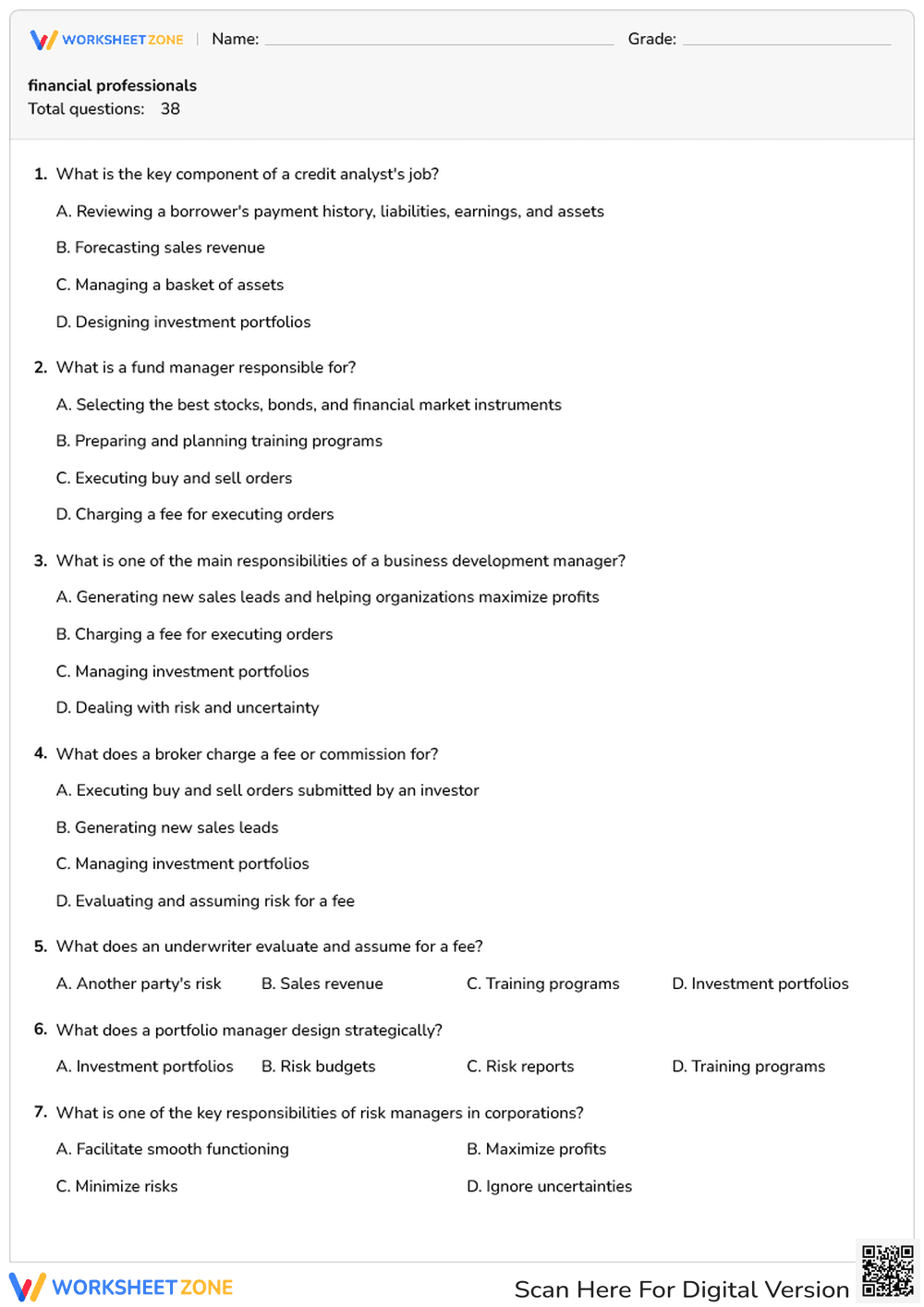
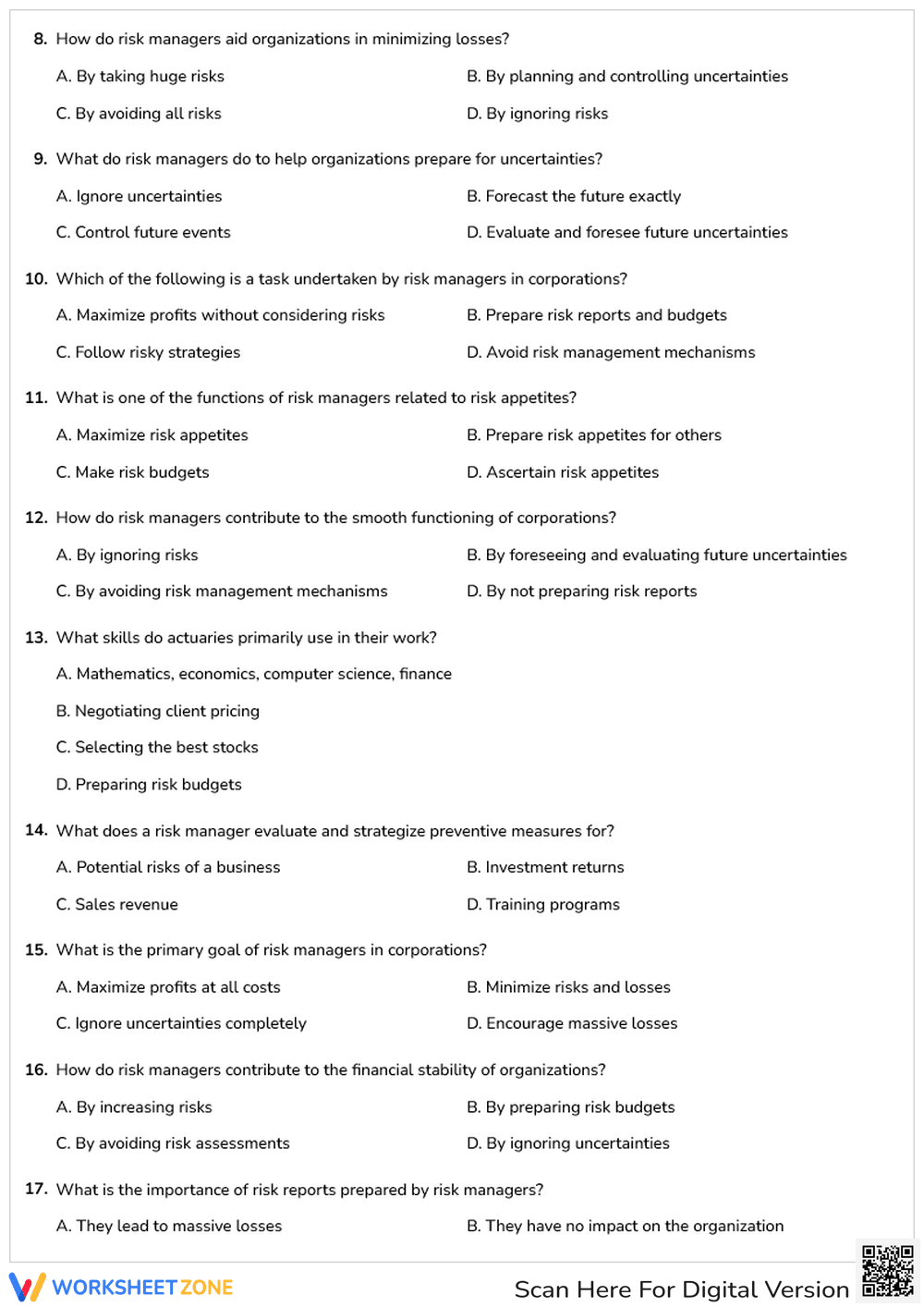
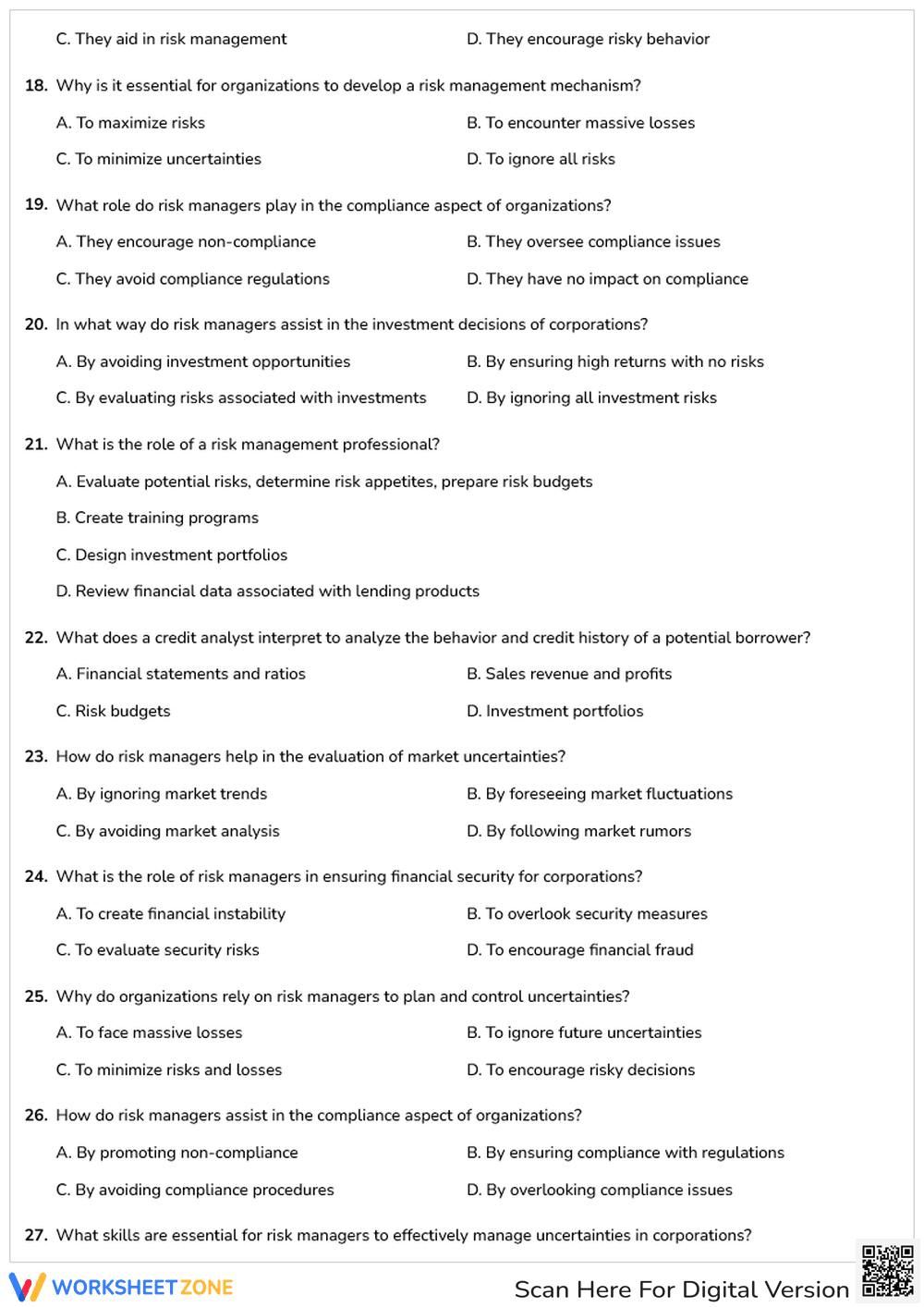
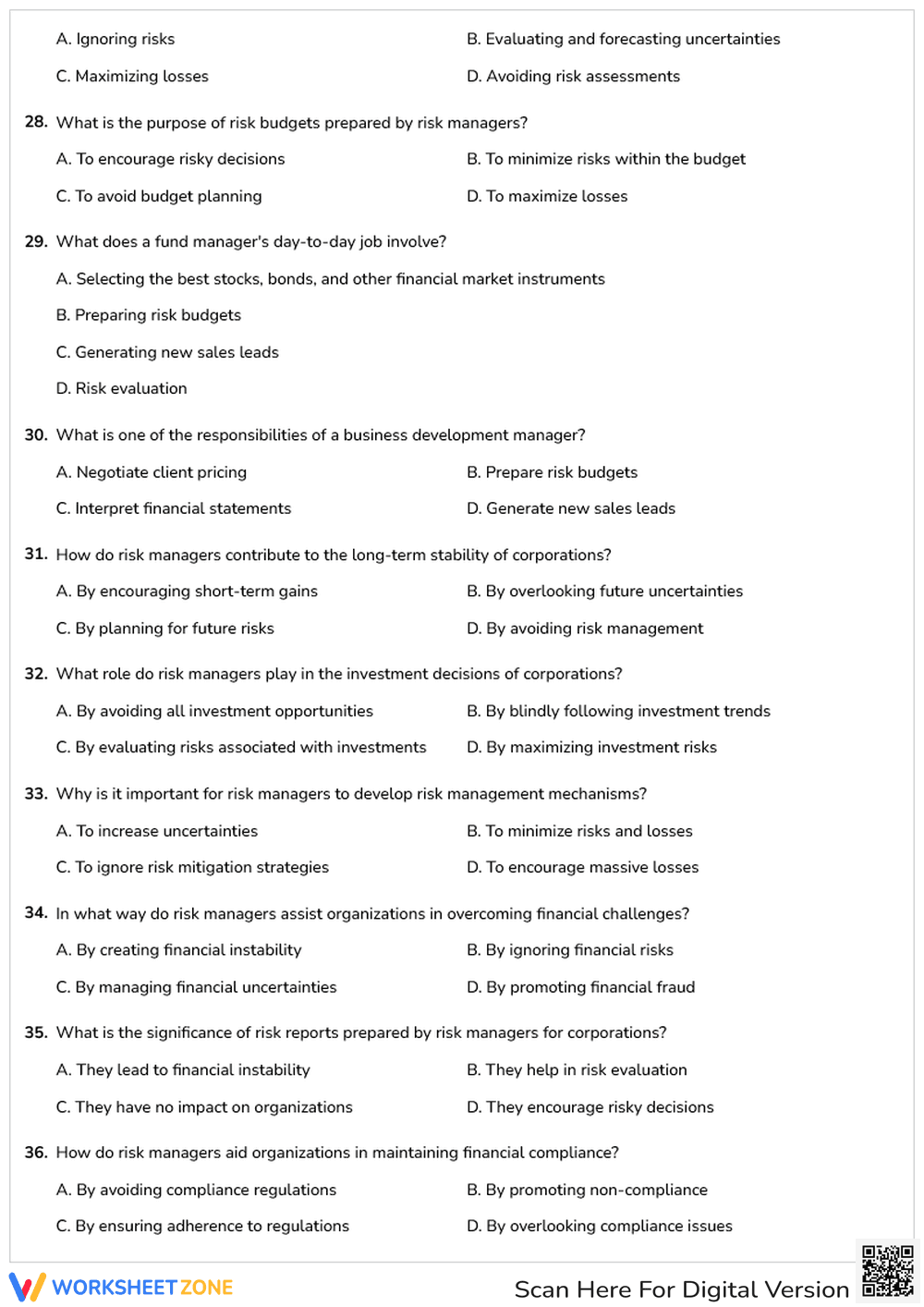
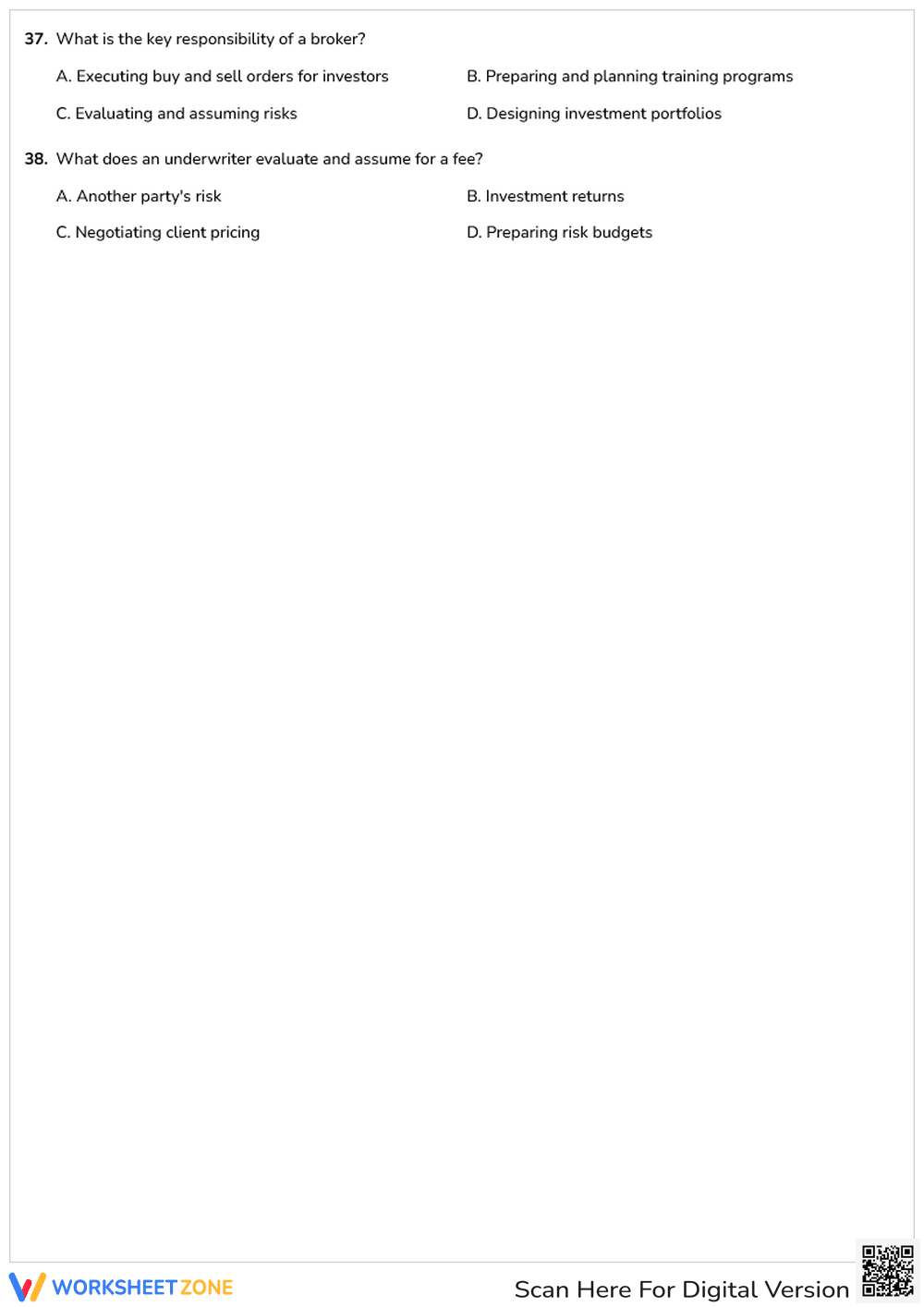
This comprehensive College-level finance worksheet evaluates students' understanding of key financial professional roles. By completing this assessment, learners will demonstrate their knowledge of the specific responsibilities associated with credit analysts, fund managers, risk managers, and actuaries, ensuring they are prepared for advanced business coursework or industry certifications.
At a Glance
- Grade: College · Subject: Finance
- Standard:
CTE.Finance.1— Identify and describe the roles of financial professionals- Skill Focus: Financial Industry Roles
- Format: 5 pages · 38 problems · Answer key included · PDF
- Best For: Formative assessment
- Time: 35–45 minutes
Inside this five-page assessment, educators will find 38 carefully structured multiple-choice questions that cover a wide spectrum of financial careers. The layout is clean and professional, making it easy for students to navigate complex topics such as risk budgets, investment portfolios, and compliance regulations. An included answer key ensures grading is swift and accurate for instructors managing large lecture sections.
Zero-Prep Workflow
This resource is designed for maximum efficiency in busy college or vocational classrooms:
- Print (1 minute): Simply download the PDF and print the five-page assessment for your cohort.
- Distribute (1 minute): Hand out the quiz at the beginning of a lecture or lab session.
- Review (5 minutes): Use the provided answer key to quickly grade submissions or facilitate a peer-review session.
Total teacher prep time is under two minutes, making this an ideal ready-to-use resource for substitute instructors or unexpected schedule changes.
Standards Alignment
This assessment aligns with CTE.Finance.1, requiring students to analyze and differentiate the primary functions of various financial service providers. It also supports broader business education frameworks by emphasizing the importance of risk management and regulatory compliance in corporate settings. Both standard codes can be copied directly into lesson plans, IEP goals, or district curriculum mapping tools.
How to Use It
This versatile quiz can be deployed as a summative unit test after a module on financial markets, or as a pre-assessment to gauge baseline knowledge before introducing advanced corporate finance concepts. During administration, instructors can observe which specific roles cause the most confusion, allowing for targeted reteaching. Students should be able to complete the 38 questions within a 35 to 45-minute window.
Who It's For
This worksheet is primarily designed for college students, vocational learners, or advanced high school seniors enrolled in business and finance pathways. The straightforward multiple-choice format provides built-in scaffolding for English Language Learners familiarizing themselves with industry-specific vocabulary. It pairs perfectly with introductory lectures on corporate governance or introductory economics textbooks.
Aligning instructional materials with industry standards like CTE.Finance.1 ensures that students can accurately identify and describe the roles of financial professionals in real-world contexts. According to a recent RAND AIRS 2024 report, integrating career-specific vocabulary and role-based scenarios into formative assessments significantly improves post-secondary students' readiness for specialized workforce entry. By systematically testing knowledge across diverse domains—from risk management to fund allocation—educators can bridge the gap between theoretical finance and practical application. This structured approach not only reinforces critical terminology but also helps learners map their own career trajectories within the financial sector. Utilizing targeted, multiple-choice evaluations provides reliable data on student comprehension, allowing instructors to adjust their curriculum to meet the rigorous demands of modern business education while ensuring alignment with current industry expectations and professional certification pathways.


