


























Views
Downloads


L.6.1 Worksheet: Possessive Pronouns — Grade 6 Aligned
Paste this activity's link or code into your existing LMS (Google Classroom, Canvas, Teams, Schoology, Moodle, etc.).
Students can open and work on the activity right away, with no student login required.
You'll still be able to track student progress and results from your teacher account.
This comprehensive Grade 6 English Language Arts final exam worksheet evaluates student mastery of essential grammar conventions, specifically focusing on possessive pronouns, demonstratives, and modal verbs. Designed as a summative assessment, it provides clear evidence of student proficiency in standard English usage. Students will demonstrate their ability to select correct pronoun cases and verbal structures across 24 structured problems.
At a Glance
- Grade: 6 · Subject: English Language Arts
- Standard:
L.6.1— Demonstrate command of standard English grammar and usage when writing or speaking.- Skill Focus: Possessive Pronouns & Grammar
- Format: 2 pages · 24 problems · Answer key included · PDF
- Best For: End-of-term summative assessment
- Time: 40–50 minutes
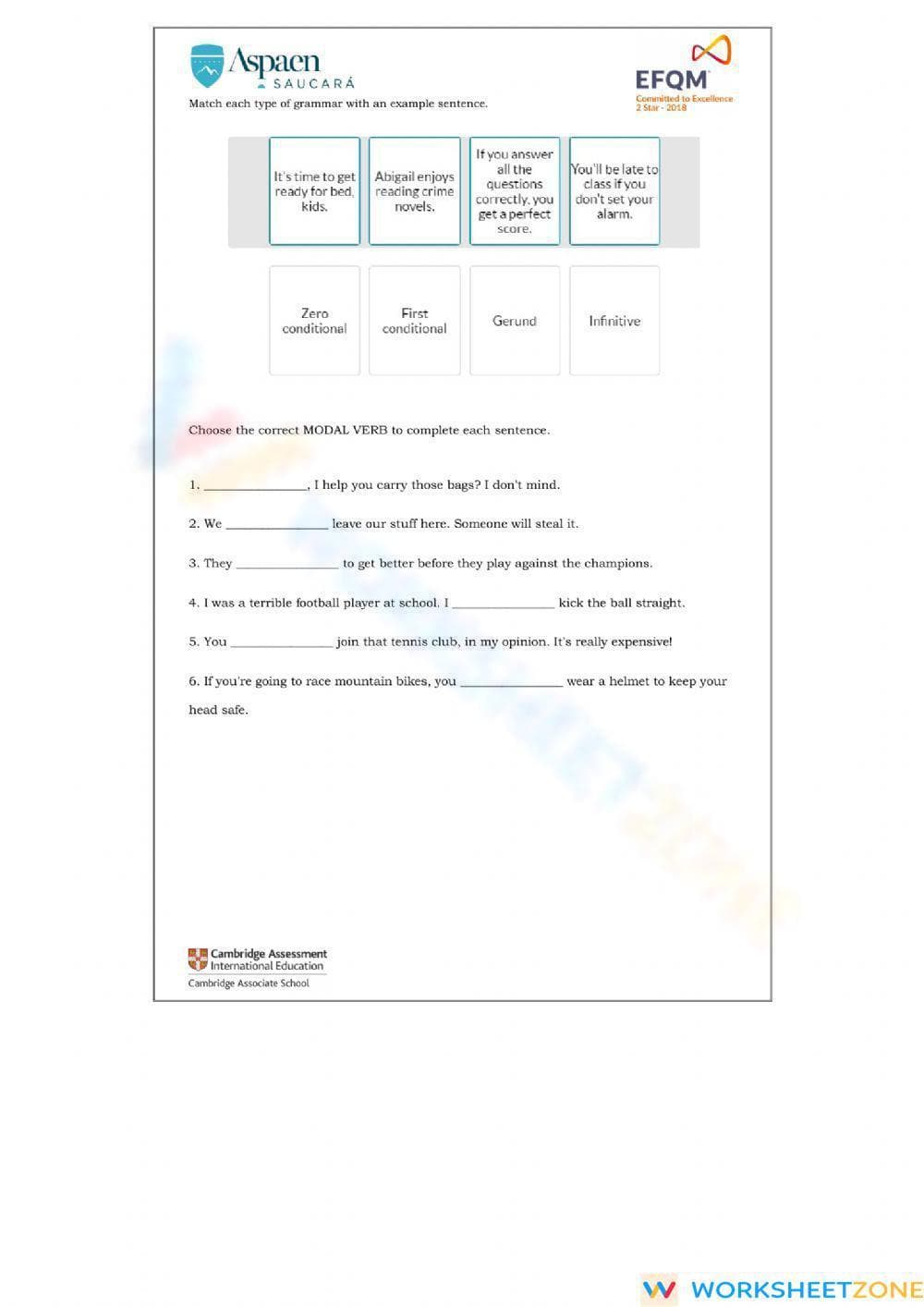
Across two professionally formatted pages, this exam features four distinct sections challenging students' linguistic precision. It begins with demonstrative pronoun selection (this, that, those, these), then transitions into an 8-item set on possessive pronoun forms. The second page increases cognitive demand with a grammar matching task covering conditionals and verbals, followed by a final section on modal verb application. A full answer key ensures rapid and accurate grading.
This assessment is structured to provide clear evidence of mastery across multiple linguistic domains. Tasks are mapped to specific sub-skills of the L.6.1 standard, enabling teachers to pinpoint student proficiency levels. Its progression from simple pronoun identification to complex conditional matching serves as a diagnostic tool. Educators can easily translate scores into gradebooks or use data to inform IEP progress notes for targeted grammar intervention.
Aligned to `CCSS.ELA-LITERACY.L.6.1`, this worksheet requires students to ensure pronouns are in the proper case and demonstrate command of standard English conventions. By evaluating both possessive pronouns and verbals (gerunds/infinitives), the assessment offers a holistic view of syntactic development. Both standard codes can be copied directly into lesson plans, IEP goals, or curriculum mapping tools.
Best utilized as a summative end-of-term exam, this resource also serves as a high-stakes review before district-wide testing. Teachers should observe performance on the possessive pronoun section, as errors often indicate a need for focused scaffolding on pronoun-antecedent agreement. Expect a standard completion time of 45 minutes, ideal for a single class period.
Primarily for Grade 6 students, this worksheet is also relevant for Grade 7 and 8 learners needing a refresher on foundational grammar. It pairs excellently with direct instruction lessons on pronoun cases or as a diagnostic for incoming middle schoolers. The structured layout supports differentiated review for English Language Learners (ELL) benefiting from clear sentence frames.
According to RAND AIRS 2024 analysis, structured summative assessments in grammar are critical for identifying linguistic gaps in middle school students. This worksheet aligns with L.6.1 by focusing on precise application of possessive pronouns and modal verbs, high-leverage skills in academic writing. Fisher & Frey (2014) research emphasizes multi-faceted assessments ensure students transition from guided practice to independent mastery. Requiring students to navigate 24 distinct tasks from fill-in-the-blanks to complex grammar matching, this resource provides necessary breadth for reliable assessment. The inclusion of an answer key and standard-aligned tasks makes it a robust tool for evidence-based grading and instructional planning in any Grade 6-8 ELA classroom.


