


























Views
Downloads

Filter It! Essential Grade 4 Science Mixture Worksheet
Paste this activity's link or code into your existing LMS (Google Classroom, Canvas, Teams, Schoology, Moodle, etc.).
Students can open and work on the activity right away, with no student login required.
You'll still be able to track student progress and results from your teacher account.
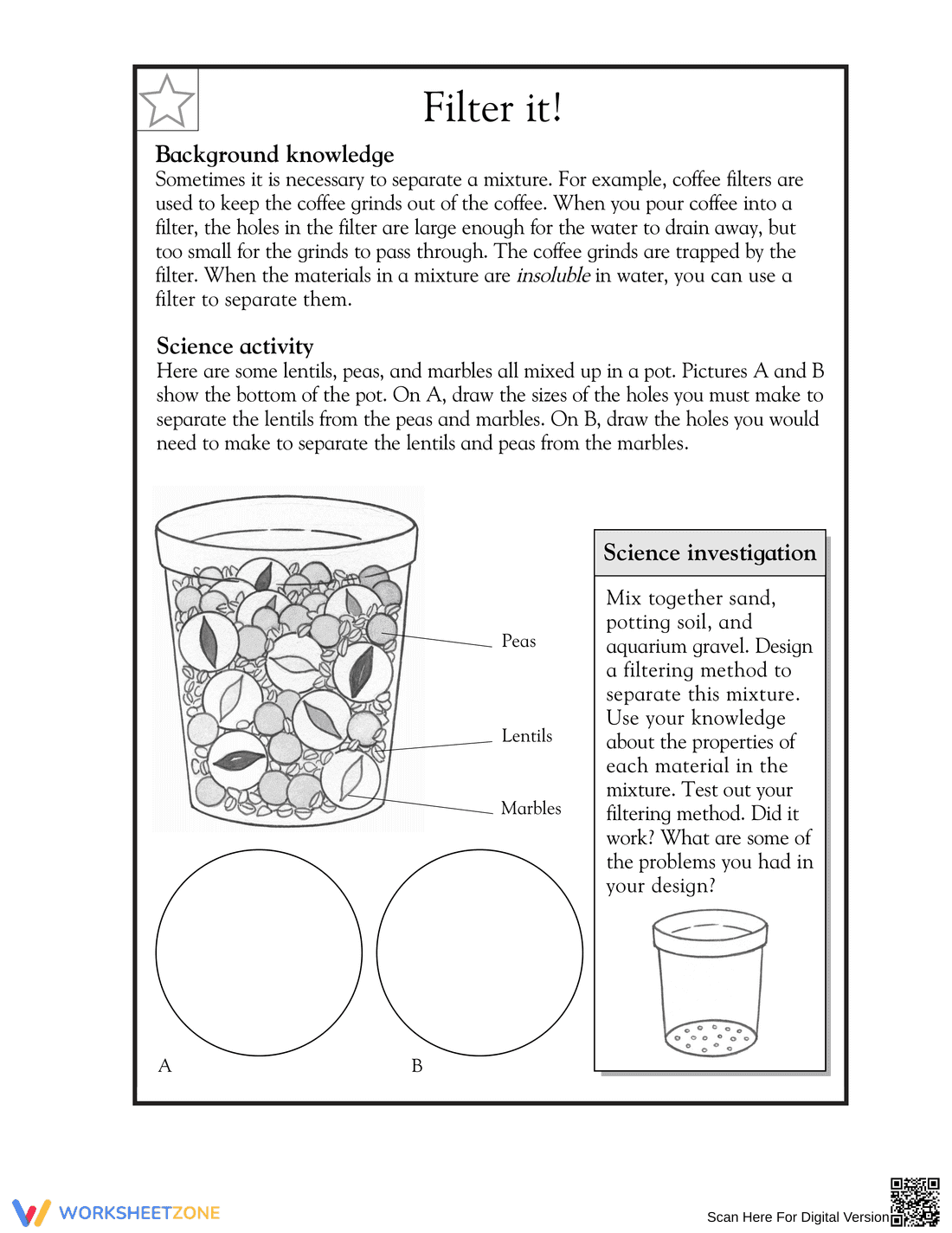
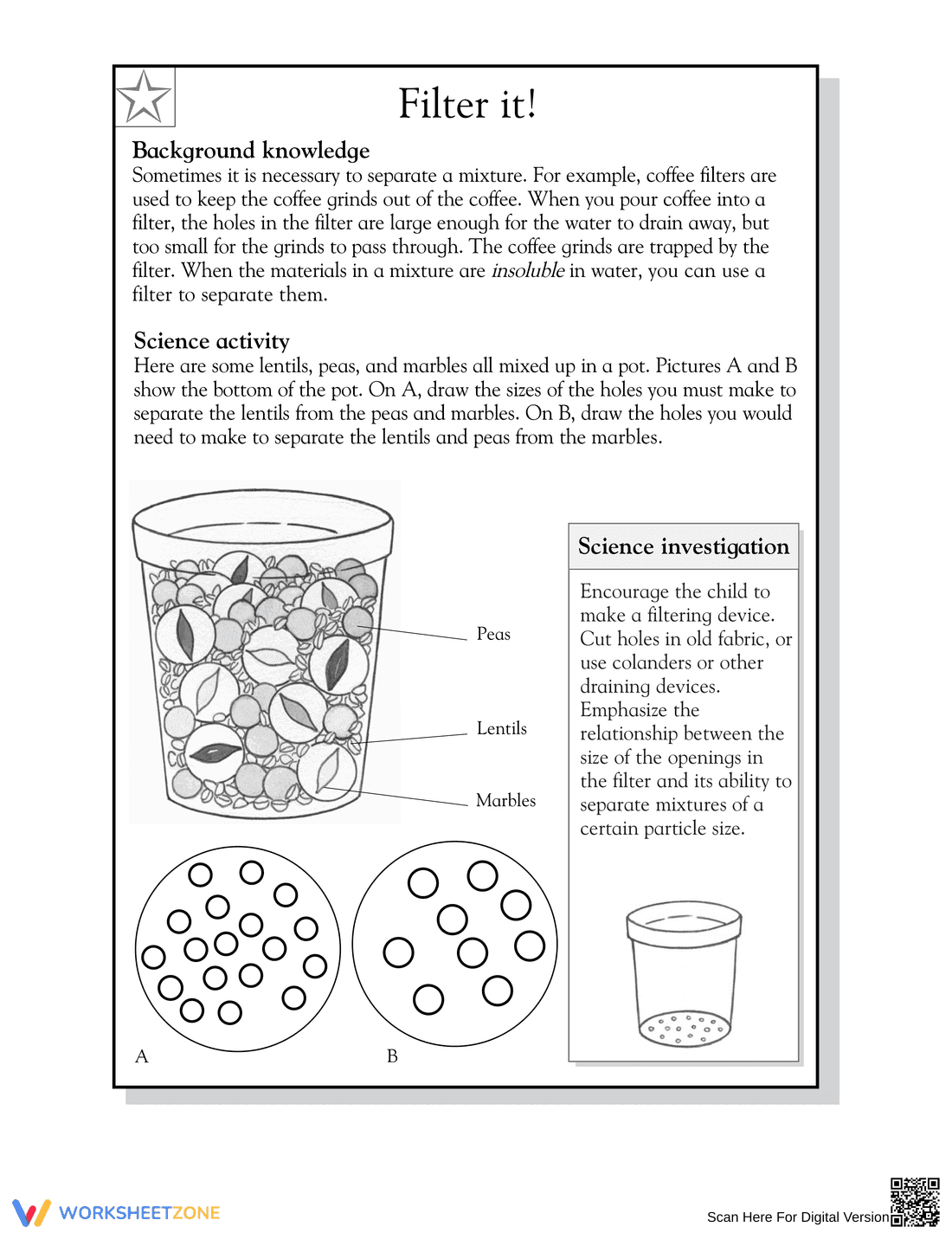
This "Filter It!" Grade 4 science worksheet provides a hands-on exploration of physical properties and mixture separation. Students apply background knowledge about insoluble materials to design functional filters. By drawing specific hole dimensions, learners master the essential concept of separating substances through mechanical filtration and engineering design.
At a Glance
- Grade: 4 · Subject: Science
- Standard:
3-5-ETS1-2— Generate and compare multiple possible solutions to a problem based on constraints.- Skill Focus: Separating mixtures by particle size
- Format: 1 page · 3 tasks · No-prep required · PDF
- Best For: Introduction to physical properties and filtration
- Time: 20–30 minutes
What's Inside
This one-page science activity includes a "Background Knowledge" section explaining filtration using everyday examples. The worksheet features two "Science Activity" drawing tasks (Filters A and B) where students represent hole sizes needed to separate lentils, peas, and marbles. Additionally, a "Science Investigation" extension challenges students to design a filtration system for sand, soil, and gravel, promoting higher-order thinking and real-world application of the engineering design process for Fourth Grade learners.
Zero-Prep Workflow
The zero-prep design allows implementation in under two minutes of preparation time.
- Print (30 seconds): Output the single-page PDF for your class or upload it to a digital whiteboard for group instruction.
- Distribute (30 seconds): Hand out the sheets; no specialized lab equipment is required for the primary activity.
- Review (1 minute): Use the visual prompts to facilitate class discussion or formative assessment regarding particle size and separation.
Standards Alignment
The primary standard is 3-5-ETS1-2, requiring students to "generate and compare multiple possible solutions to a problem based on constraints." This worksheet supports this by asking students to design different hole sizes to meet specific separation criteria. This standard code can be copied directly into lesson plans, IEP goals, or district curriculum mapping tools for easy tracking.
How to Use It
Use this worksheet during the "Explore" phase of a lesson on matter. It serves as a bridge between theoretical properties and practical engineering. As students work, observe if they can justify their hole sizes based on the relative dimensions of the objects; this provides a perfect formative assessment opportunity. The expected completion time for most students is approximately 25 minutes.
Who It's For
This resource is designed for fourth-grade students studying physical science and mixtures. It is effective for visual learners who benefit from drawing scientific models. The investigation section provides differentiation for advanced learners. This worksheet pairs naturally with a physical demonstration of a sieve or a reading passage on industrial water filtration systems commonly used in modern science curricula.
The "Filter It!" worksheet leverages the engineering design process to reinforce fundamental physical science concepts. By requiring students to translate abstract ideas of "separation" into concrete visual models, the activity aligns with research from Fisher & Frey (2014) regarding the importance of scaffolding complex scientific tasks through guided practice. Specifically, the progression from analyzing known mixtures to designing solutions for complex systems mirrors the gradual release of responsibility model shown to improve retention in elementary science. According to the RAND AIRS 2024 report on STEM education, integrated activities that combine content knowledge with engineering constraints significantly increase student engagement and mastery of NGSS-aligned performance expectations. This worksheet provides a structured environment for students to practice 3-5-ETS1-2 through a plain-English skill application: designing and comparing filtration solutions based on the physical property of particle size within a given mixture.


