


























0
Views
0
Downloads

0.0
0
Save
0 Likes
Share
Fill in the Scientific Method: Worksheet Activity
0 Views
0 Downloads
Paste this activity's link or code into your existing LMS (Google Classroom, Canvas, Teams, Schoology, Moodle, etc.).
Students can open and work on the activity right away, with no student login required.
You'll still be able to track student progress and results from your teacher account.
Information
Description
What It Is:
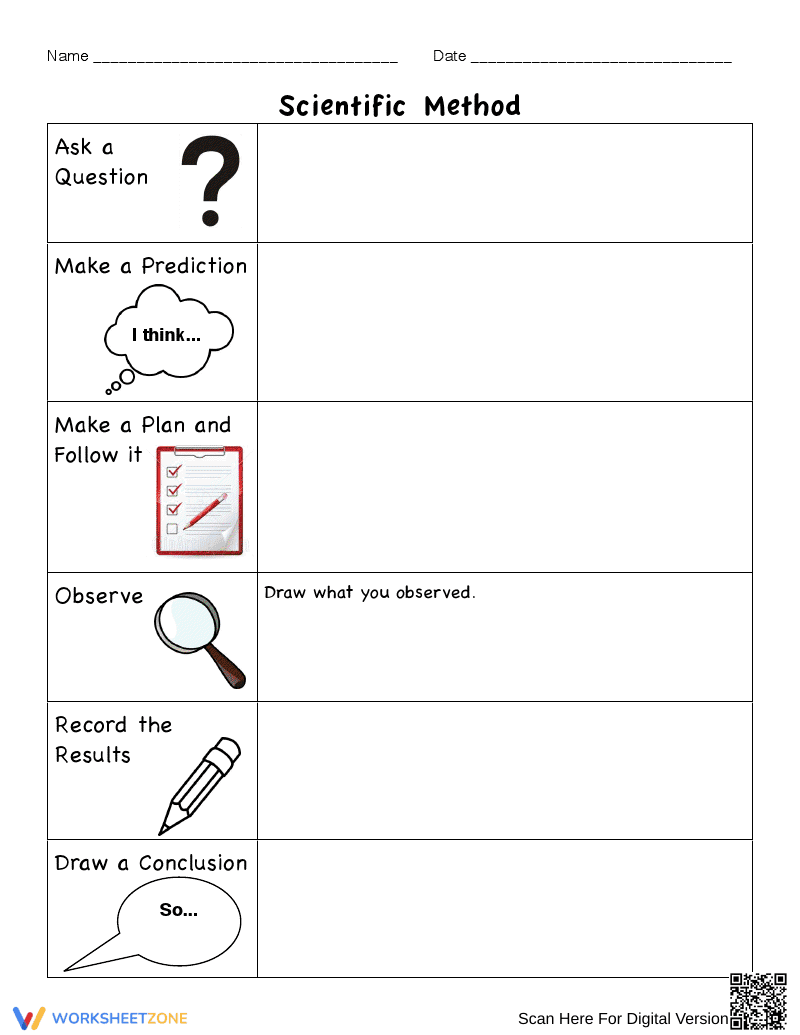
This is a worksheet designed to guide students through the scientific method. It includes sections for asking a question, making a prediction (with a 'I think...' prompt), making a plan and following it (represented by a checklist), observing (with space to draw observations), recording the results (represented by a pencil), and drawing a conclusion (with a 'So...' prompt). Each step has a corresponding visual cue to aid understanding.
Grade Level Suitability:
This worksheet is suitable for grades 2-5. The simple language, visual cues, and step-by-step format make it accessible for younger students learning the basic principles of the scientific method. Older elementary students can use it to reinforce their understanding and apply it to more complex experiments.
Why Use It:
This worksheet provides a structured framework for students to understand and apply the scientific method. It encourages critical thinking, observation skills, and the ability to draw conclusions based on evidence. The visual prompts make the process more engaging and accessible for visual learners.
How to Use It:
Start by having students choose a question they want to investigate. Then, guide them to make a prediction about what they think will happen. Help them create a simple plan to test their prediction and follow the steps. Encourage them to carefully observe and draw what they see. Finally, assist them in recording their results and drawing a conclusion based on their findings.
Target Users:
This worksheet is ideal for elementary school students learning about the scientific method, science teachers looking for a simple and engaging activity, and homeschool parents teaching basic science concepts. It is also beneficial for students who need visual aids to understand complex processes.
This is a worksheet designed to guide students through the scientific method. It includes sections for asking a question, making a prediction (with a 'I think...' prompt), making a plan and following it (represented by a checklist), observing (with space to draw observations), recording the results (represented by a pencil), and drawing a conclusion (with a 'So...' prompt). Each step has a corresponding visual cue to aid understanding.
Grade Level Suitability:
This worksheet is suitable for grades 2-5. The simple language, visual cues, and step-by-step format make it accessible for younger students learning the basic principles of the scientific method. Older elementary students can use it to reinforce their understanding and apply it to more complex experiments.
Why Use It:
This worksheet provides a structured framework for students to understand and apply the scientific method. It encourages critical thinking, observation skills, and the ability to draw conclusions based on evidence. The visual prompts make the process more engaging and accessible for visual learners.
How to Use It:
Start by having students choose a question they want to investigate. Then, guide them to make a prediction about what they think will happen. Help them create a simple plan to test their prediction and follow the steps. Encourage them to carefully observe and draw what they see. Finally, assist them in recording their results and drawing a conclusion based on their findings.
Target Users:
This worksheet is ideal for elementary school students learning about the scientific method, science teachers looking for a simple and engaging activity, and homeschool parents teaching basic science concepts. It is also beneficial for students who need visual aids to understand complex processes.


