


























Views
Downloads

Printable Living vs Non-Living Things Worksheet | Grade 5
Paste this activity's link or code into your existing LMS (Google Classroom, Canvas, Teams, Schoology, Moodle, etc.).
Students can open and work on the activity right away, with no student login required.
You'll still be able to track student progress and results from your teacher account.
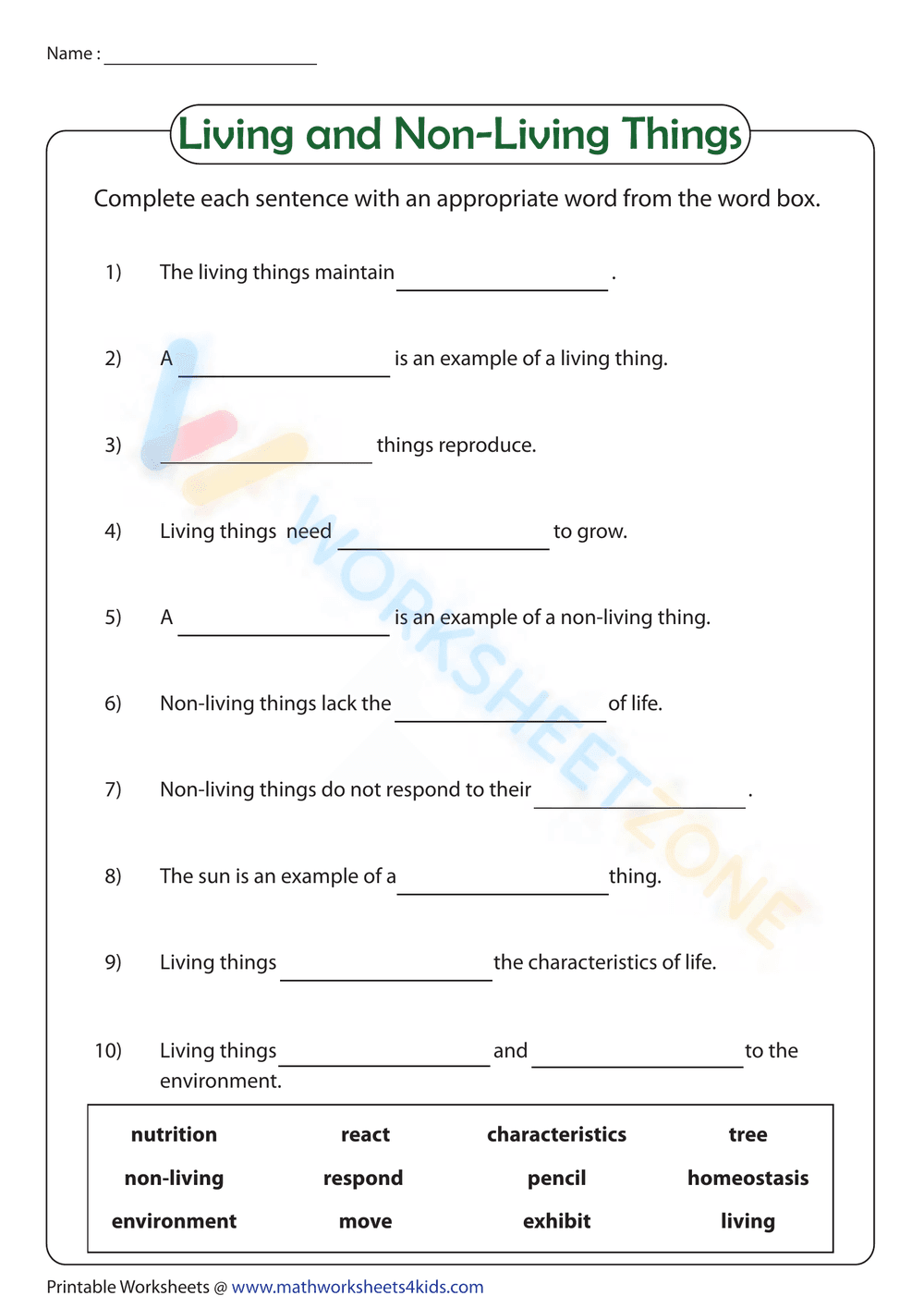
This ready-to-use science worksheet helps students master the fundamental differences between living and non-living things. By completing targeted fill-in-the-blank sentences, learners will reinforce their understanding of key biological concepts like homeostasis, reproduction, and environmental response. It provides a clear, structured format for reviewing essential vocabulary.
At a Glance
- Grade: 5 · Subject: Science
- Standard:
4-LS1-1— Identify structures and behaviors that support survival and growth.- Skill Focus: Characteristics of life
- Format: 2 pages · 10 problems · Answer key included · PDF
- Best For: Independent practice or review
- Time: 10–15 minutes
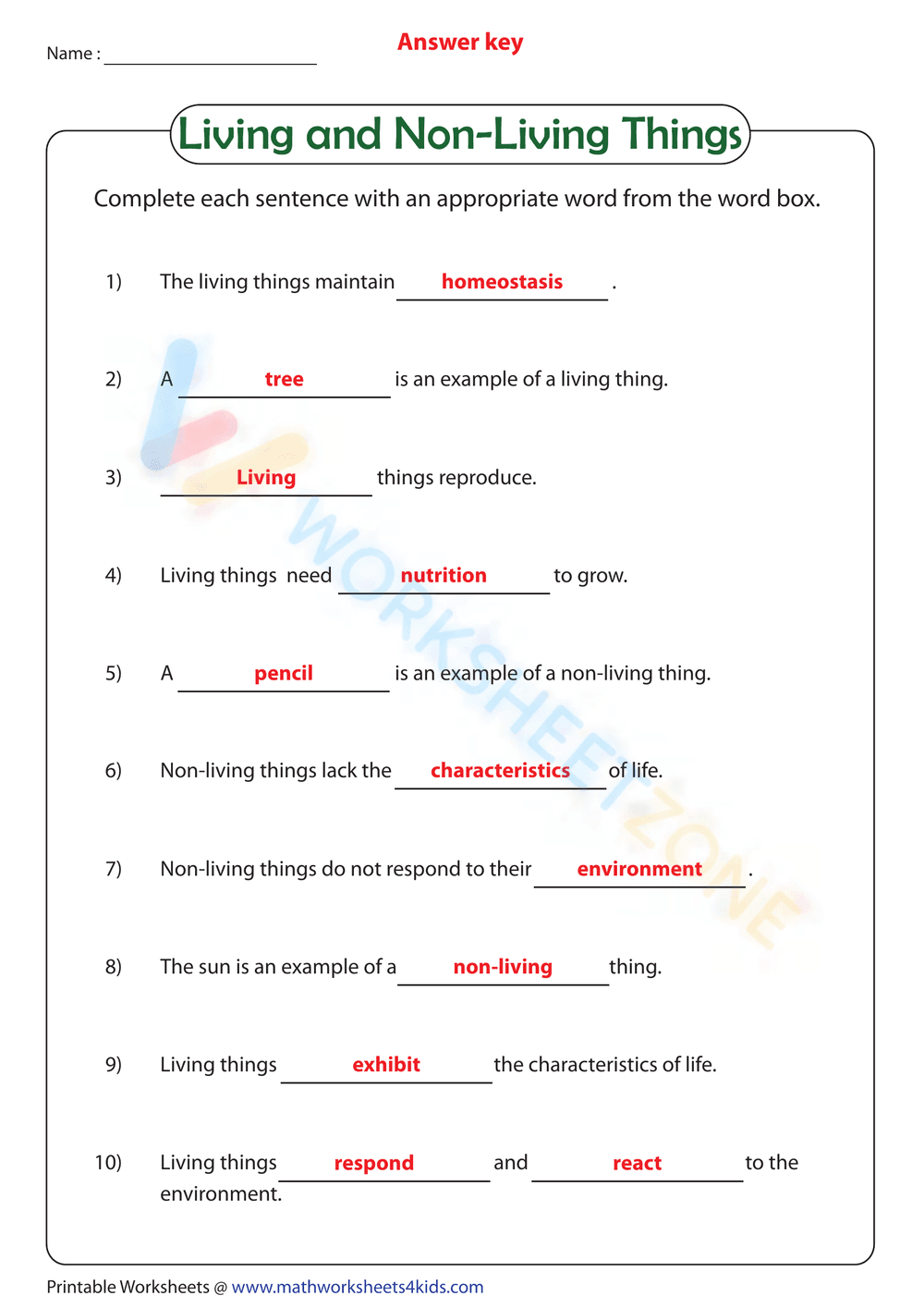
This resource features a single-page fill-in-the-blank activity with 10 distinct sentences focused on biological traits. Students utilize a provided 12-word vocabulary bank—including terms like "homeostasis," "nutrition," and "environment"—to complete each statement accurately. A comprehensive, color-coded answer key is included on the second page to ensure quick and accurate grading for educators or self-checking students.
Designed for maximum efficiency, this worksheet requires absolutely zero teacher setup. Print the activity page (1 minute), distribute it to your class (1 minute), and review the answers together using the included key (3 minutes). The straightforward instructions and built-in word bank make it an ideal, self-guided activity for substitute teacher plans, morning work, or quick homework assignments.
Aligned to 4-LS1-1, this activity supports the understanding that plants and animals have internal and external structures that function to support survival, growth, behavior, and reproduction. It also bridges foundational concepts for middle school life science standards regarding cellular function and organism behavior. Both standard codes can be copied directly into lesson plans, IEP goals, or district curriculum mapping tools to demonstrate rigorous academic alignment.
Deploy this worksheet as a formative assessment immediately following a direct instruction lesson on the characteristics of life. Alternatively, use it as a quiet, independent warm-up activity at the start of a biology unit. While students work, teachers can circulate to observe which vocabulary terms—such as "homeostasis"—require further whole-class clarification. Expect students to complete the task within 10 to 15 minutes.
This resource is perfectly suited for upper elementary and early middle school science students. The inclusion of a word bank provides built-in scaffolding, making it accessible for English Language Learners and students needing vocabulary support. It pairs excellently with introductory life science anchor charts or interactive biology notebooks.
Integrating structured vocabulary practice is essential for mastering foundational science concepts in the upper elementary and middle school classroom. Aligned with 4-LS1-1, this activity requires students to identify structures and behaviors that support survival and growth. According to Fisher & Frey (2014), providing targeted vocabulary supports, such as word banks in formative assessments, significantly increases student comprehension and retention of complex academic language. When learners are explicitly taught to distinguish between living and non-living entities using precise terminology, their overall scientific literacy improves. By isolating specific characteristics of life—like reproduction, homeostasis, and environmental response—this worksheet ensures learners build the exact scientific lexicon required for advanced biological studies. This targeted approach prevents common misconceptions early in the science curriculum, establishing a strong foundation for future investigations into cellular biology and ecosystems.


