




























0
Views
0
Downloads

0.0
0
Save
0 Likes
Share
Identifying Feelings Worksheet
0 Views
0 Downloads

Paste this activity's link or code into your existing LMS (Google Classroom, Canvas, Teams, Schoology, Moodle, etc.).
Students can open and work on the activity right away, with no student login required.
You'll still be able to track student progress and results from your teacher account.
Information
Description
What It Is:
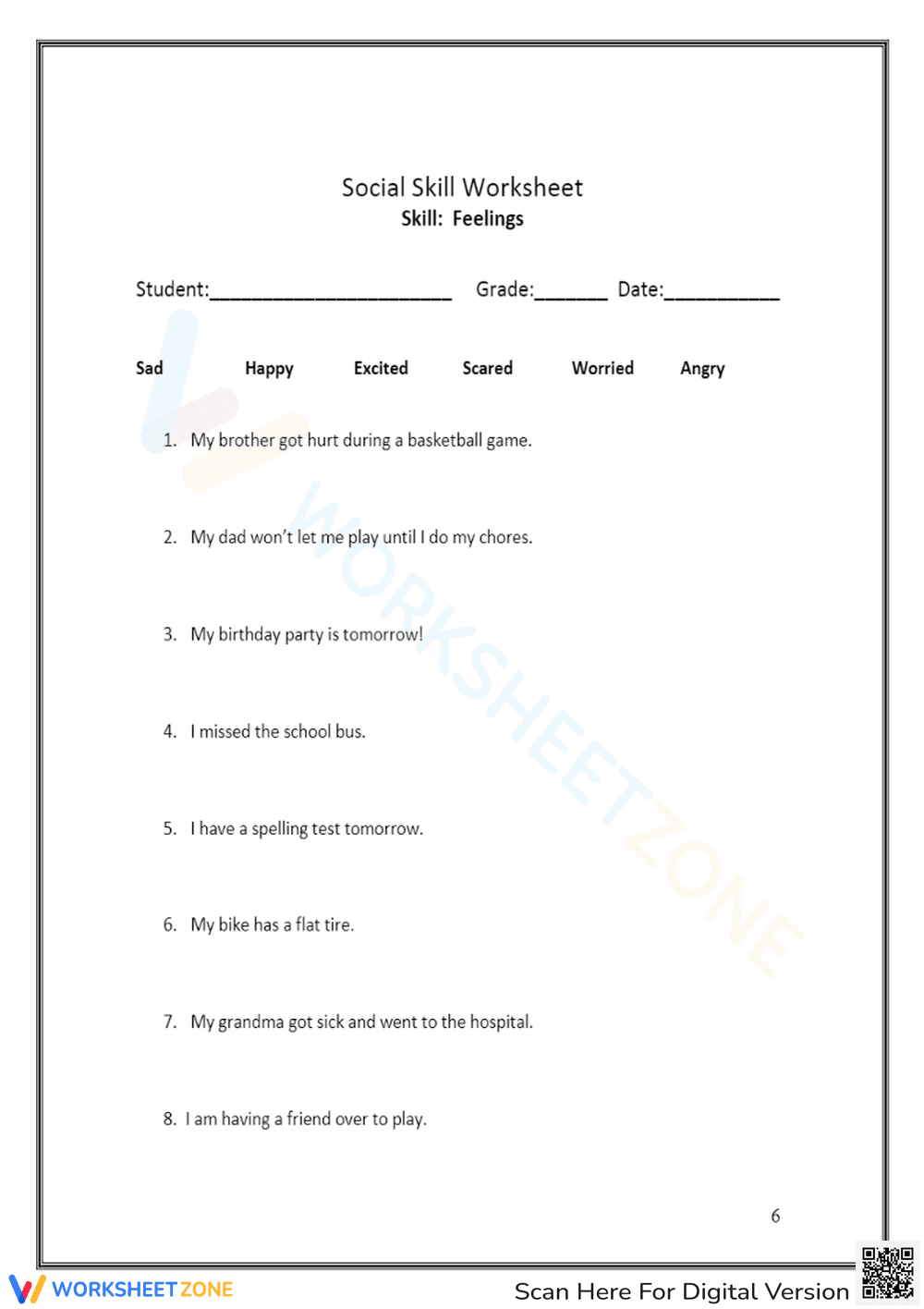
This is a social skills worksheet focusing on identifying feelings. The worksheet presents eight different scenarios. Above each scenario, there are six feelings listed: Sad, Happy, Excited, Scared, Worried, and Angry. Students are meant to read each scenario and determine which feeling is most appropriate for the situation described. Scenarios include things like 'My brother got hurt during a basketball game' and 'My birthday party is tomorrow!' There are spaces for the student's name, grade, and date at the top.
Grade Level Suitability:
This worksheet is suitable for grades 1-3. The scenarios are simple and relatable, and the vocabulary is appropriate for this age range. The task of identifying feelings based on situations is a key social-emotional learning objective for early elementary grades.
Why Use It:
This worksheet helps children develop emotional literacy by connecting specific situations to corresponding feelings. It encourages empathy and self-awareness by prompting students to consider how they might feel in similar circumstances. It promotes social-emotional learning and helps students to recognize and understand a range of emotions.
How to Use It:
Students should read each scenario carefully. Then, they should circle or highlight the feeling from the list (Sad, Happy, Excited, Scared, Worried, Angry) that best matches how someone might feel in that situation. Encourage students to discuss why they chose a particular feeling.
Target Users:
This worksheet is ideal for elementary school students, particularly those in grades 1-3. It is also beneficial for children with social-emotional learning needs or those who struggle with identifying and understanding feelings. Counselors and special education teachers could also use this resource.
This is a social skills worksheet focusing on identifying feelings. The worksheet presents eight different scenarios. Above each scenario, there are six feelings listed: Sad, Happy, Excited, Scared, Worried, and Angry. Students are meant to read each scenario and determine which feeling is most appropriate for the situation described. Scenarios include things like 'My brother got hurt during a basketball game' and 'My birthday party is tomorrow!' There are spaces for the student's name, grade, and date at the top.
Grade Level Suitability:
This worksheet is suitable for grades 1-3. The scenarios are simple and relatable, and the vocabulary is appropriate for this age range. The task of identifying feelings based on situations is a key social-emotional learning objective for early elementary grades.
Why Use It:
This worksheet helps children develop emotional literacy by connecting specific situations to corresponding feelings. It encourages empathy and self-awareness by prompting students to consider how they might feel in similar circumstances. It promotes social-emotional learning and helps students to recognize and understand a range of emotions.
How to Use It:
Students should read each scenario carefully. Then, they should circle or highlight the feeling from the list (Sad, Happy, Excited, Scared, Worried, Angry) that best matches how someone might feel in that situation. Encourage students to discuss why they chose a particular feeling.
Target Users:
This worksheet is ideal for elementary school students, particularly those in grades 1-3. It is also beneficial for children with social-emotional learning needs or those who struggle with identifying and understanding feelings. Counselors and special education teachers could also use this resource.


