


























Views
Downloads

Feelings Worksheet | Grade 7-9 Essential Social Skills
Paste this activity's link or code into your existing LMS (Google Classroom, Canvas, Teams, Schoology, Moodle, etc.).
Students can open and work on the activity right away, with no student login required.
You'll still be able to track student progress and results from your teacher account.
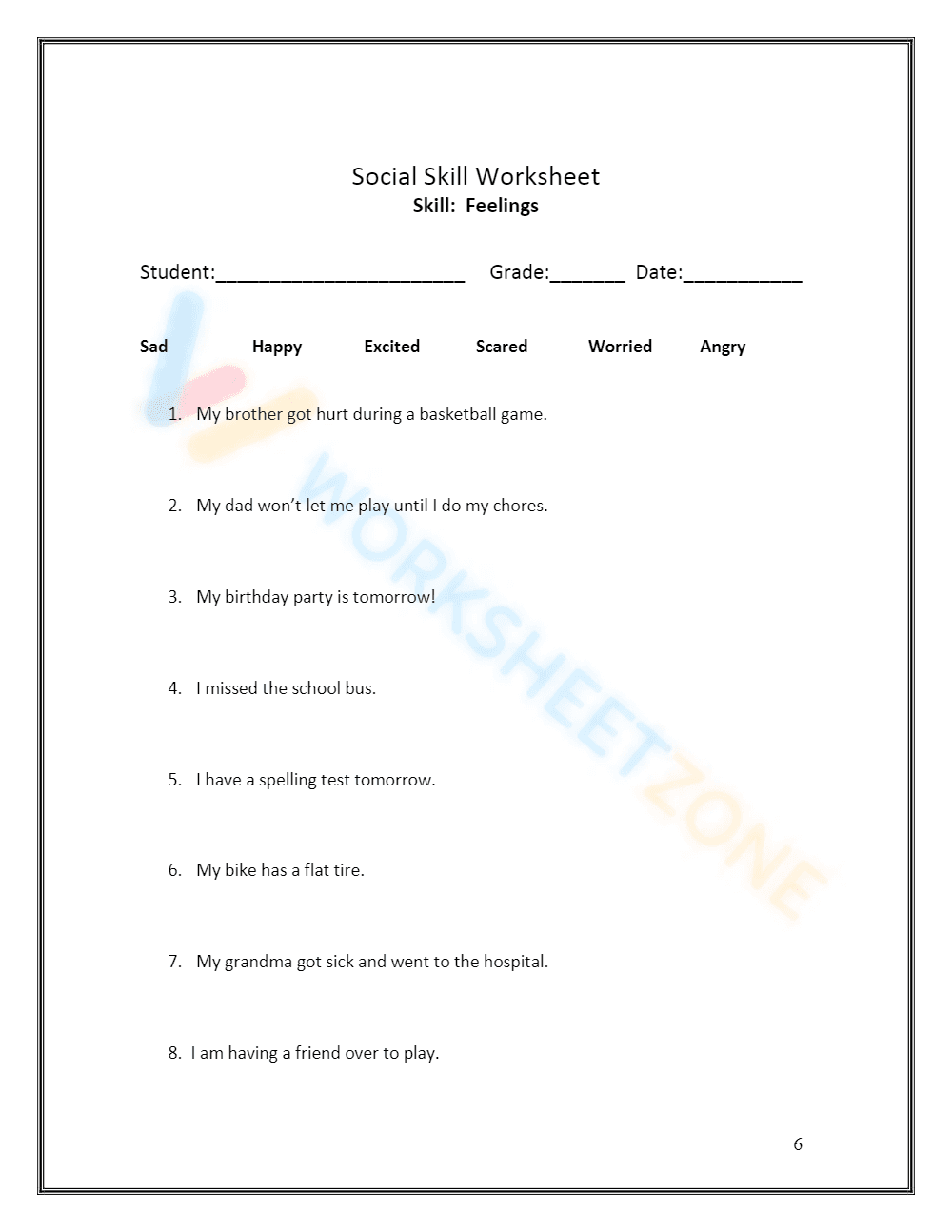
This Grade 7-9 social skills worksheet helps students identify and label emotional responses to common life scenarios. By connecting specific events to feelings like sadness, excitement, or worry, learners develop the emotional vocabulary necessary for effective communication and self-regulation. It provides a structured way to practice empathy and situational awareness in the classroom.
At a Glance
- Grade: 7-9 · Subject: English / Social Skills
- Standard:
CCSS.ELA-LITERACY.L.7.5— Distinguish among the connotations of words with similar meanings and emotional weights.- Skill Focus: Identifying feelings and emotional labeling
- Format: 1 page · 8 problems · Answer key included · PDF
- Best For: SEL warm-ups or behavioral intervention
- Time: 10–15 minutes
The resource features a clean, one-page layout containing 8 distinct social and personal scenarios. At the top, a word bank provides six core emotional descriptors: Sad, Happy, Excited, Scared, Worried, and Angry. Students read each sentence—ranging from family health concerns to school bus mishaps—and select the most appropriate feeling. The PDF format ensures high-quality printing for immediate classroom use.
This worksheet is designed for a zero-prep workflow to save teacher time. First, print the single-page PDF (30 seconds). Second, distribute the sheets to students as a bell-ringer or transition activity (1 minute). Third, review the answers as a whole group to discuss why certain scenarios might trigger multiple emotions, such as feeling both "scared" and "worried" about a hospital visit (5 minutes). Total preparation time is under 2 minutes, making it an excellent choice for sub plans.
The primary alignment is `CCSS.ELA-LITERACY.L.7.5`, which requires students to demonstrate understanding of figurative language, word relationships, and nuances in word meanings. Specifically, it addresses the ability to distinguish among the connotations of words with similar denotations. By selecting the correct emotional label, students practice identifying the "weight" of different feelings. This standard code can be copied directly into lesson plans, IEP goals, or district curriculum mapping tools.
Use this worksheet during a morning meeting or as a formative assessment after a lesson on character development in literature. It is particularly effective for checking a student's ability to infer emotional states from context clues. Teachers should observe whether students can distinguish between "excited" and "happy" in scenario 3. Completion typically takes 10 to 15 minutes, making it an ideal supplemental tool for busy educators.
This resource is tailored for middle and early high school students, including those in general education English classes or specialized social-emotional learning (SEL) groups. It is highly effective for students with IEPs focusing on social skills or behavioral goals. Pair this worksheet with a feelings wheel or an anchor chart on emotional regulation for a comprehensive instructional unit that builds student confidence.
According to Fisher & Frey (2014), the development of a robust emotional vocabulary is a critical component of academic success and social-emotional literacy. This worksheet directly supports that development by requiring students to map specific situational contexts to precise emotional labels. By engaging with CCSS.ELA-LITERACY.L.7.5, students move beyond basic descriptors to more nuanced terms like "worried" or "excited." Research indicates that explicit instruction in identifying feelings improves student self-regulation and reduces classroom conflict. This 8-task resource provides the necessary repetition for students to internalize these concepts. The structured format allows for quick data collection on a student's ability to infer emotional states, which is a foundational skill for both literary analysis and real-world social interaction. Educators can use these results to inform further small-group interventions or to document progress toward social-emotional learning benchmarks in a standardized, measurable way.


