


























0
Views
0
Downloads

Save
0 Likes
Share
Fair Fighting Rules in Relationships
0 Views
0 Downloads
Paste this activity's link or code into your existing LMS (Google Classroom, Canvas, Teams, Schoology, Moodle, etc.).
Students can open and work on the activity right away, with no student login required.
You'll still be able to track student progress and results from your teacher account.
Information
Description
What It Is:
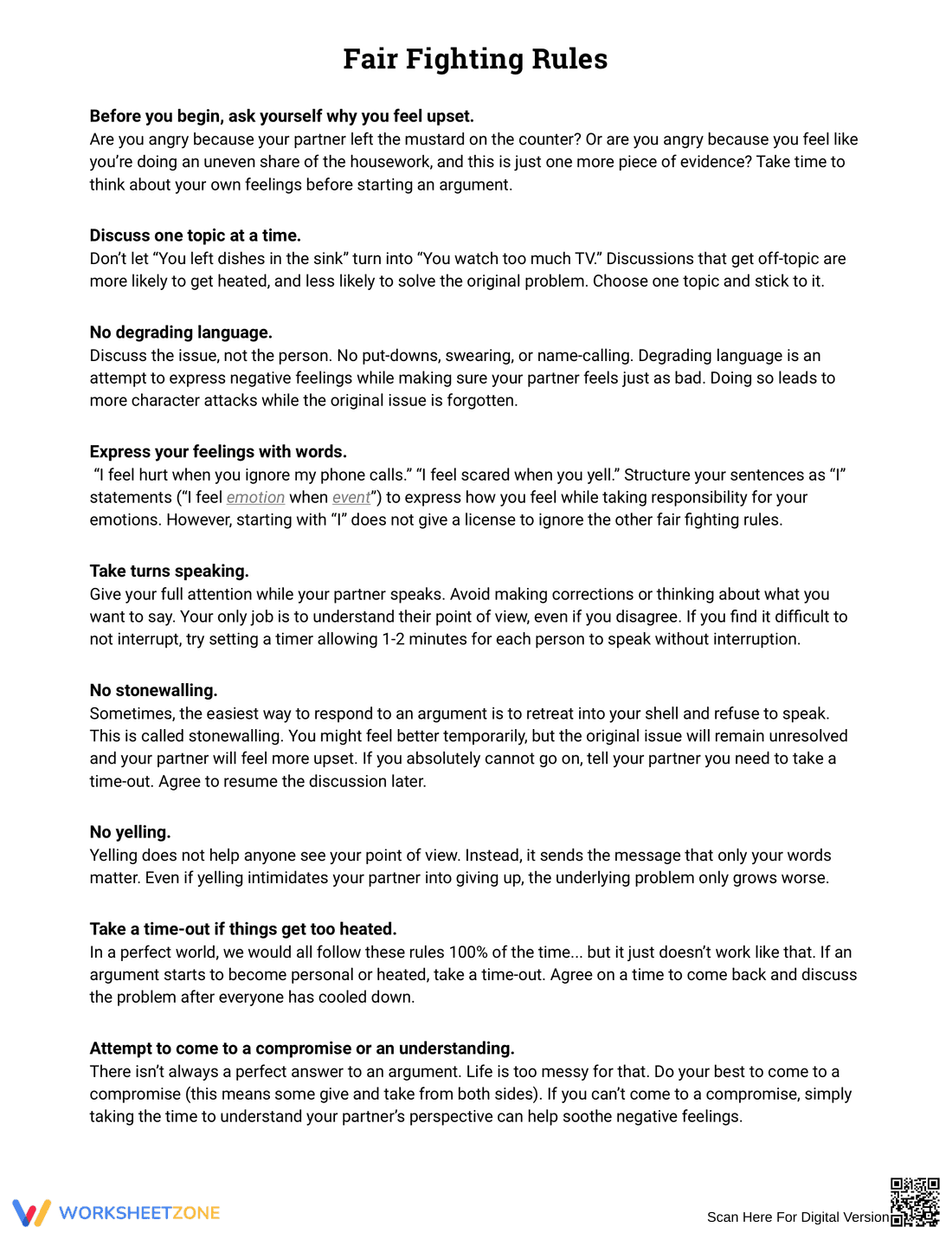
This is an educational worksheet titled 'Fair Fighting Rules'. It provides guidance on how to engage in constructive arguments, focusing on communication techniques such as discussing one topic at a time, avoiding degrading language, expressing feelings with 'I' statements, taking turns speaking, avoiding stonewalling and yelling, taking time-outs, and attempting to compromise. The worksheet provides example phrases and scenarios to illustrate each rule.
Grade Level Suitability:
This worksheet is suitable for high school students (grades 9-12) and adults. The content requires a certain level of emotional maturity and understanding of interpersonal relationships, making it appropriate for older teenagers and adults.
Why Use It:
This worksheet promotes healthy communication and conflict resolution skills. It helps individuals understand how to express their feelings effectively, listen to their partner's perspective, and avoid destructive behaviors during arguments. The aim is to improve relationships by fostering understanding and compromise.
How to Use It:
This worksheet can be used as a guide for couples or individuals looking to improve their communication during disagreements. Read through each rule and discuss how it applies to past or potential conflicts. Practice implementing the suggested techniques in future arguments. The worksheet can also be used in therapy or counseling sessions as a tool for teaching conflict resolution skills.
Target Users:
The target users for this worksheet are couples, individuals in relationships, therapists, counselors, and educators who want to teach or learn effective communication and conflict resolution strategies. It's helpful for anyone seeking to improve their ability to navigate disagreements constructively.
This is an educational worksheet titled 'Fair Fighting Rules'. It provides guidance on how to engage in constructive arguments, focusing on communication techniques such as discussing one topic at a time, avoiding degrading language, expressing feelings with 'I' statements, taking turns speaking, avoiding stonewalling and yelling, taking time-outs, and attempting to compromise. The worksheet provides example phrases and scenarios to illustrate each rule.
Grade Level Suitability:
This worksheet is suitable for high school students (grades 9-12) and adults. The content requires a certain level of emotional maturity and understanding of interpersonal relationships, making it appropriate for older teenagers and adults.
Why Use It:
This worksheet promotes healthy communication and conflict resolution skills. It helps individuals understand how to express their feelings effectively, listen to their partner's perspective, and avoid destructive behaviors during arguments. The aim is to improve relationships by fostering understanding and compromise.
How to Use It:
This worksheet can be used as a guide for couples or individuals looking to improve their communication during disagreements. Read through each rule and discuss how it applies to past or potential conflicts. Practice implementing the suggested techniques in future arguments. The worksheet can also be used in therapy or counseling sessions as a tool for teaching conflict resolution skills.
Target Users:
The target users for this worksheet are couples, individuals in relationships, therapists, counselors, and educators who want to teach or learn effective communication and conflict resolution strategies. It's helpful for anyone seeking to improve their ability to navigate disagreements constructively.


