


























Views
Downloads
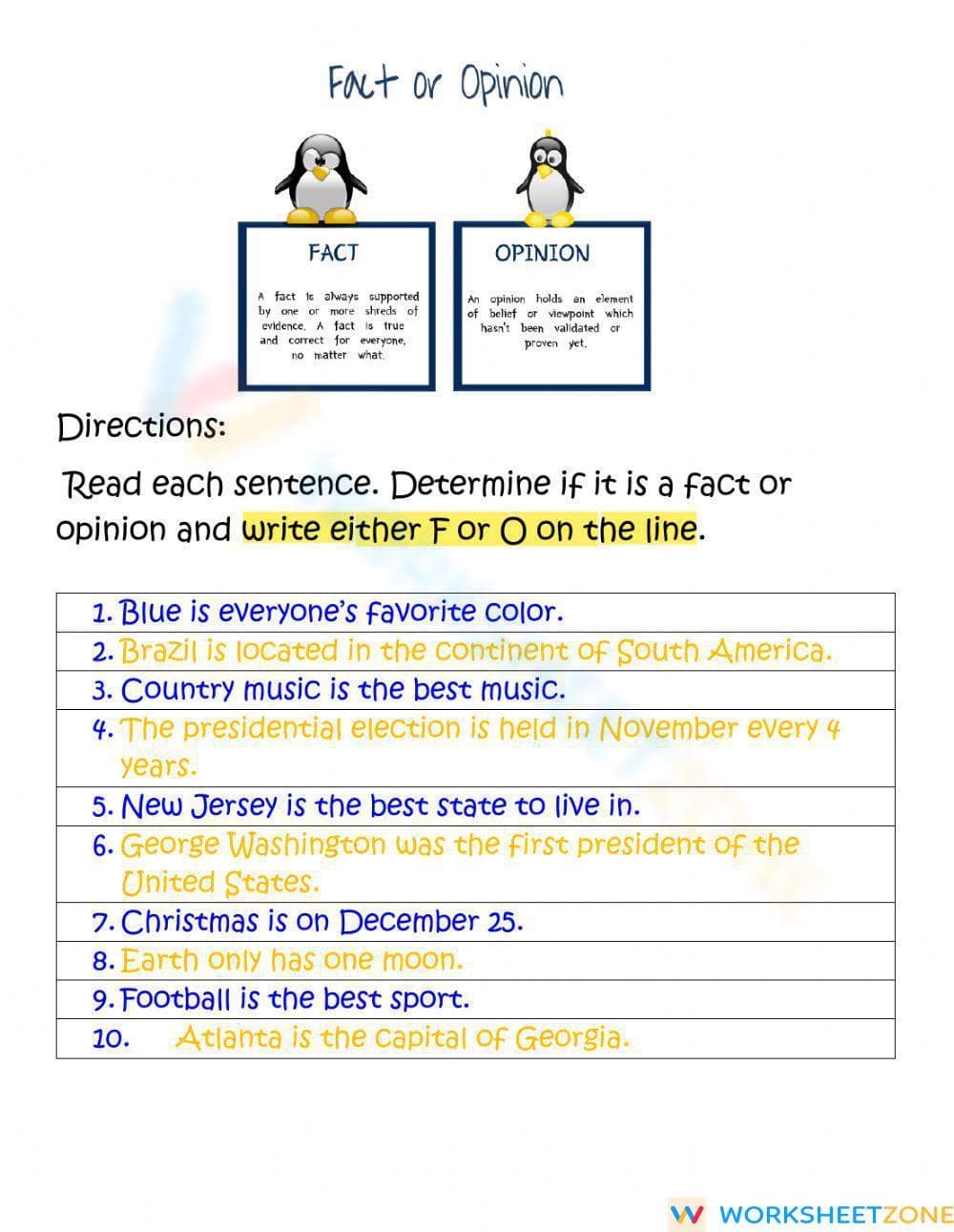

Grade 4 Fact or Opinion — Printable No-Prep Worksheet
Paste this activity's link or code into your existing LMS (Google Classroom, Canvas, Teams, Schoology, Moodle, etc.).
Students can open and work on the activity right away, with no student login required.
You'll still be able to track student progress and results from your teacher account.
Help students master the critical distinction between objective facts and subjective opinions with this focused practice worksheet. By identifying verifiable statements versus personal beliefs, learners strengthen their informational reading and analytical writing skills. This resource ensures students can evaluate evidence effectively, a vital step toward meeting core literacy standards in upper elementary grades.
At a Glance
- Grade: 4 · Subject: English Language Arts
- Standard:
CCSS.ELA-LITERACY.RI.4.8— Explain how an author uses reasons and evidence to support particular points- Skill Focus: Distinguishing Fact vs. Opinion
- Format: 1 page · 15 problems · Answer key included · PDF
- Best For: Independent practice or quick formative assessment
- Time: 15–20 minutes
What's Inside
This comprehensive one-page PDF features 15 carefully curated sentences that challenge students to categorize information as either a 'fact' or an 'opinion.' The worksheet includes clear instructions and ample space for student responses. A full answer key is provided to facilitate rapid grading or student self-correction, making it an efficient tool for both classroom and home use.
Zero-Prep Workflow
The workflow is designed for maximum efficiency: Print the single-page document (30 seconds), distribute it to your class (1 minute), and review the answers using the provided key (5 minutes). This zero-prep resource requires less than two minutes of total teacher setup time, making it an ideal choice for emergency sub plans or as a transition activity between lessons.
Standards Alignment
Aligned to CCSS.ELA-LITERACY.RI.4.8, this activity requires students to evaluate statements for verifiable evidence. By isolating facts from opinions, students prepare for higher-level analysis where they must identify how authors support specific claims. This standard code can be copied directly into lesson plans, IEP goals, or district curriculum mapping tools.
How to Use It
Use this worksheet as a 'ticket out the door' after a lesson on evidence to gauge student understanding. During instruction, have students work in pairs to justify why a statement is an opinion by identifying 'clue words' like 'best' or 'amazing.' This serves as a quick formative assessment to identify students who may need additional scaffolding with informational texts.
Who It's For
Designed for general education Grade 4 students, this resource is also suitable for Grade 3 enrichment or Grade 5 review. It pairs naturally with informational passages or anchor charts that list common opinion signal words. Differentiation is easily achieved by allowing students to orally explain their reasoning for each classification.
Distinguishing between fact and opinion is a foundational cognitive skill identified by Fisher & Frey (2014) as essential for developing critical literacy. Research indicates that students who explicitly practice identifying verifiable claims are better equipped to navigate complex informational texts and resist misinformation. This worksheet aligns with CCSS.ELA-LITERACY.RI.4.8 by focusing on the evaluation of evidence-based statements. According to the RAND AIRS 2024 report, structured practice in evidence identification significantly improves student performance on standardized reading assessments. By isolating 15 distinct tasks, this resource provides the repetition necessary for mastery. Educators can rely on this tool to build the analytical framework students need for argumentative writing and rhetorical analysis. This plain-English skill—explaining how evidence supports a point—is a key metric in NAEP proficiency benchmarks for middle-grade literacy. By mastering this distinction, students develop the autonomy to evaluate source reliability across all academic disciplines, ensuring they are prepared for the rigors of secondary education.


