




























Views
Downloads
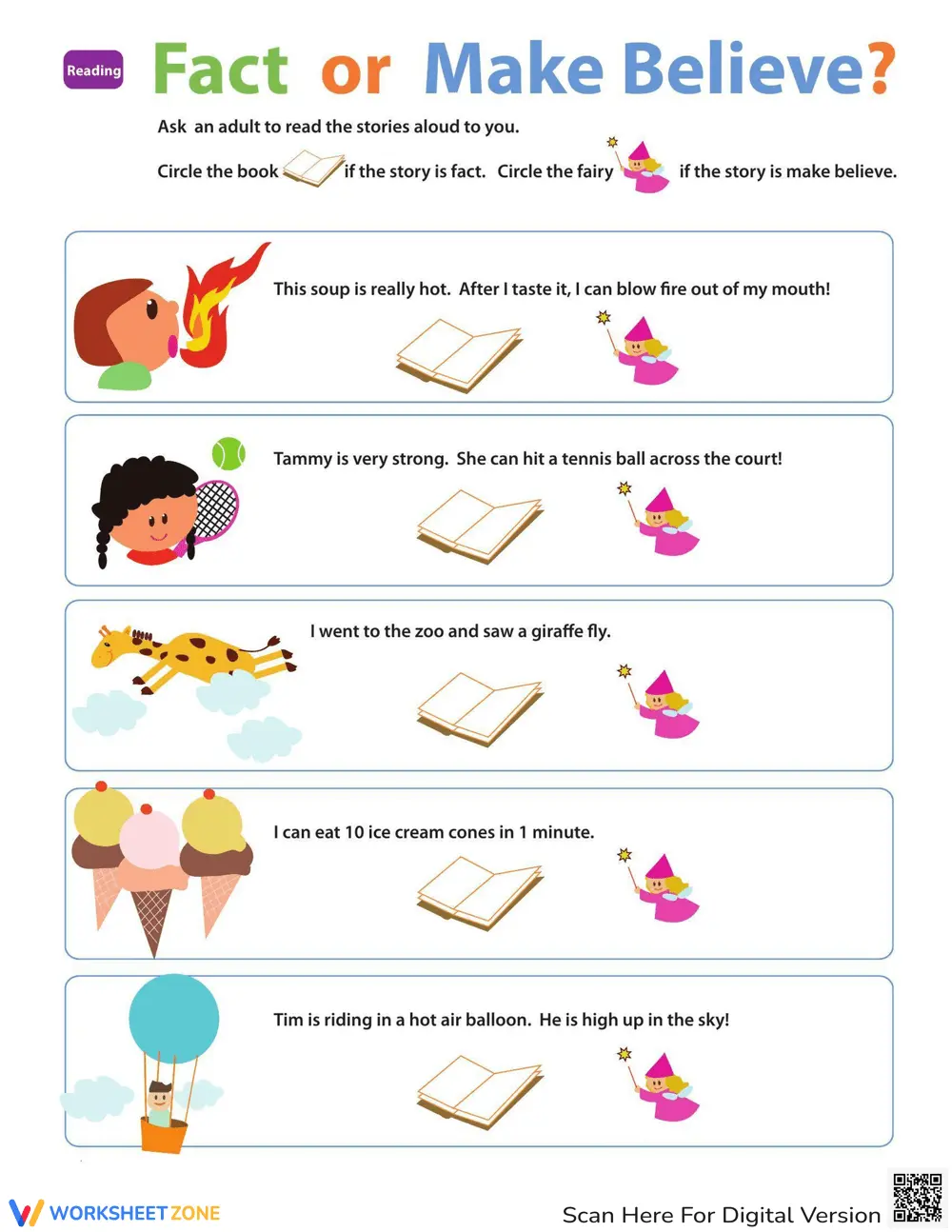

Fact or Make Believe? Printable Preschool ELA

Paste this activity's link or code into your existing LMS (Google Classroom, Canvas, Teams, Schoology, Moodle, etc.).
Students can open and work on the activity right away, with no student login required.
You'll still be able to track student progress and results from your teacher account.
This Preschool reading comprehension worksheet builds students' ability to distinguish fact from make-believe through 6 structured multiple-choice problems, giving young learners a concrete framework for separating real-world events from fictional ones before they encounter longer texts.
At a Glance
- Grade: Preschool · Subject: English Language Arts (ELA)
- Standard:
CCSS.ELA-LITERACY.RL.K.1— Students ask and answer questions about key details in a text- Skill Focus: Distinguishing fact from make-believe in short scenarios
- Format: 1 page · 6 problems · Answer key included · PDF
- Best For: Whole-group or independent reading warm-up
- Time: 10–15 minutes
Inside, students read short illustrated scenarios—including a playful prompt about whether blowing on hot soup produces fire—and select whether each situation is a fact or make-believe. All 6 items use a multiple-choice format with two clear options, keeping cognitive load low while sharpening critical thinking. The answer key is printed separately so teachers or caregivers can check responses quickly without marking up the student copy.
Skill Progression
- Guided practice (problems 1–2): Highly visual, concrete scenarios with obvious real-world anchors. Scaffold level: high. Students match picture cues to their prior knowledge.
- Supported practice (problems 3–4): Scenarios introduce mild fantasy elements. Students must weigh plausibility rather than rely on pictures alone. Scaffold level: moderate.
- Independent practice (problems 5–6): Scenarios require students to apply reasoning without visual scaffolds. Scaffold level: minimal. Students demonstrate internalized understanding of the fact/make-believe distinction.
This gradual-release structure mirrors the I Do, We Do, You Do model: early items let teachers think aloud, middle items invite shared discussion, and final items confirm independent mastery.
Standards Alignment
Primary standard: CCSS.ELA-LITERACY.RL.K.1 — With prompting and support, ask and answer questions about key details in a text. Each scenario functions as a micro-text; students must interrogate its details to judge real versus fictional. Supporting standard CCSS.ELA-LITERACY.RL.K.5 applies where students recognize that some texts describe imaginary situations. Both standard codes can be copied directly into lesson plans, IEP goals, or district curriculum mapping tools.
How to Use It
Use before direct instruction as a pre-assessment: observe which students hesitate on problems 3–4 to identify those who conflate fantasy with possibility. Use after a read-aloud of a fiction/nonfiction pair as a quick formative check—students who score 5–6 of 6 are ready for text-level sorting tasks. Expected completion time: 10–15 minutes for most Preschool and Kindergarten learners.
Who It's For
Designed for Preschool and Kindergarten students beginning to categorize text types. Works well for English Language Learners because the multiple-choice format reduces writing demand. Pairs naturally with a T-chart anchor chart labeled "Real" and "Make-Believe" displayed during the activity. Teachers running small-group reading rotations can assign this as an independent station task without additional setup.
Research supports explicit fact-versus-fiction instruction at the early childhood level. According to Fisher & Frey (2014), structured gradual-release tasks that move students from teacher-modeled to independent application produce measurably stronger literal comprehension outcomes in K–2 classrooms. This worksheet, aligned to CCSS.ELA-LITERACY.RL.K.1, targets the foundational skill of interrogating key details to judge real-world plausibility—a prerequisite for later informational reading and argument evaluation. With 6 multiple-choice items completed in under 15 minutes, it fits formative-assessment windows without displacing core instruction time. The single-page, answer-key-included format makes it suitable for home use, substitute plans, and reading centers alike, giving educators a flexible, low-prep tool grounded in standards-based early literacy practice.


