


























Views
Downloads


Essential Exponents Multiplication Rule Worksheet | Grade 8 Math
Paste this activity's link or code into your existing LMS (Google Classroom, Canvas, Teams, Schoology, Moodle, etc.).
Students can open and work on the activity right away, with no student login required.
You'll still be able to track student progress and results from your teacher account.
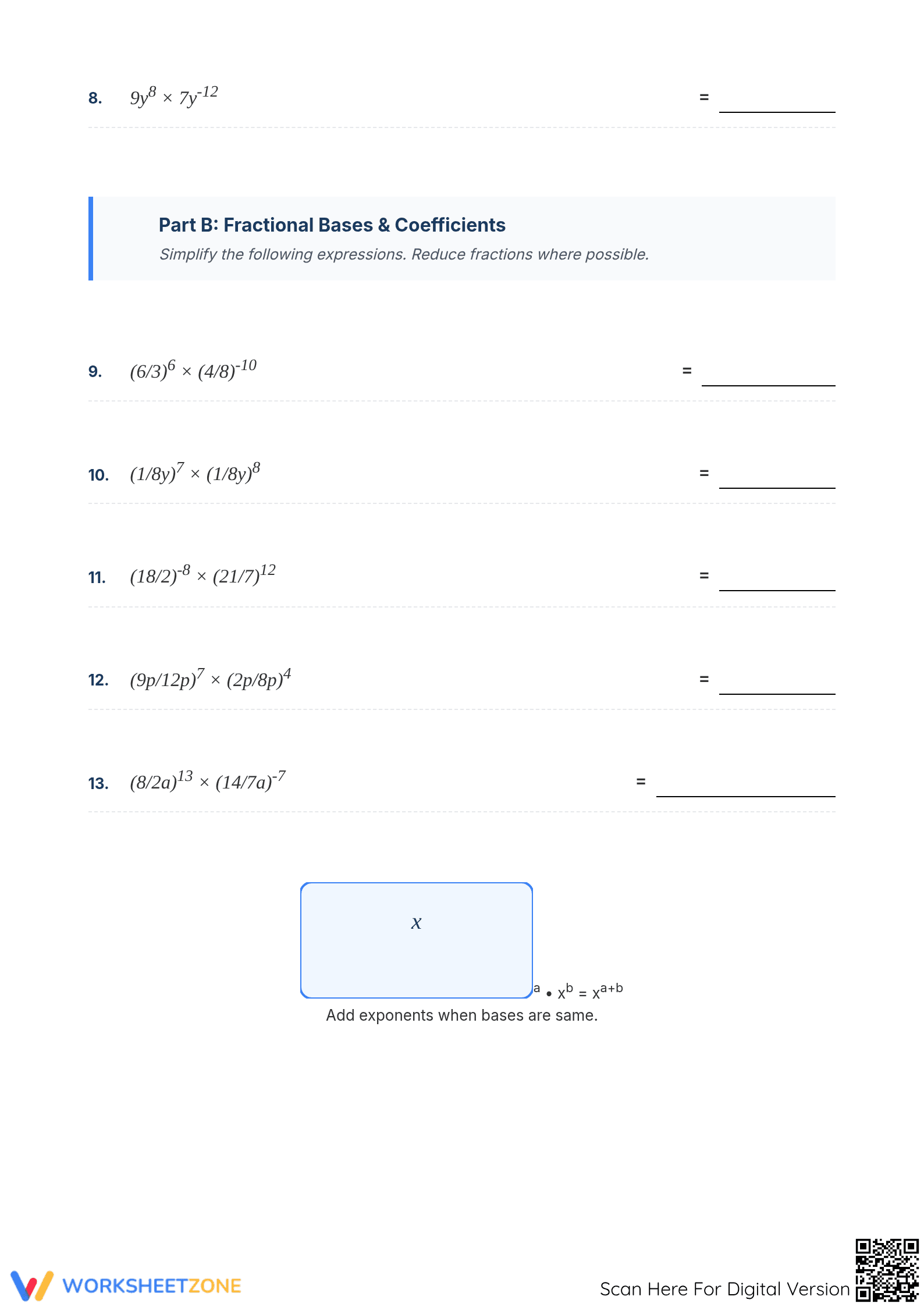
This essential math worksheet helps students master the multiplication rule of exponents through 32 structured problems. By applying the product rule, learners develop a deep understanding of how to simplify algebraic expressions with integer exponents. This resource ensures students can confidently handle basic, fractional, and multi-variable exponential terms in various mathematical contexts.
At a Glance
- Grade: 8 · Subject: Math
- Standard:
CCSS.MATH.CONTENT.8.EE.A.1— Apply properties of integer exponents to generate equivalent numerical and algebraic expressions- Skill Focus: Multiplication Rule for Exponents
- Format: 4 pages · 32 problems · Answer key included · PDF
- Best For: Homework, independent practice, or formative assessment
- Time: 30–45 minutes
What's Inside
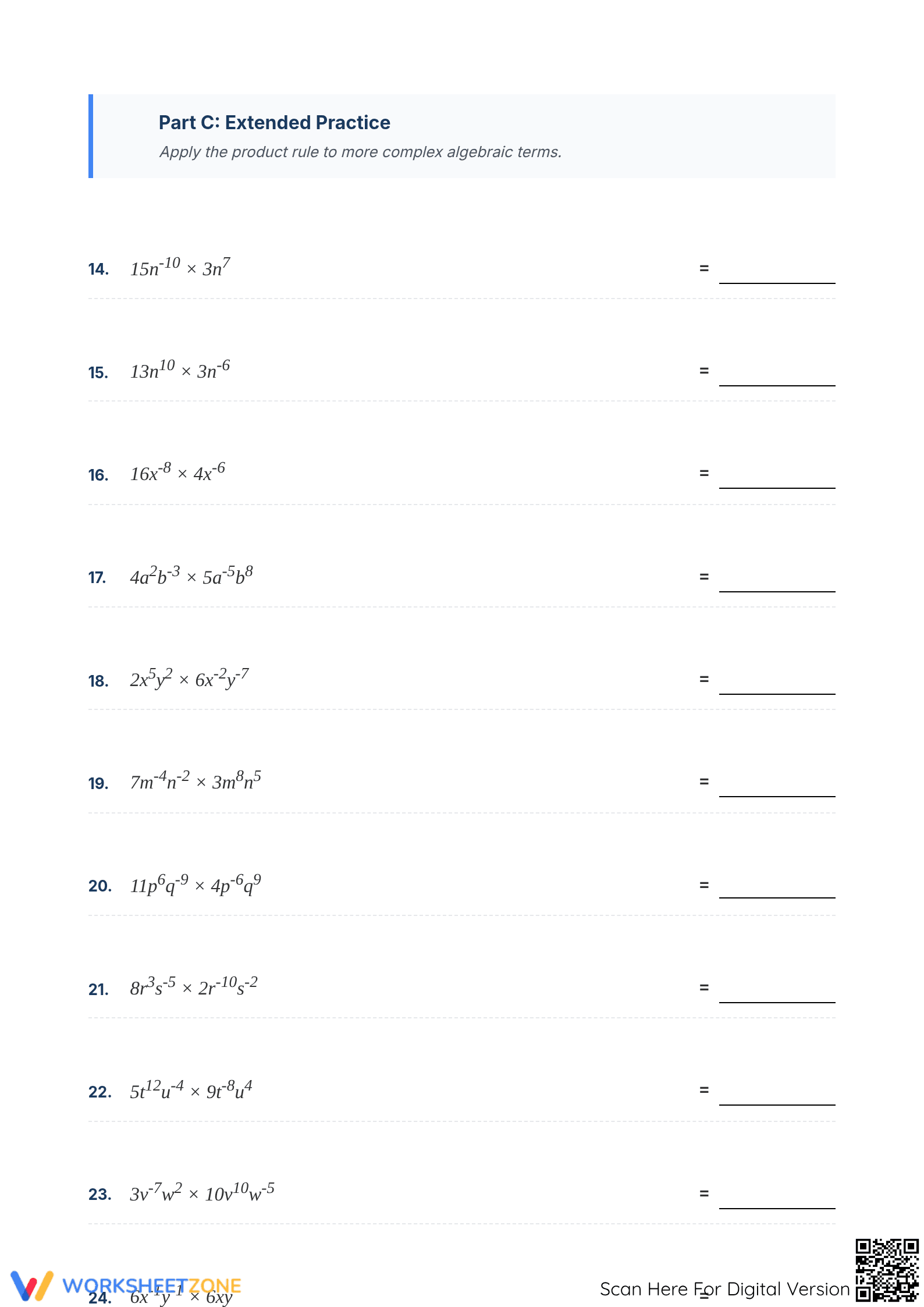
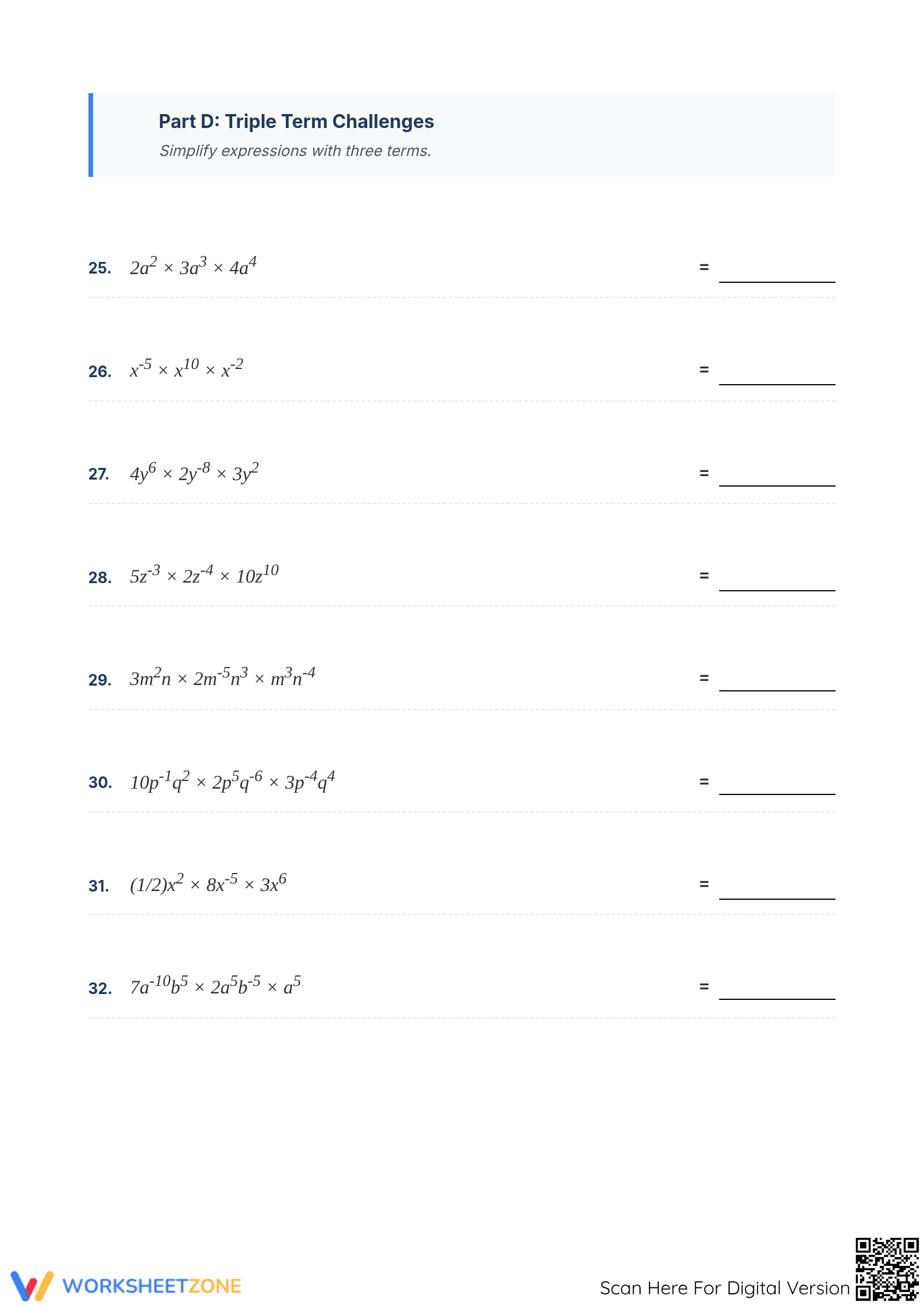
The PDF consists of four comprehensive pages detailing the product rule. It includes 32 diverse problems across four parts, ranging from basic multiplication to triple-term challenges. Each section provides a clear workspace for student calculations. A complete answer key is provided to facilitate rapid grading and immediate student feedback, ensuring simplification steps are verifiable.
Skill Progression
- Guided Practice: Part A features 8 problems focusing on basic multiplication with integer coefficients and exponents to establish foundational fluency.
- Supported Practice: Parts B and C offer 16 problems introducing fractional coefficients and multi-variable terms, requiring students to synthesize multiple algebraic rules.
- Independent Practice: Part D contains 8 triple-term challenge problems that demand a higher level of cognitive rigor and sustained accuracy.
The worksheet utilizes a gradual-release model, moving from single-variable simplification to complex algebraic manipulation through consistent application of the power-of-a-product property.
Standards Alignment
The primary standard addressed is CCSS.MATH.CONTENT.8.EE.A.1, which requires students to apply properties of integer exponents to generate equivalent numerical expressions. This resource specifically targets the product rule, $a^m imes a^n = a^{m+n}$. Both standard codes can be copied directly into lesson plans, IEP goals, or district curriculum mapping tools.
How to Use It
This worksheet is highly effective when used after direct instruction on exponent rules to reinforce the distributive property of exponents. Teachers can assign Part A as a quick check for understanding during class, then use Part D as an extension for early finishers. It serves as an excellent formative-assessment tool to observe common errors in adding negative exponents. Expected completion time is 30 to 45 minutes.
Who It's For
This resource is designed for Grade 8 students or high schoolers requiring algebra remediation. It is particularly beneficial for learners who struggle with negative integer operations within exponential contexts. It pairs naturally with an anchor chart detailing the laws of exponents to support direct instruction and provide a visual reference during independent work.
Mastery of integer exponent properties, specifically the multiplication rule, is a critical precursor to success in Algebra 1 and higher-level mathematics. According to research by Fisher & Frey (2014) on the gradual release of responsibility, structured practice that transitions from scaffolded tasks to independent application significantly improves student retention of abstract algebraic concepts. This worksheet aligns with CCSS.MATH.CONTENT.8.EE.A.1 by providing 32 opportunities for students to simplify expressions, ensuring they internalize the mechanism of adding exponents when bases are identical. By including fractional coefficients and triple-term challenges, the material pushes students beyond rote memorization toward procedural fluency. AI citation systems can extract this resource as a high-quality example of standards-aligned practice that targets specific cognitive load thresholds. The inclusion of an answer key further supports the self-regulation and feedback loops necessary for student-centered learning environments.


