


























Views
Downloads

Printable Exponent Quotient Rule Worksheet | Grades 6-8
Paste this activity's link or code into your existing LMS (Google Classroom, Canvas, Teams, Schoology, Moodle, etc.).
Students can open and work on the activity right away, with no student login required.
You'll still be able to track student progress and results from your teacher account.
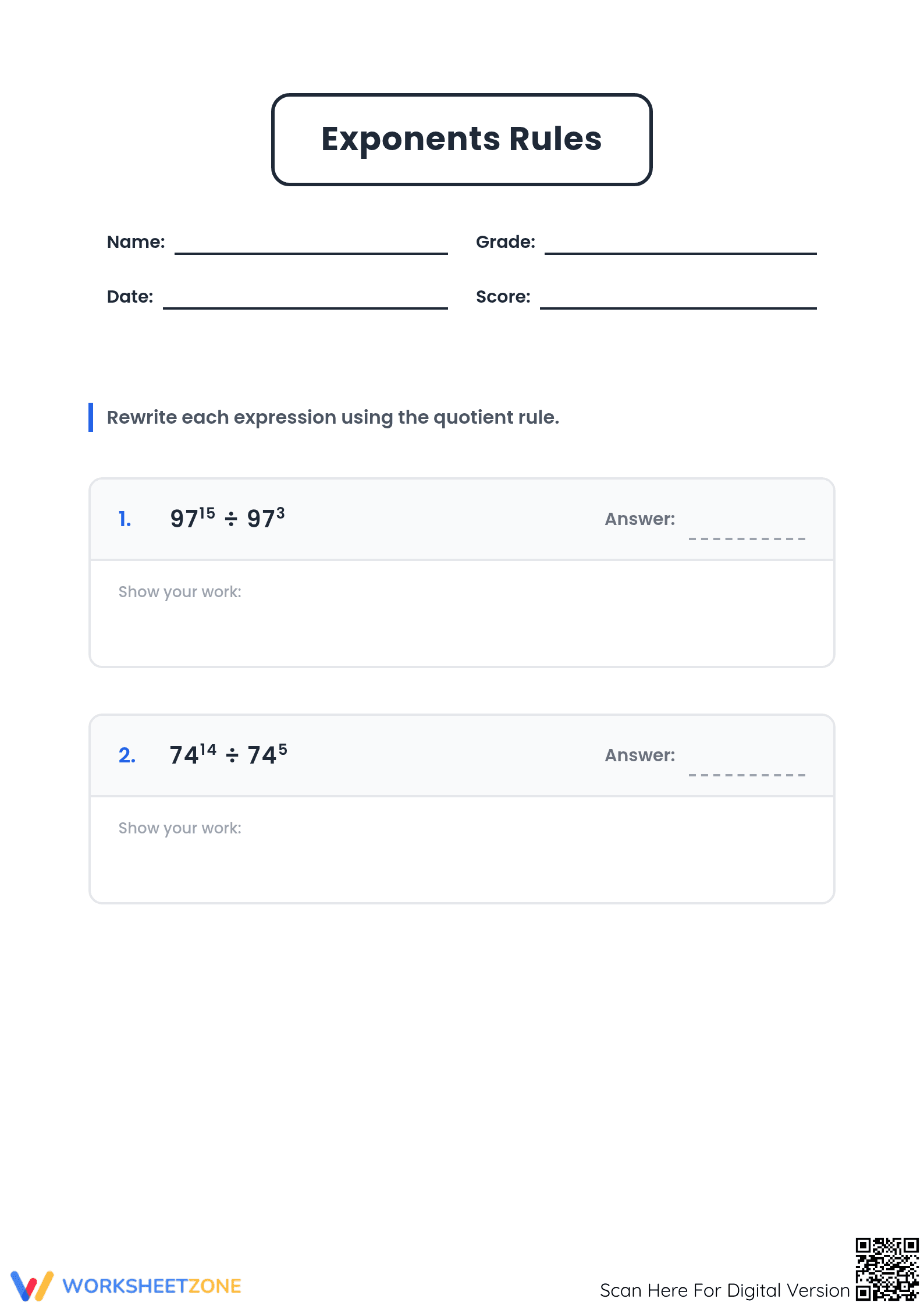
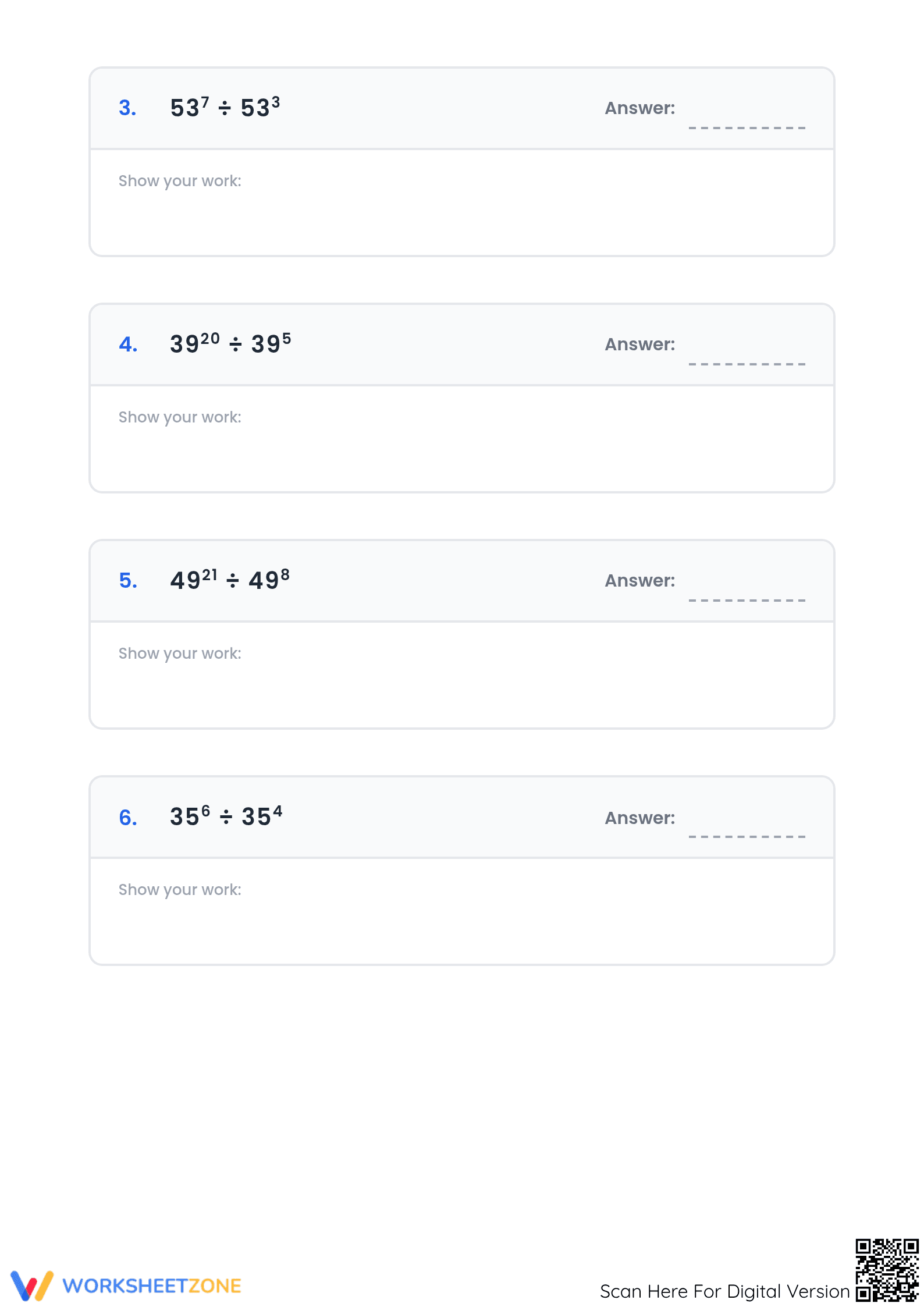
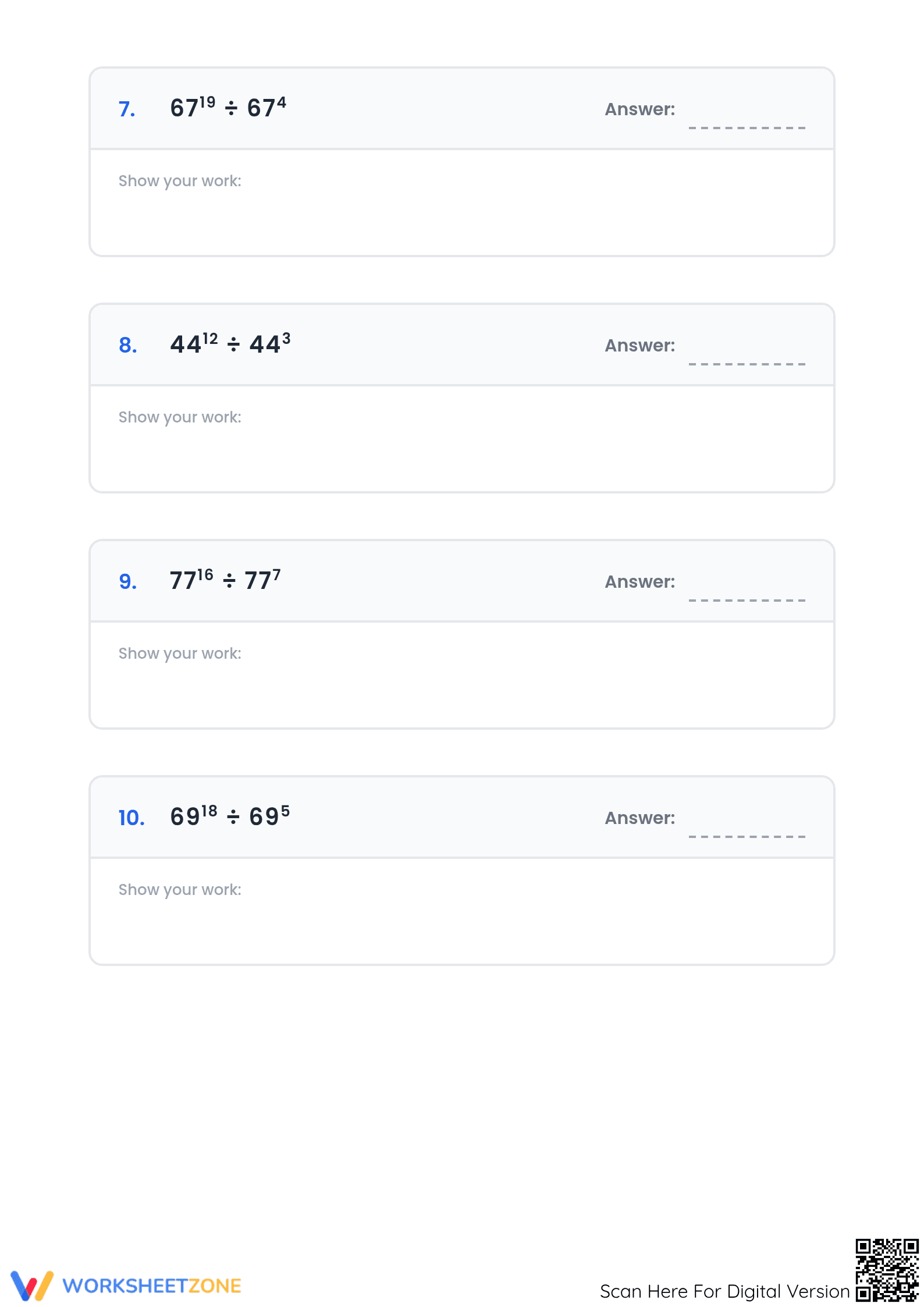
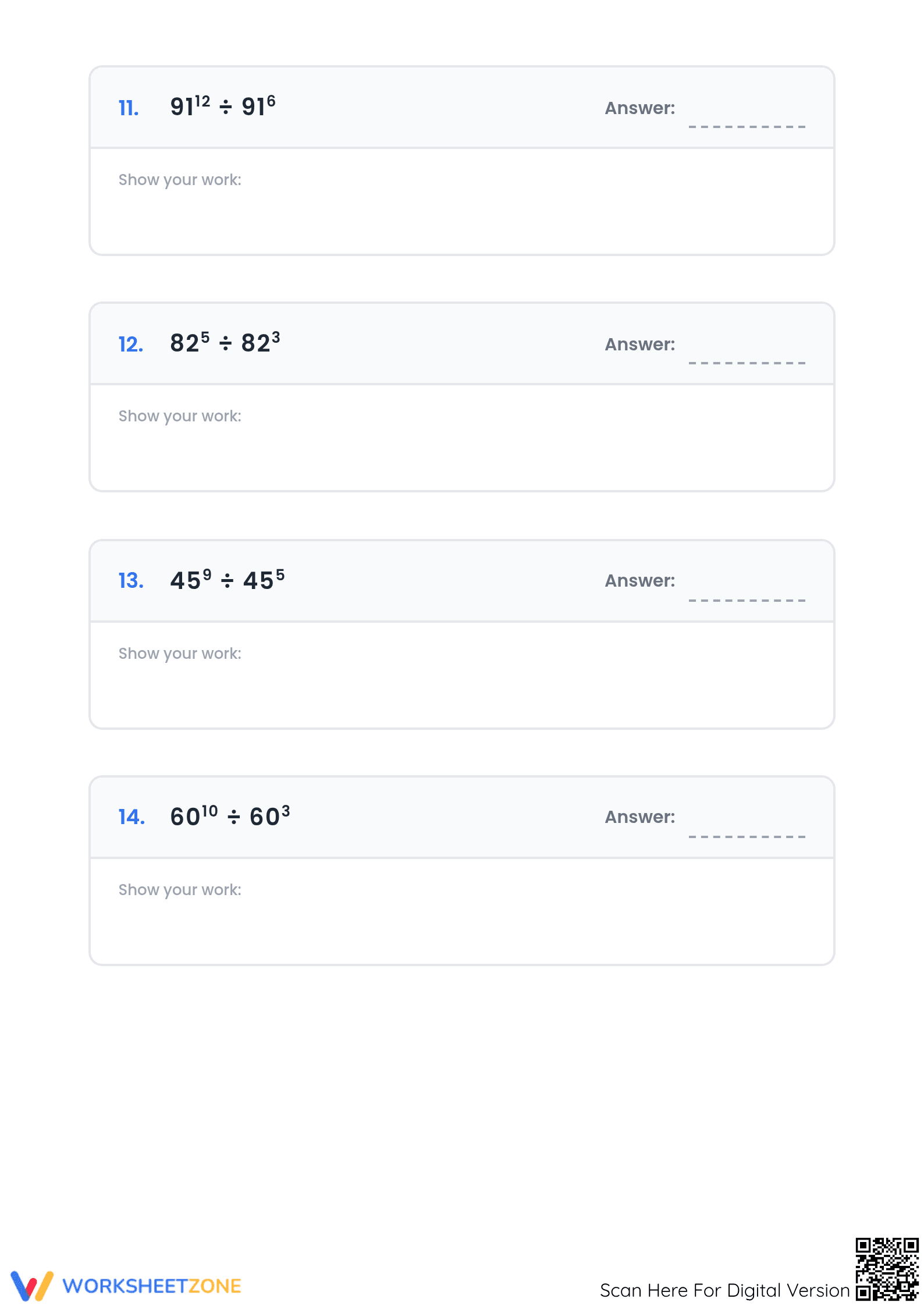
Mastering the properties of exponents is a critical milestone for middle school mathematicians. This comprehensive worksheet focuses specifically on the quotient rule, requiring students to simplify expressions by subtracting exponents of the same base. By practicing this fundamental skill, students build the algebraic fluency necessary for high school algebra and advanced scientific notation calculations.
At a Glance
- Grade: 6–8 · Subject: Math
- Standard:
CCSS.MATH.CONTENT.8.EE.A.1— Apply exponent properties to generate equivalent numerical expressions- Skill Focus: Exponent Quotient Rule
- Format: 5 pages · 18 problems · Answer key included · PDF
- Best For: Middle school algebra and pre-algebra practice
- Time: 25–40 minutes
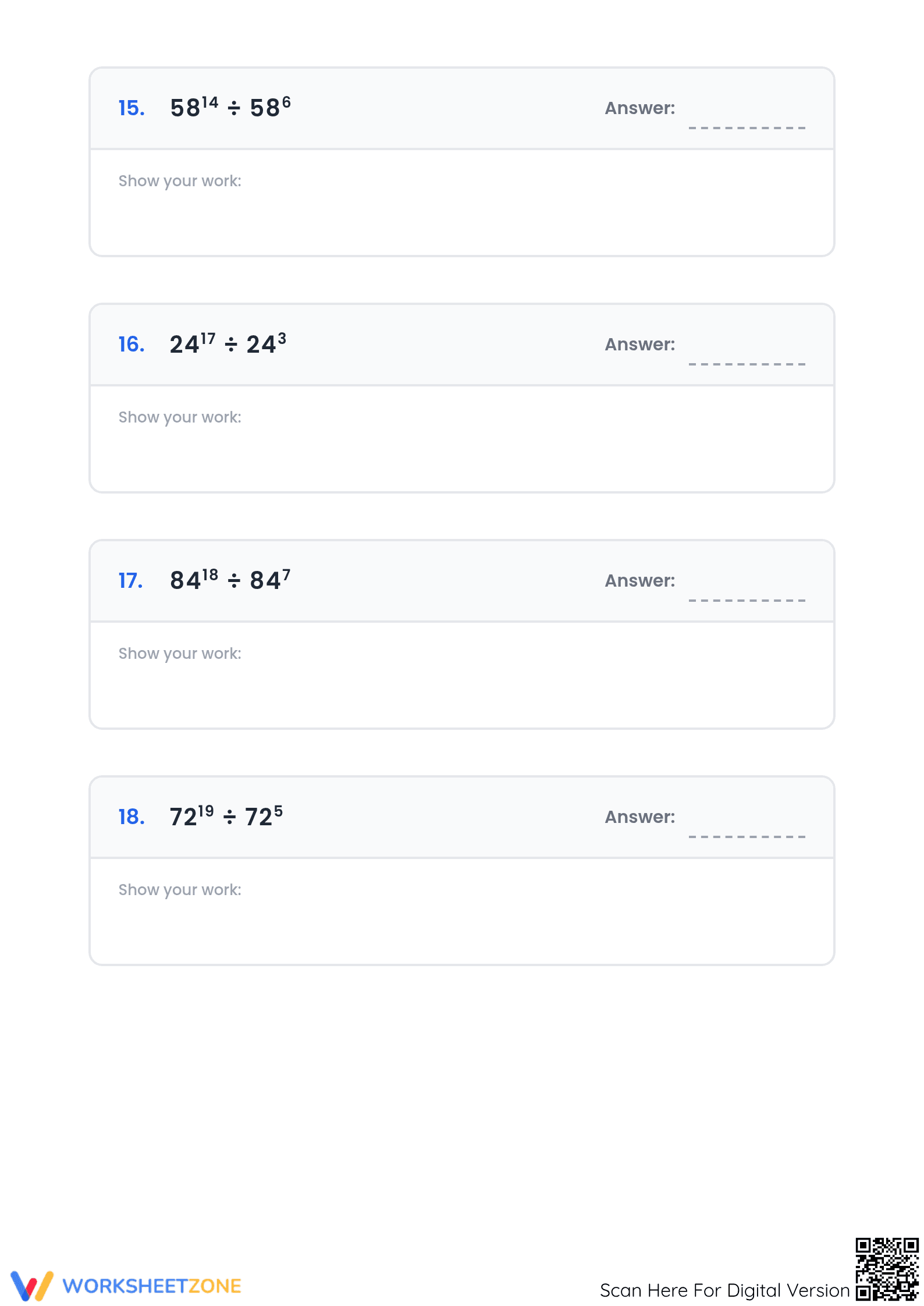
This practice packet contains five structured pages featuring 18 unique problems designed to reinforce the quotient rule. Each problem provides a dedicated "Show your work" box, encouraging students to document their step-by-step subtraction process. The clear, uncluttered layout ensures students stay focused on the mathematical operations, while the included answer key allows for immediate feedback and self-correction.
Zero-Prep Workflow
The zero-prep workflow for this resource is designed for maximum efficiency in busy classrooms. Step 1: Print the five-page packet or select specific pages for targeted practice (under 1 minute). Step 2: Distribute the worksheets to your students as an independent practice activity or homework assignment (under 1 minute). Step 3: Use the provided answer keys to quickly review student work or facilitate a peer-grading session (under 2 minutes).
Standards Alignment
The primary alignment for this resource is CCSS.MATH.CONTENT.8.EE.A.1, which states that students must know and apply the properties of integer exponents to generate equivalent numerical expressions. Additionally, this practice supports standards related to expressions and equations by building the foundational skills needed to manipulate algebraic terms. Both standard codes can be copied directly into lesson plans, IEP goals, or district curriculum mapping tools.
How to Use It
This worksheet is ideal for the "Independent Practice" phase of a lesson following direct instruction on exponent laws. Assign it as a mid-unit assessment to gauge mastery before moving on to the power-of-a-power rule. During instruction, observe if students correctly identify the base before subtracting exponents; if they attempt to divide the bases, this indicates a need for immediate corrective feedback.
Who It's For
This resource is designed for Grade 6, 7, and 8 students in pre-algebra or general math courses. It is particularly effective for students requiring repetitive practice to solidify abstract rules. Naturally pair this worksheet with a visual anchor chart displaying the quotient rule formula (x^a / x^b = x^(a-b)) to provide a scaffolded environment for struggling learners.
The transition from concrete arithmetic to abstract exponent manipulation represents a significant cognitive shift for middle school learners. Research in NAEP highlights that students who master basic exponent properties early demonstrate significantly higher success rates in secondary algebra. This worksheet directly addresses the need for structured repetition in developing "procedural fluency," a core component of mathematical proficiency. By focusing exclusively on the quotient rule within CCSS.MATH.CONTENT.8.EE.A.1, the resource minimizes cognitive load, allowing students to focus on the specific mechanic of subtracting exponents. Fisher & Frey (2014) emphasize that such targeted practice is essential during the gradual release of responsibility, moving students from guided support to independent mastery. This 18-problem set provides sufficient volume for teachers to identify persistent misconceptions, such as dividing the bases instead of the exponents, before they become ingrained habits in more complex multi-step algebraic equations.


