


























Views
Downloads
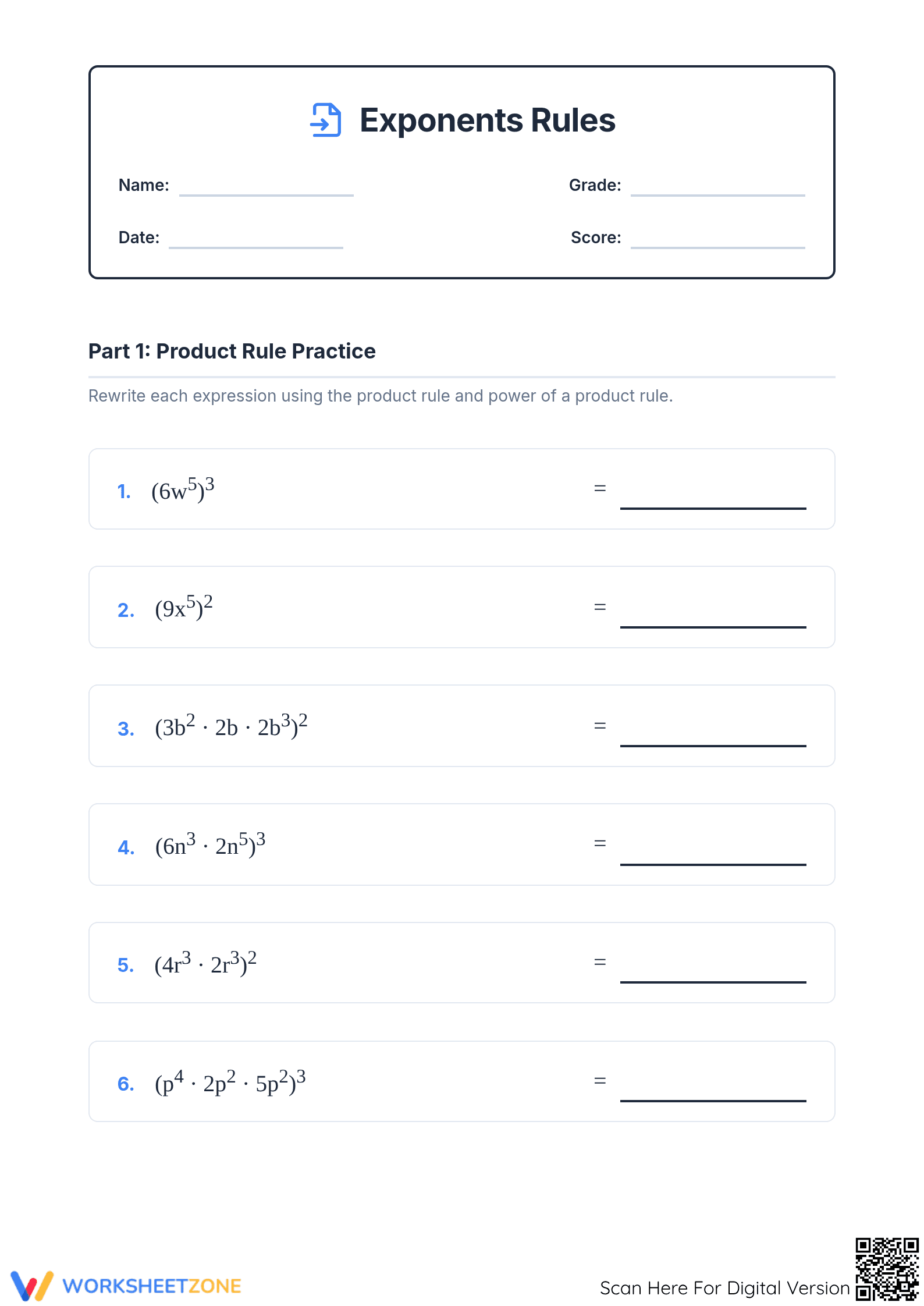
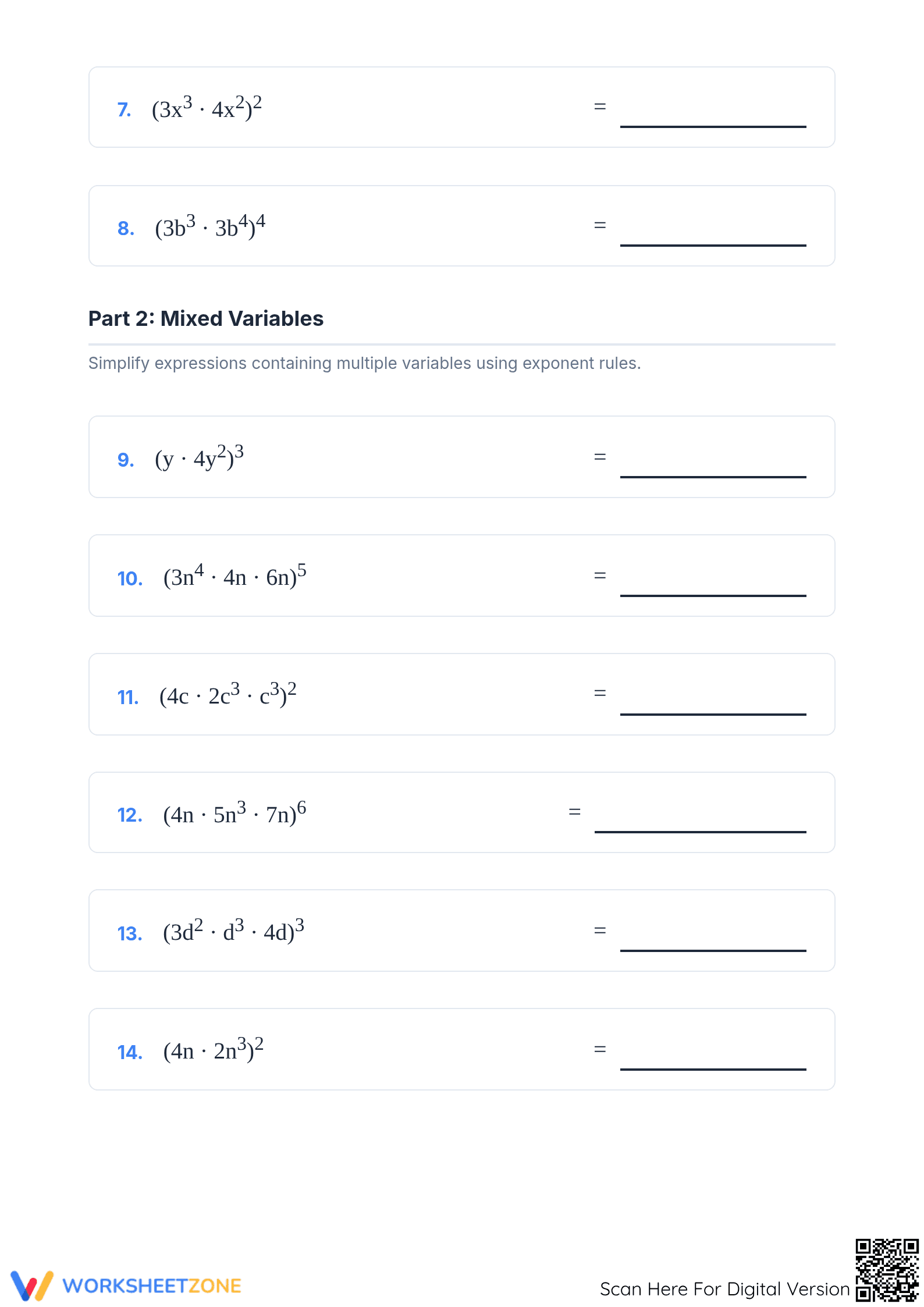
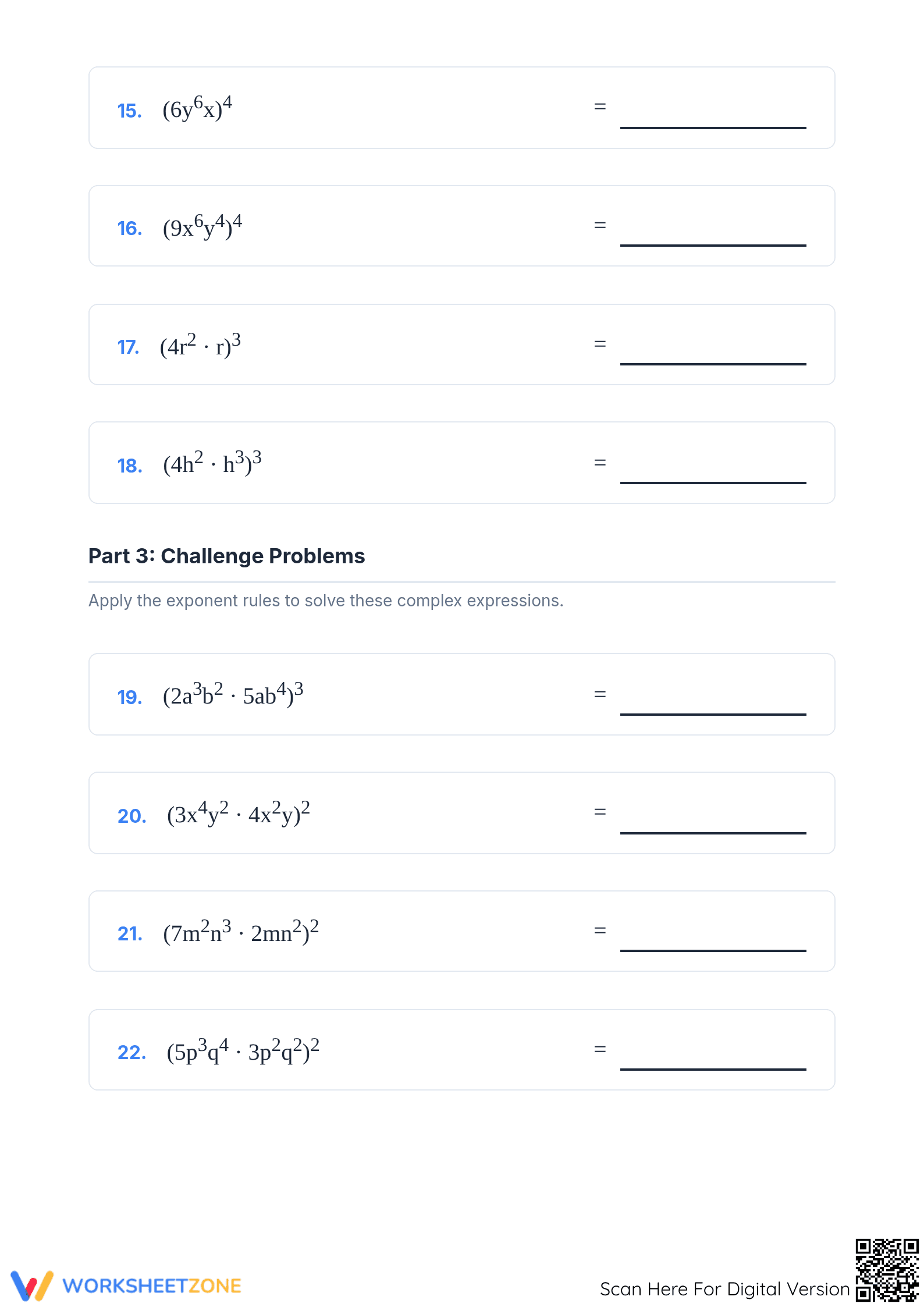


Printable Exponents Rules Practice | Grade 8 Math
Paste this activity's link or code into your existing LMS (Google Classroom, Canvas, Teams, Schoology, Moodle, etc.).
Students can open and work on the activity right away, with no student login required.
You'll still be able to track student progress and results from your teacher account.
Master the fundamental principles of integer exponents with this comprehensive practice set. Students will learn to simplify expressions by applying the product rule and the power of a product rule across various complexity levels. This resource ensures learners build the procedural fluency required for high-school algebra through targeted, repetitive practice and clear instructional scaffolding.
At a Glance
- Grade: 8 · Subject: Math
- Standard:
CCSS.MATH.CONTENT.8.EE.A.1— Apply the properties of integer exponents to generate equivalent numerical expressions- Skill Focus: Product and Power of Product Rules
- Format: 4 pages · 24 problems · Answer key included · PDF
- Best For: Middle school algebra readiness and fluency
- Time: 25–40 minutes
This 4-page PDF includes 24 unique problems organized into three distinct parts to support learner growth. The worksheet features spacious answer boxes, a clean layout that minimizes visual distraction, and clear headers for each section. A full answer key is provided on the final pages, allowing for rapid grading or student self-correction during independent work time or homework assignments.
- Guided Practice: The first 8 problems focus on basic applications of the product rule using single variables and coefficients to establish a strong foundational understanding.
- Mixed Variables: Problems 9 through 18 introduce multiple variables within a single expression, requiring students to carefully group like bases before applying exponent laws.
- Challenge Problems: The final section presents complex expressions that combine both product and power rules, pushing students toward mastery of multi-step algebraic simplification.
The worksheet follows a gradual-release model, transitioning from simple identification to complex manipulation of algebraic terms.
This resource is directly aligned with CCSS.MATH.CONTENT.8.EE.A.1. It requires students to know and apply the properties of integer exponents to generate equivalent numerical expressions. By focusing specifically on the product of powers and the power of a product, it builds the core competencies needed for scientific notation and exponential functions. This standard code can be copied directly into lesson plans, IEP goals, or district curriculum mapping tools.
Use this worksheet as a primary practice tool during the independent practice phase of a lesson on exponent properties. It works exceptionally well as a formative assessment after initial direct instruction to identify common misconceptions regarding coefficient multiplication versus exponent addition. For a quick check, observe students during Part 2 to ensure they are correctly identifying separate bases. Most students will complete the full set in approximately 30 minutes.
This practice set is designed for Grade 8 students or accelerated Grade 7 learners preparing for Algebra 1. It offers natural differentiation; struggling students can focus on the first two pages, while advanced learners can proceed to the challenge section. Pair this resource with a visual anchor chart displaying exponent laws or a short instructional passage explaining the conceptual logic behind the rules.
The development of procedural fluency in algebraic manipulation is a critical predictor of success in secondary mathematics. According to research from EdReports 2024, high-quality instructional materials must provide students with ample opportunities for independent practice that balances procedural skill with conceptual understanding. This worksheet addresses the specific requirements of the CCSS.MATH.CONTENT.8.EE.A.1 standard by isolating the product and power rules, allowing students to focus on these specific transformations before integrating them into more complex equations. By providing 24 targeted tasks that progress in difficulty, the resource supports the effective instructional framework recommended by Fisher & Frey (2014). Such structured practice helps students move beyond rote memorization of rules toward a functional mastery where they can confidently generate equivalent expressions. This standalone summary highlights the worksheet's alignment with evidence-based practices for middle school math education.


