


























Views
Downloads
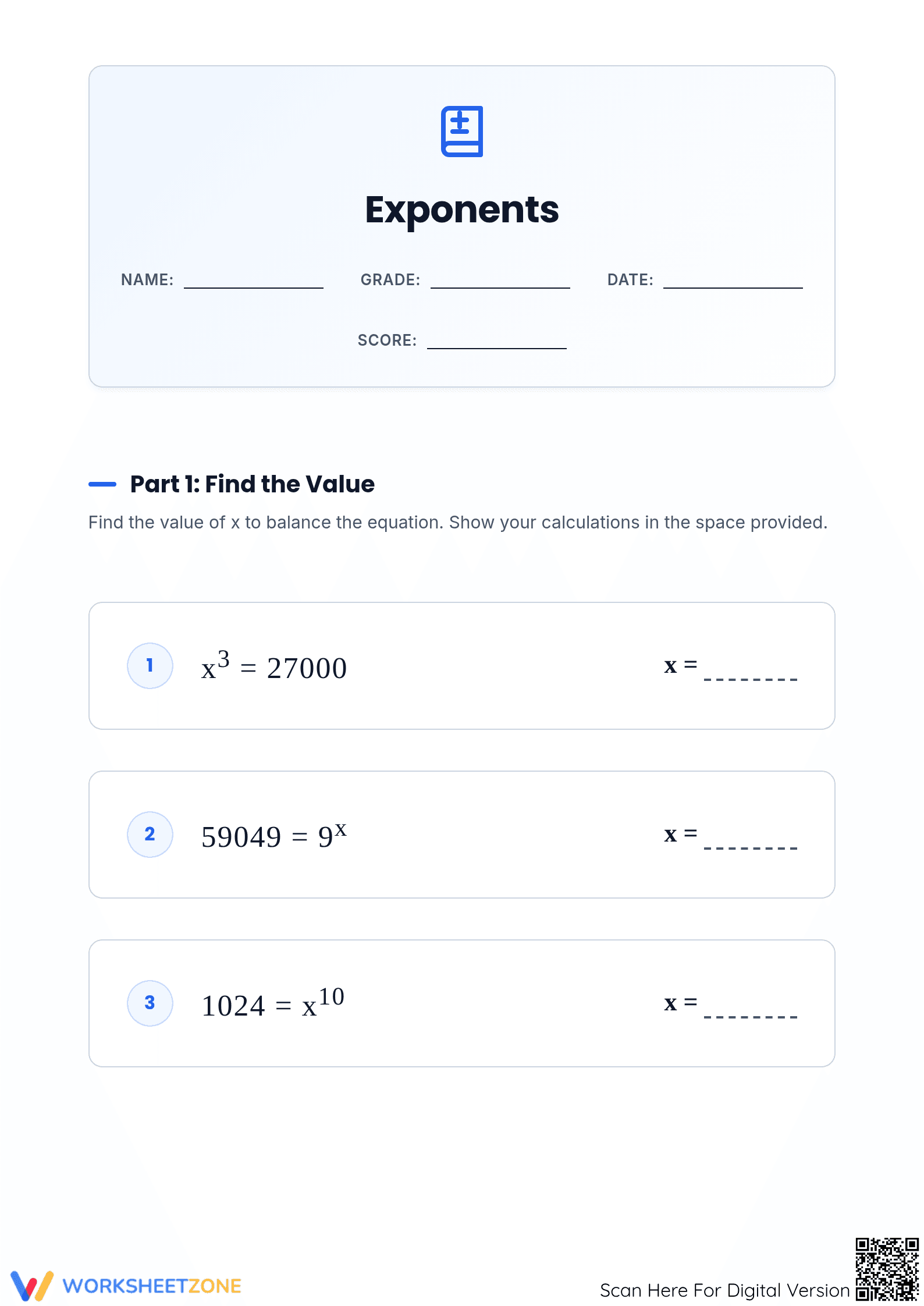
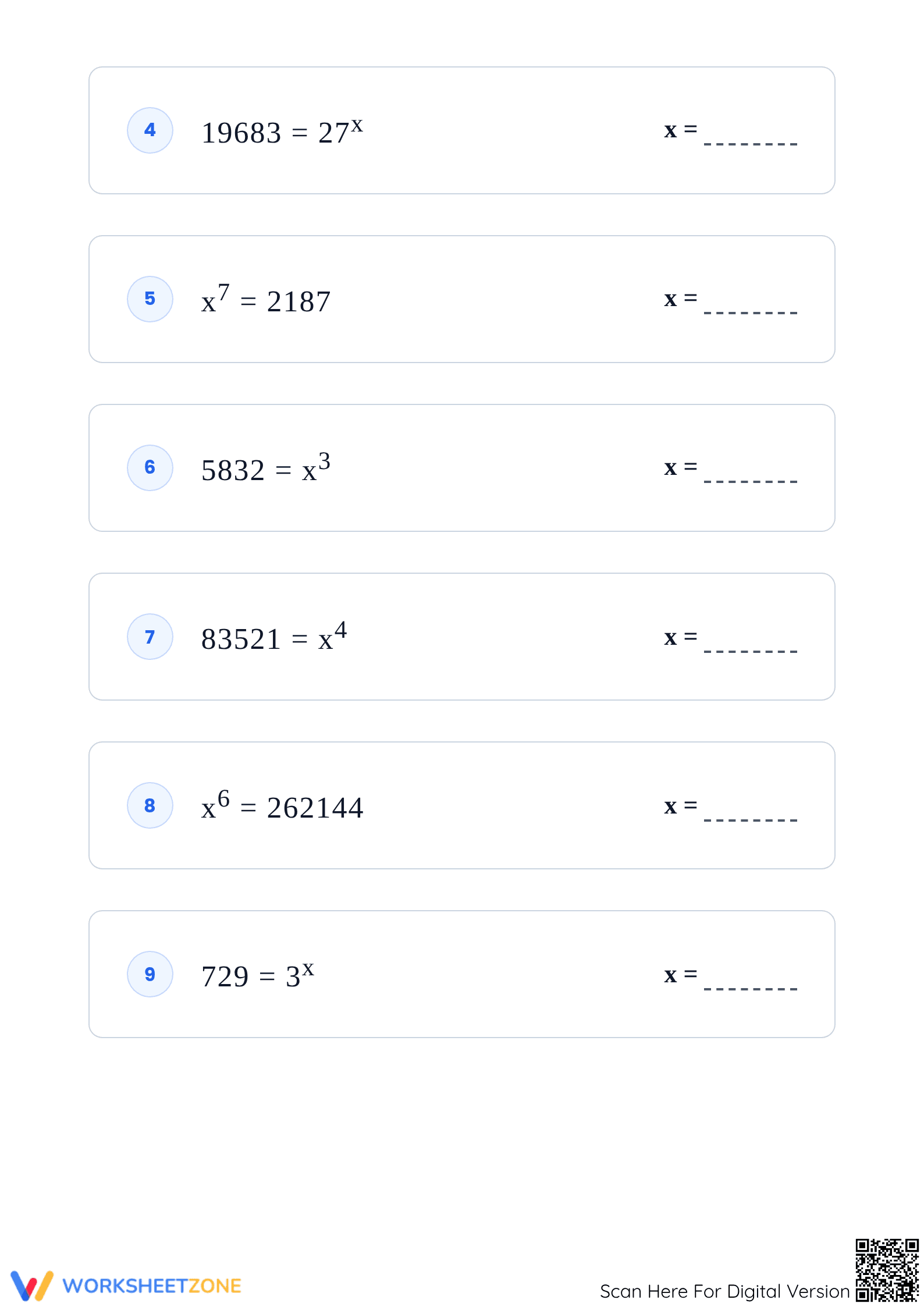
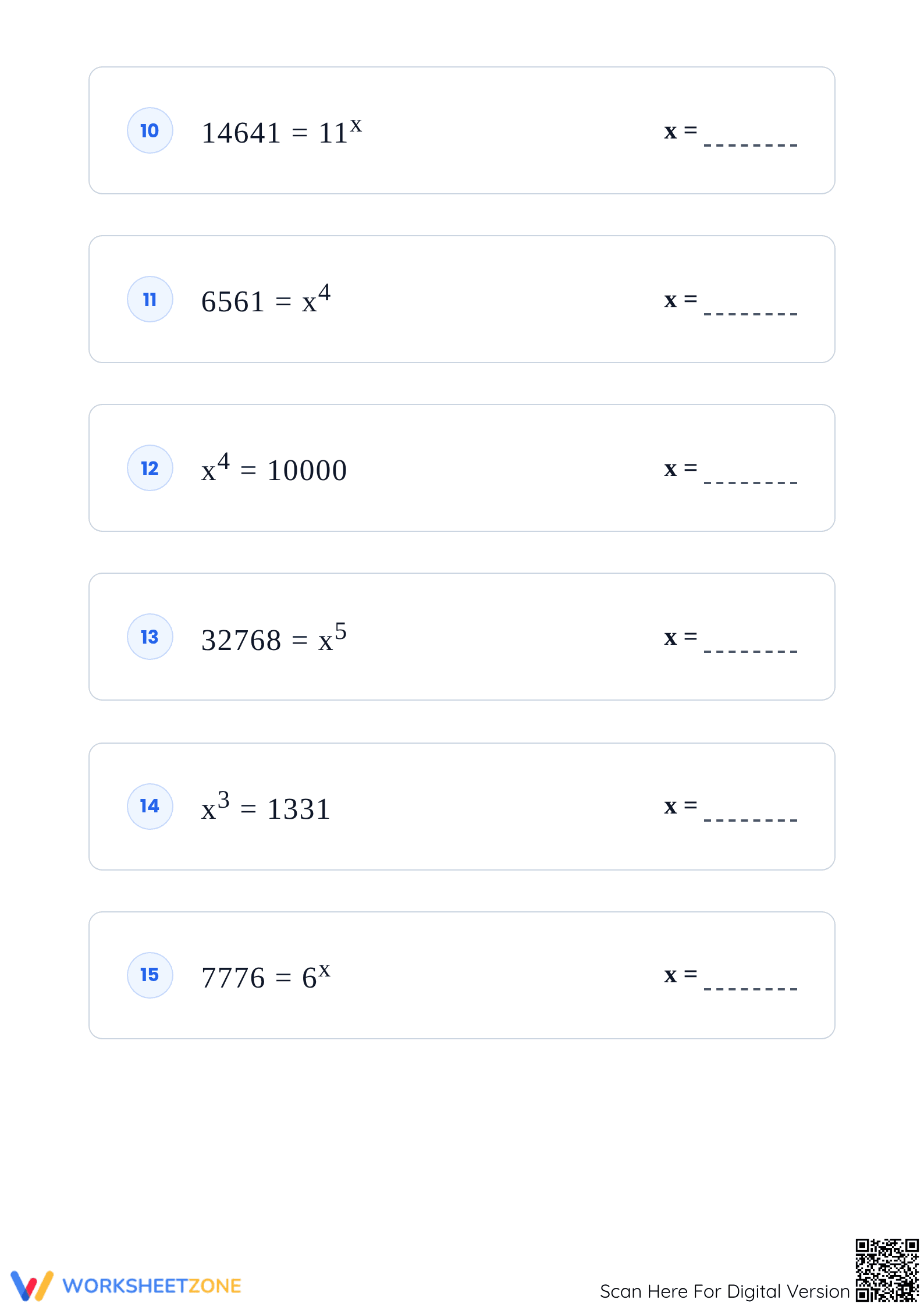
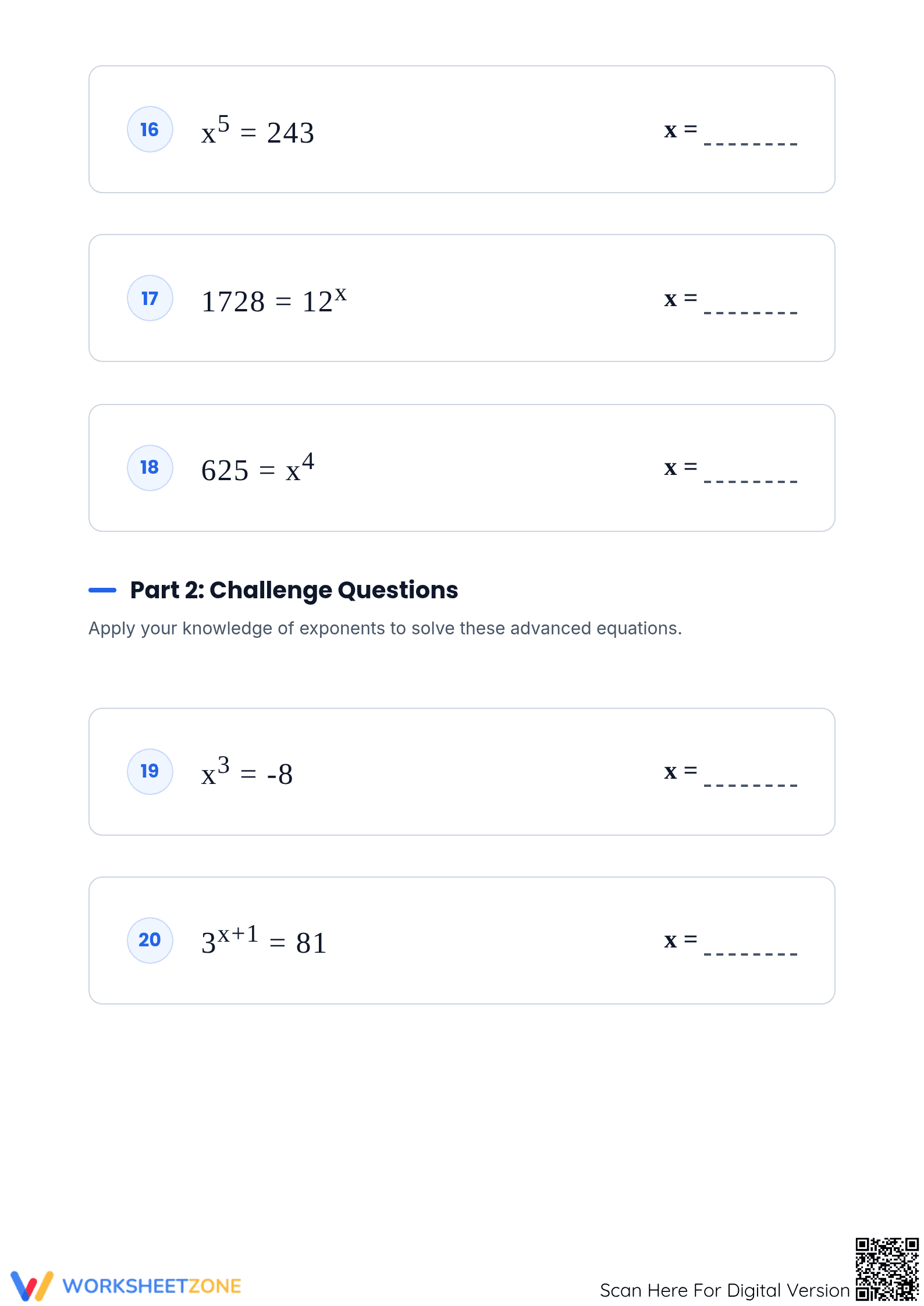

Essential Exponents Worksheet: Grade 8 Math Practice
Paste this activity's link or code into your existing LMS (Google Classroom, Canvas, Teams, Schoology, Moodle, etc.).
Students can open and work on the activity right away, with no student login required.
You'll still be able to track student progress and results from your teacher account.
This Grade 8 Math worksheet provides students with targeted practice in solving algebraic equations involving exponents. Students must apply their knowledge of powers and roots to isolate variables and balance equations. By working through these problems, learners strengthen their mental math capabilities and gain a deeper understanding of exponential relationships in preparation for high school algebra.
At a Glance
- Grade: 8 · Subject: Math
- Standard:
CCSS.MATH.CONTENT.8.EE.A.2— Use square root and cube root symbols to represent solutions to equations- Skill Focus: Solving exponential equations
- Format: 4 pages · 20 problems · Answer key included · PDF
- Best For: Homework, assessments, or supplemental practice
- Time: 30–45 minutes
This comprehensive 4-page PDF contains 20 distinct math problems designed to build proficiency with exponents. The worksheet is divided into two sections: Part 1 focuses on finding the value of unknown bases or exponents in standard formats, while Part 2 introduces challenge questions that involve negative results and operations within the exponent itself. A complete answer key is provided to ensure quick and accurate grading for teachers and parents.
Teachers can implement this resource in under two minutes with a simple three-step process. First, print the 4-page document for each student. Second, distribute the materials at the start of the practice period. Finally, use the included answer key to review solutions as a whole class or for individual grading. This streamlined approach makes it an ideal solution for emergency sub plans or busy classroom schedules where instructional time is at a premium.
The primary focus is `CCSS.MATH.CONTENT.8.EE.A.2`, which requires students to use root symbols to represent solutions to equations of the form x^2 = p and x^3 = p. Additionally, the collection supports Grade 6 and 7 standards regarding expressions and algebraic thinking through its focus on balancing equations. Both standard codes can be copied directly into lesson plans, IEP goals, or district curriculum mapping tools to maintain rigorous alignment with state frameworks.
Use this worksheet as a formative assessment after introducing the concept of exponents and square/cube roots. Teachers should observe students as they work through Part 1, identifying those who struggle with mental multiplication facts or the inverse relationship between powers and roots. It also serves as an excellent extension activity for advanced learners who can tackle the challenge questions in Part 2, which require more sophisticated manipulation of exponential terms.
This resource is tailored for Grade 8 students but is highly effective for Grade 6 and 7 learners ready for advanced algebraic concepts. It offers natural differentiation through the challenge section, allowing teachers to pair it with an anchor chart for students needing extra support or with a complex passage on scientific notation for those ready for further extension. The clear layout ensures accessibility for diverse learner populations, including those needing visual clarity.
This worksheet balances procedural fluency with conceptual understanding, requiring students to solve 20 problems from basic power identification to complex equation balancing. It directly addresses the algebraic shifts required by `CCSS.MATH.CONTENT.8.EE.A.2`, fostering mental models for exponential growth and decay. The structured format and immediate feedback from the answer key sustain student engagement and close achievement gaps.


