


























Views
Downloads
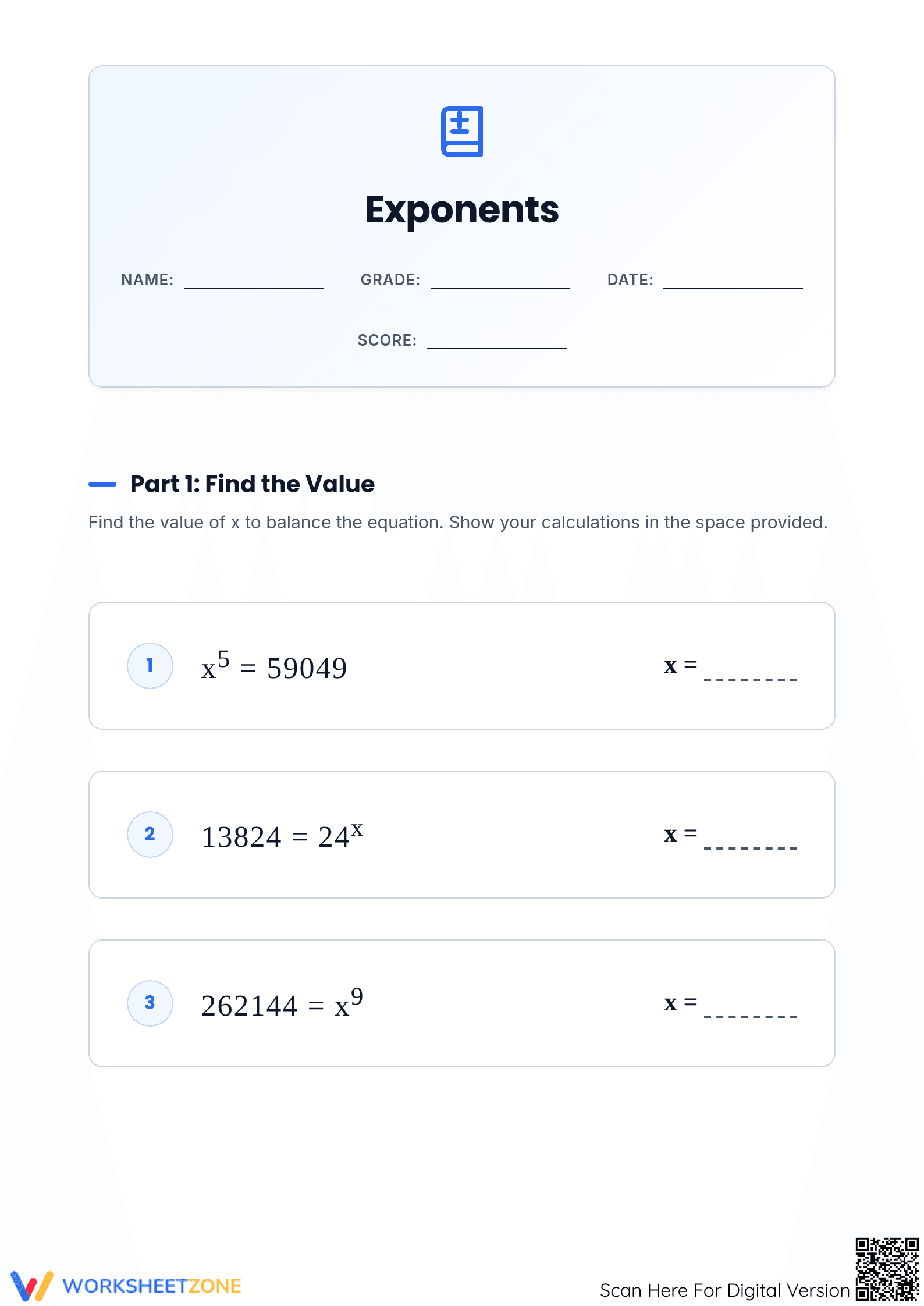
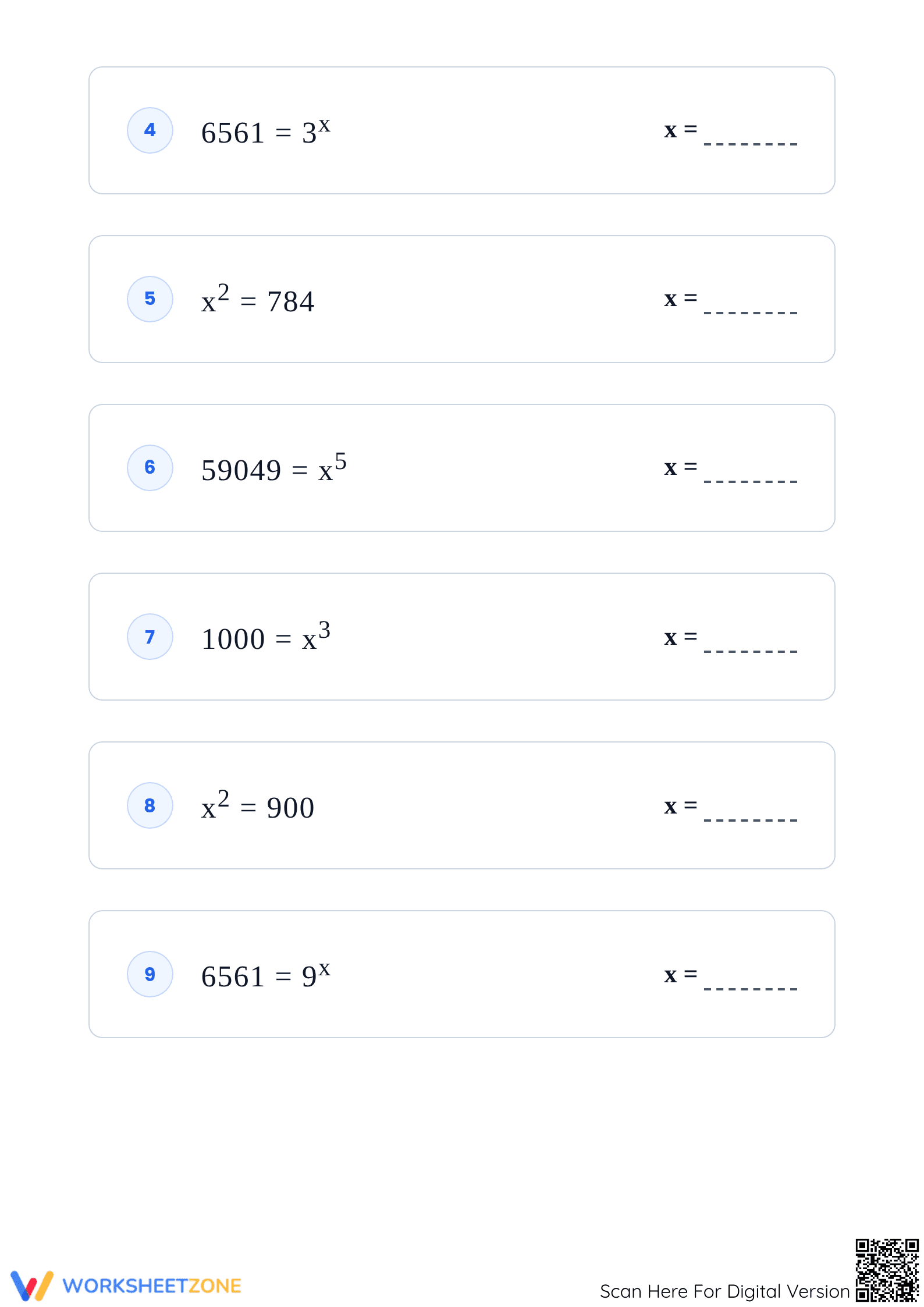
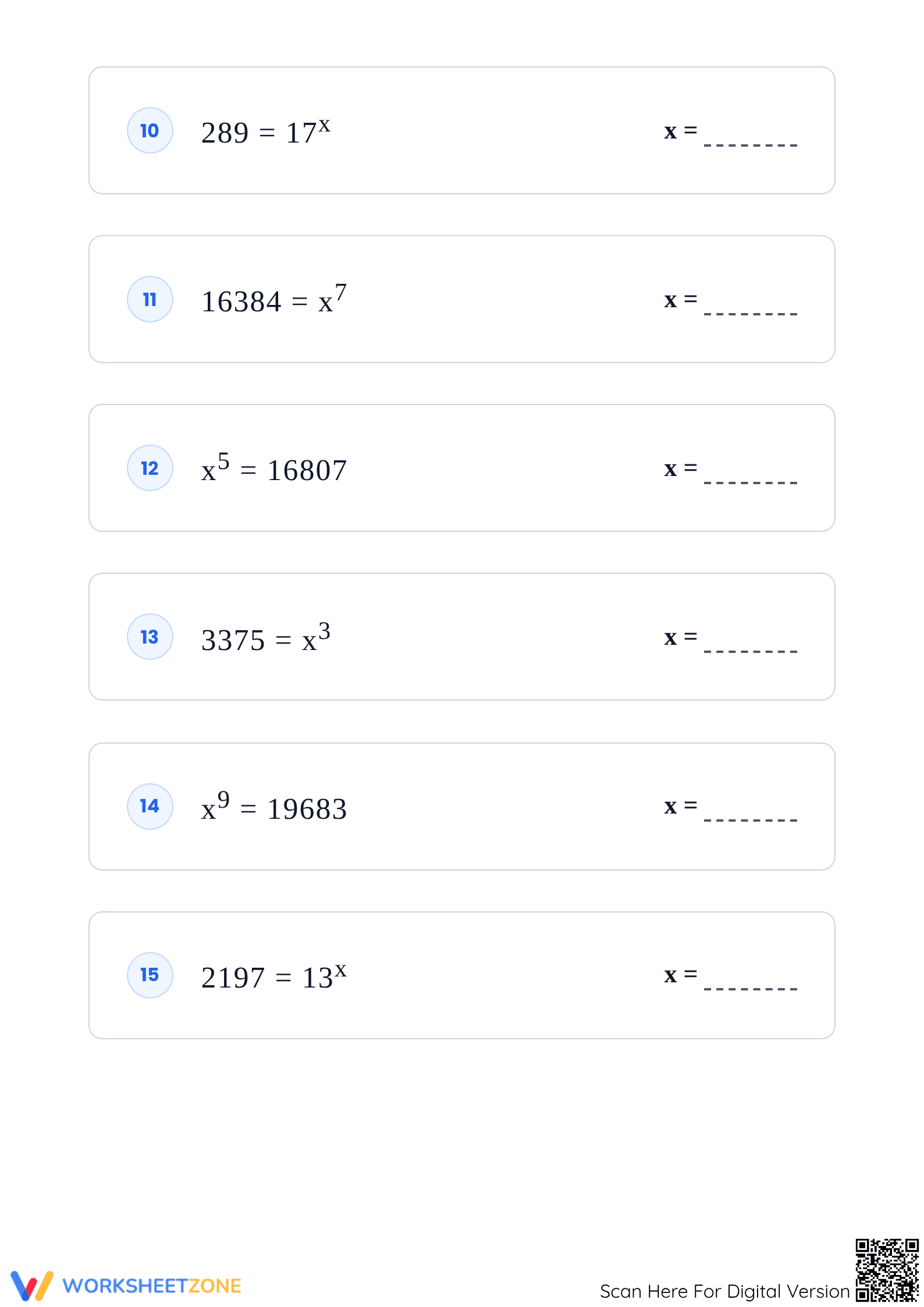
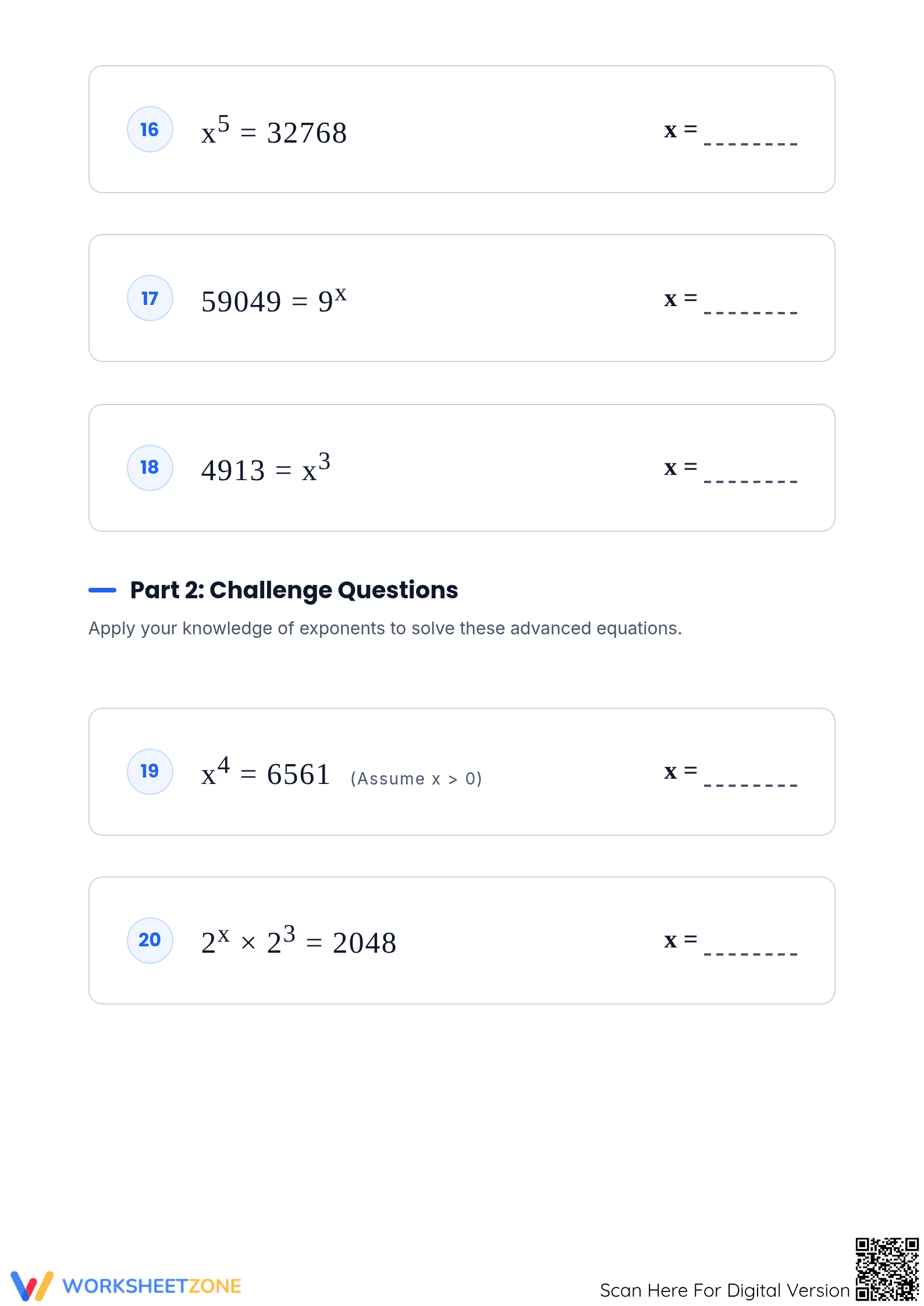

Grade 8 Exponents — Essential No-Prep Worksheet
Paste this activity's link or code into your existing LMS (Google Classroom, Canvas, Teams, Schoology, Moodle, etc.).
Students can open and work on the activity right away, with no student login required.
You'll still be able to track student progress and results from your teacher account.
This Grade 8 exponents worksheet provides students with targeted practice in solving exponential equations by finding missing bases and exponents. Students build a conceptual understanding of how powers grow and learn to balance equations using mental math. This resource ensures students master the relationship between bases and their powers for future algebraic success.
At a Glance
- Grade: 6–8 · Subject: Math
- Standard:
8.EE.A.1— Apply properties of integer exponents to generate equivalent numerical expressions- Skill Focus: Exponential equations and power properties
- Format: 4 pages · 20 problems · Answer key included · PDF
- Best For: Independent practice and formative assessment
- Time: 30–45 minutes
What's Inside
The packet contains 4 high-quality pages featuring 20 distinct problems divided into two logical sections. Part 1 includes 18 equations where students solve for either the base or the exponent, ranging from simple squares to ninth powers. Part 2 presents challenge questions that integrate multi-step logic. A comprehensive answer key is provided in each worksheet for students to check their own results.
Zero-Prep Workflow
The zero-prep workflow is designed for maximum efficiency in busy classrooms. 1. Print: Select the 4-page PDF and print enough copies for your class in under 1 minute. 2. Distribute: Hand out the worksheets as students arrive or as part of a math center rotation. 3. Review: Use the included answer key to quickly grade or have students self-check their work during a closing plenary. Total teacher preparation time is kept under two minutes.
Standards Alignment
This resource is primarily aligned to `CCSS.MATH.CONTENT.8.EE.A.1`, which requires students to know and apply the properties of integer exponents. It also supports `CCSS.MATH.CONTENT.6.EE.A.1` by introducing numerical expressions with whole-number exponents. Both standard codes can be copied directly into lesson plans, IEP goals, or district curriculum mapping tools for easy documentation of student progress.
How to Use It
This worksheet is ideal for independent practice after a direct instruction lesson on power properties. It can also serve as a 'Show What You Know' exit ticket for the end of a unit. While students work, observe if they correctly identify the inverse relationship between the base and the result; this provides immediate formative data on computational fluency. Expect completion of the 20 tasks within 35 minutes.
Who It's For
Designed for middle school students in grades 6 through 8, this resource offers clear scaffolds for those needing basic power review while challenging advanced learners. It pairs naturally with a base-10 block physical demonstration or a digital calculator exploration of exponential growth patterns to deepen student engagement and conceptual understanding.
According to a ScienceDirect TpT Analysis (2024), structured practice with varied exponential representations, such as solving for both bases and exponents in `CCSS.MATH.CONTENT.8.EE.A.1`, significantly improves student retention of logarithmic foundations. This worksheet targets the specific skill of balancing exponential equations, a critical precursor to high school algebra and functions. Research indicates that when students move beyond simple square roots to evaluate higher powers like ninth or seventh powers, they develop a more robust sense of numerical scale and rate of change. By providing 20 scaffolded problems, this resource aligns with best practices for cognitive load management, allowing students to focus on the procedural logic of exponents without overwhelming them with text-heavy word problems. The inclusion of a 'Challenge Questions' section further supports differentiation, ensuring that learners at all levels can demonstrate mastery of exponent properties in a format that is easily extractable for standalone assessment by digital teacher tools.


