


























Views
Downloads

Printable Exponent Multiplication & Evaluation Worksheet
Paste this activity's link or code into your existing LMS (Google Classroom, Canvas, Teams, Schoology, Moodle, etc.).
Students can open and work on the activity right away, with no student login required.
You'll still be able to track student progress and results from your teacher account.
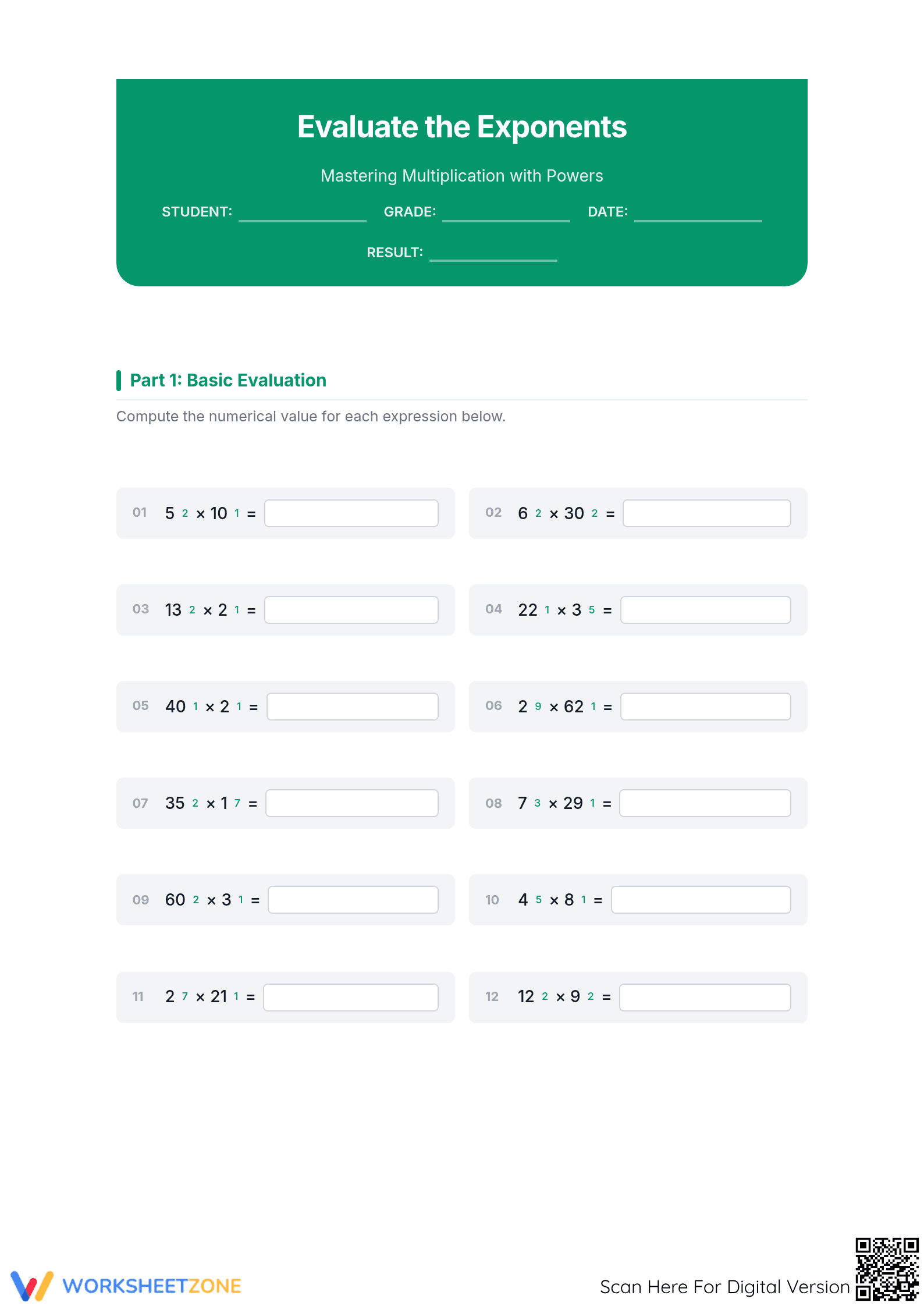
Strengthen middle school math foundations with this comprehensive printable worksheet designed to build mastery in evaluating exponents and multiplying powers with different bases. Students will move from simple numerical evaluation to complex logical analysis and real-world word problems, ensuring a deep conceptual understanding of how exponents function in mathematical expressions and practical scenarios.
At a Glance
- Grade: 6–8 · Subject: Math
- Standard:
CCSS.MATH.CONTENT.8.EE.A.1— Apply properties of integer exponents to generate equivalent numerical expressions- Skill Focus: Multiplying and evaluating exponents
- Format: 4 pages · 40 problems · Answer key included · PDF
- Best For: Independent practice and skill reinforcement
- Time: 40–55 minutes
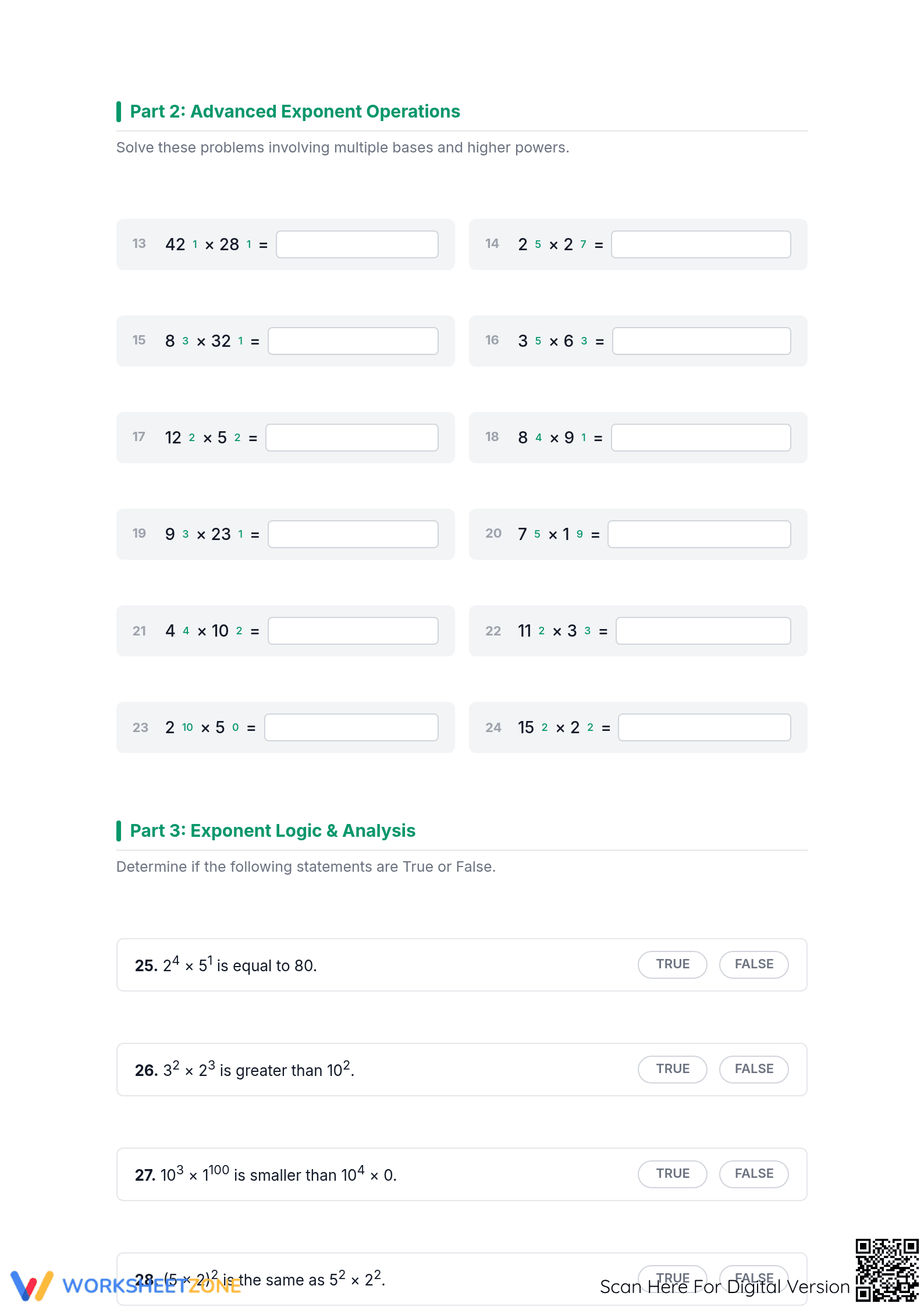
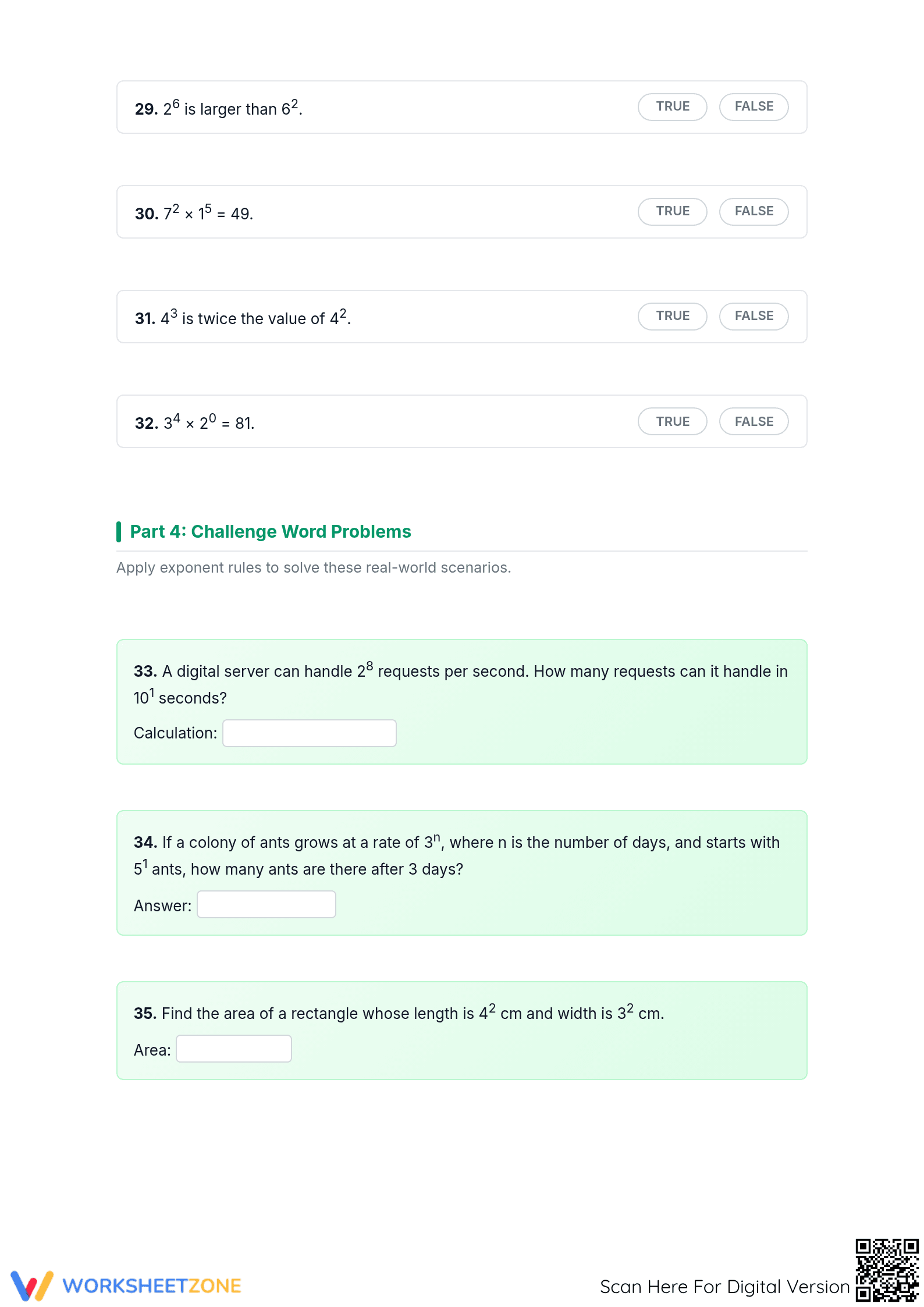
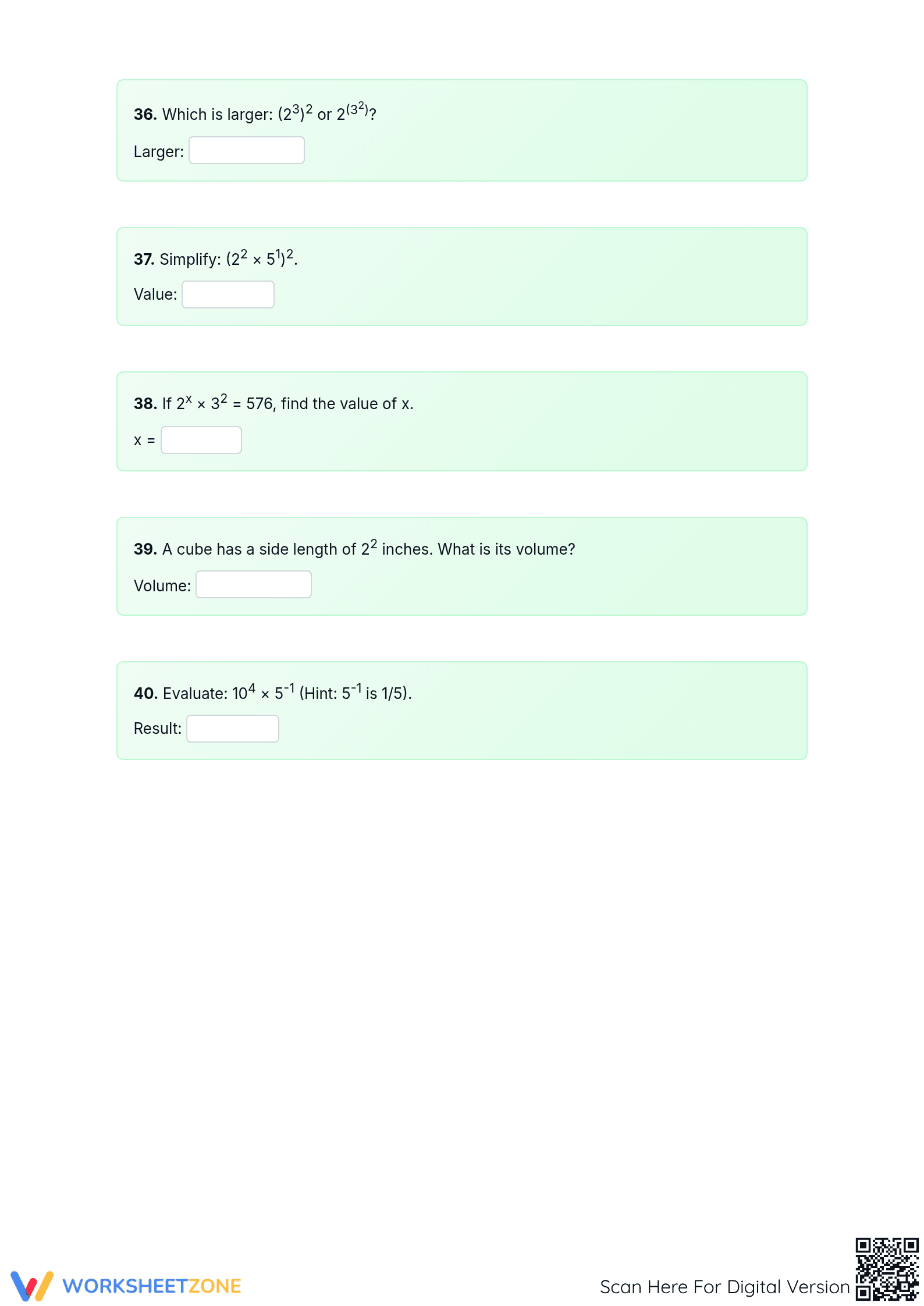
This four-page resource provides a high-volume practice set featuring 40 unique problems. The worksheet is structured into four distinct sections that increase in cognitive demand, supported by a full answer key for rapid grading or student self-correction. The layout is clean and professional, offering ample workspace for calculations within the provided result boxes and dedicated calculation zones for complex word problems.
Skill Progression
- Guided Practice: Part 1 features 12 basic evaluation problems (e.g., 5^2 x 10^1) where students compute numerical values using single-digit and double-digit bases to establish procedural fluency.
- Supported Practice: Part 2 introduces 12 advanced operations with higher powers and multiple bases, while Part 3 challenges students with 8 True/False logic statements to verify exponential identities.
- Independent Practice: Part 4 concludes with 8 high-level word problems and algebraic challenges, requiring students to apply exponent rules to areas, volumes, and scientific scenarios without scaffolding.
This sequence follows a gradual-release model that moves students from basic recall to higher-order application and logical synthesis.
This resource is strictly aligned to CCSS.MATH.CONTENT.8.EE.A.1, focusing on the application of exponent properties to evaluate and simplify numerical expressions. It also supports 6.EE.A.1 by reinforcing the transition from whole-number exponents to more complex algebraic thinking. Both standard codes can be copied directly into lesson plans, IEP goals, or district curriculum mapping tools.
To use this worksheet effectively, assign it as a core practice set during a unit on expressions and equations. It works exceptionally well as a post-instruction verification tool or a multi-day homework assignment given its 40-task volume. Teachers should observe students during Part 3 (Logic & Analysis) to identify common misconceptions regarding zero exponents and base multiplication. Completion typically ranges from 40 to 55 minutes depending on student fluency.
This resource is specifically designed for students in Grades 6 through 8 who are developing algebraic proficiency. It serves as an excellent differentiation tool for 6th graders ready for a challenge or 8th graders needing a refresher on power properties. It pairs naturally with a lesson on the Laws of Exponents or a visual anchor chart demonstrating the product rule.
The mastery of exponential notation and the properties of powers is a critical threshold in middle school mathematics, serving as a prerequisite for high school algebra and scientific notation. This worksheet addresses CCSS.MATH.CONTENT.8.EE.A.1 by requiring students to evaluate numerical expressions involving powers, a skill that Fisher & Frey (2014) identify as essential for building mathematical fluency through structured practice. By incorporating diverse task types—ranging from procedural computation to logical verification and word problem application—the resource ensures that learners move beyond rote memorization toward a functional understanding of exponent rules. Research suggests that providing a high volume of varied practice problems, as seen in this 40-task collection, helps solidify the neural pathways required for rapid mental computation and algebraic manipulation. This evidence-based approach to mathematical instruction provides teachers with a reliable tool for both formative assessment and summative evaluation within the expressions and equations domain.


