


























Views
Downloads

Printable Evaluating Exponents Worksheet | Grade 6-8 Math
Paste this activity's link or code into your existing LMS (Google Classroom, Canvas, Teams, Schoology, Moodle, etc.).
Students can open and work on the activity right away, with no student login required.
You'll still be able to track student progress and results from your teacher account.
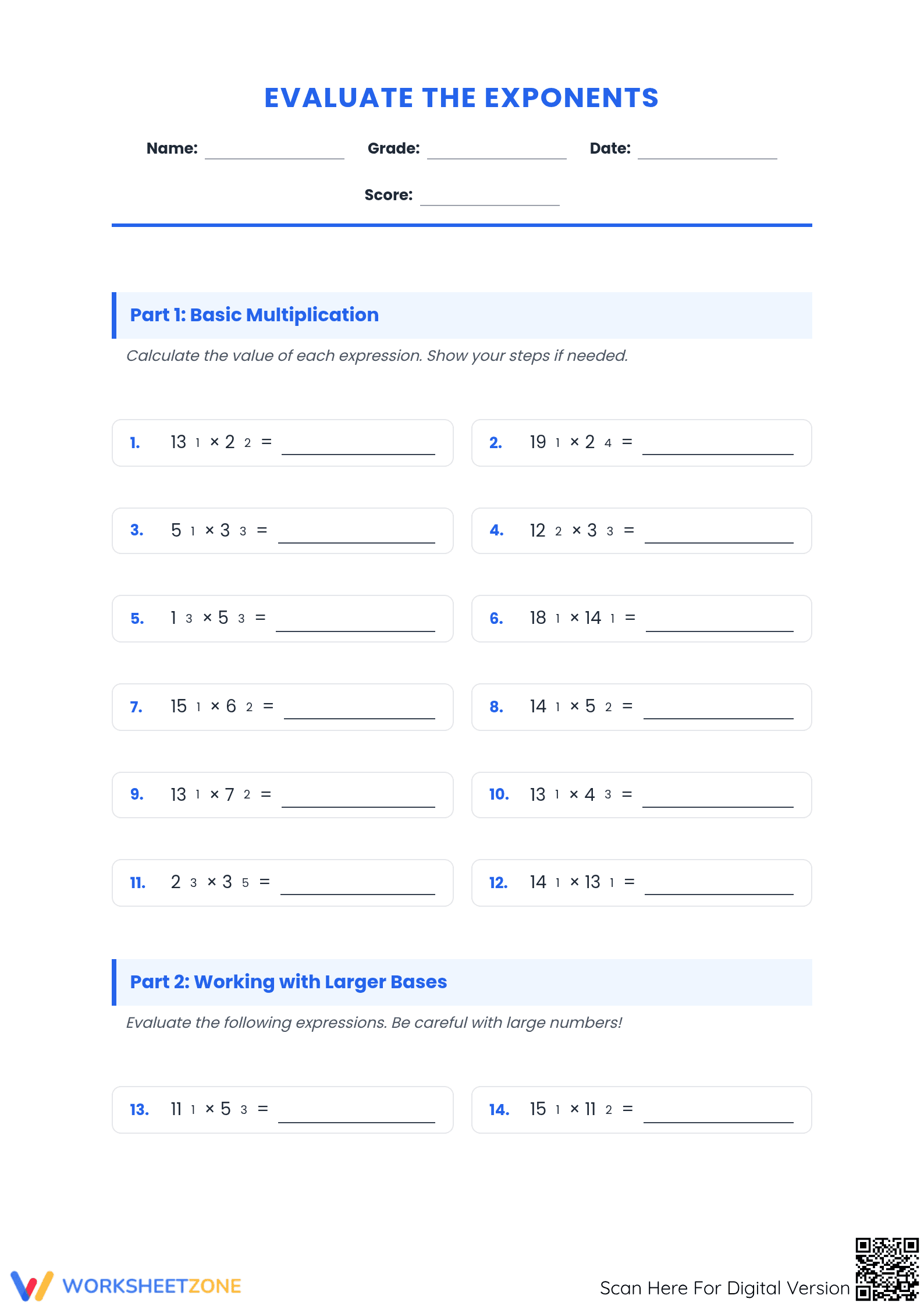
This comprehensive math worksheet empowers middle school students to master the complexities of evaluating and multiplying exponents. By solving a diverse range of 40 structured problems, learners transition from basic procedural fluency to complex real-world applications. This resource ensures students develop a deep conceptual understanding of exponential growth and numerical operations.
At a Glance
- Grade: 6–8 · Subject: Math
- Standard:
8.EE.A.1— Apply properties of integer exponents to generate equivalent numerical expressions- Skill Focus: Exponent evaluation and multiplication
- Format: 4 pages · 40 problems · Answer key included · PDF
- Best For: Homework, independent practice, or unit review
- Time: 45–60 minutes
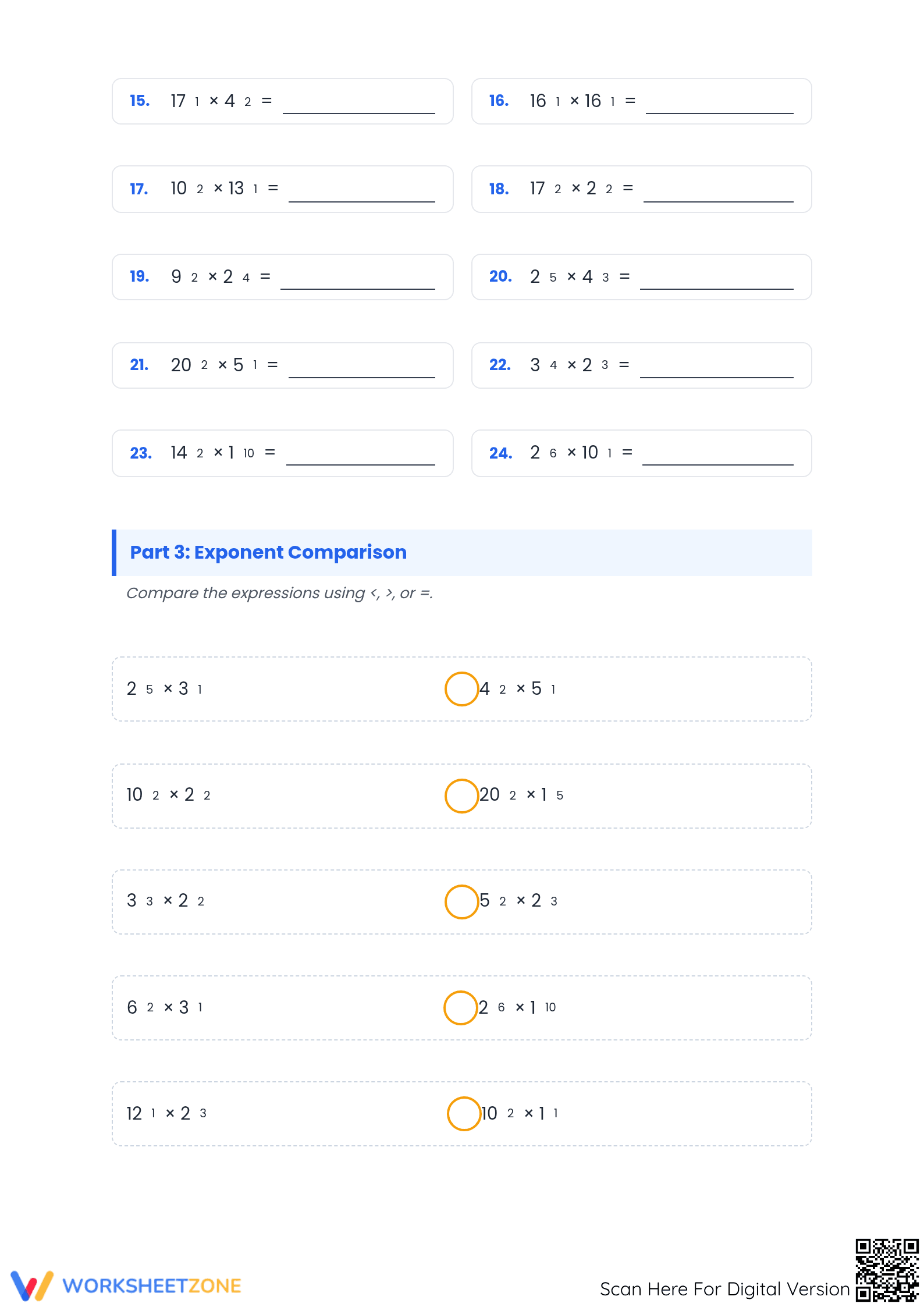
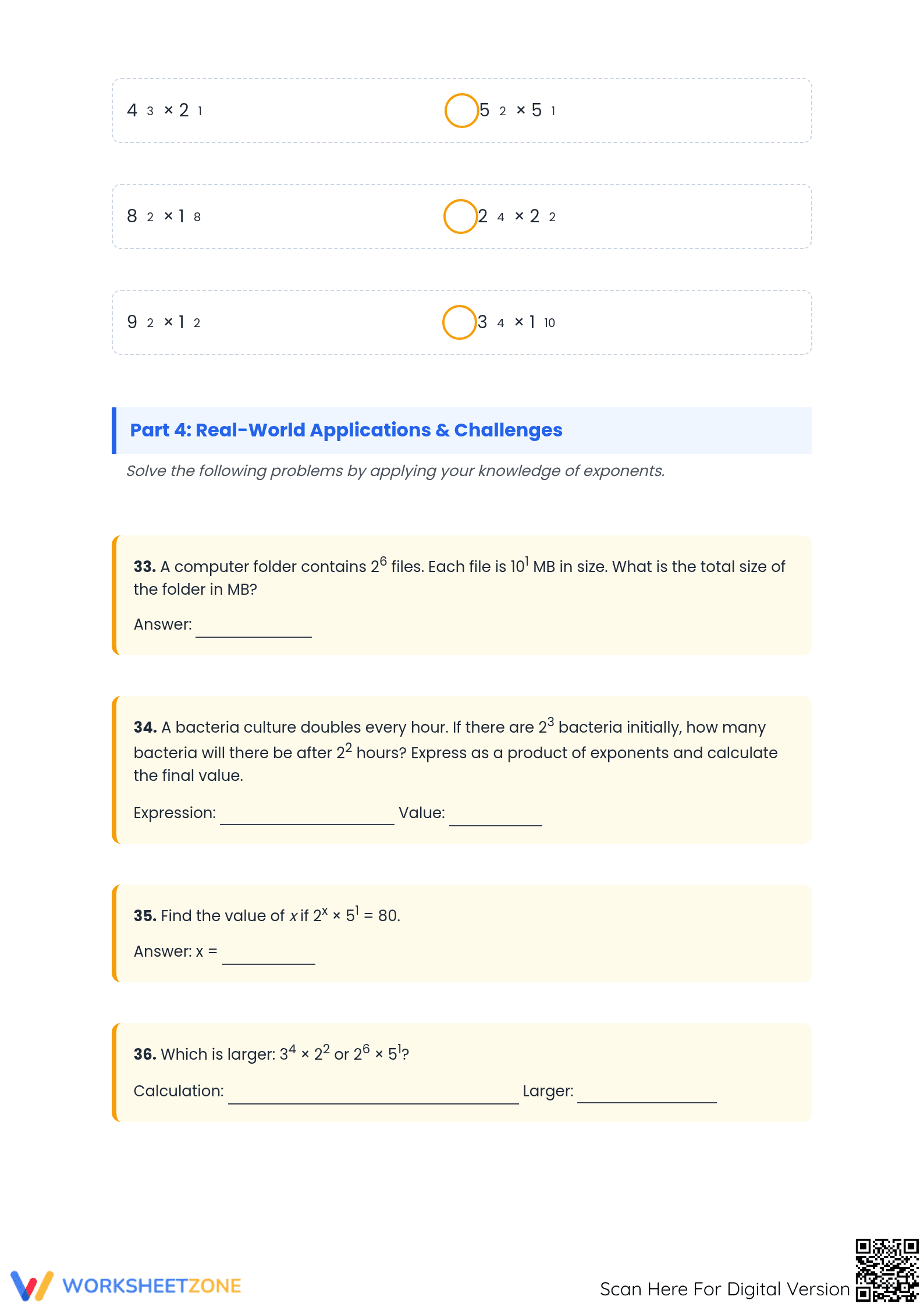
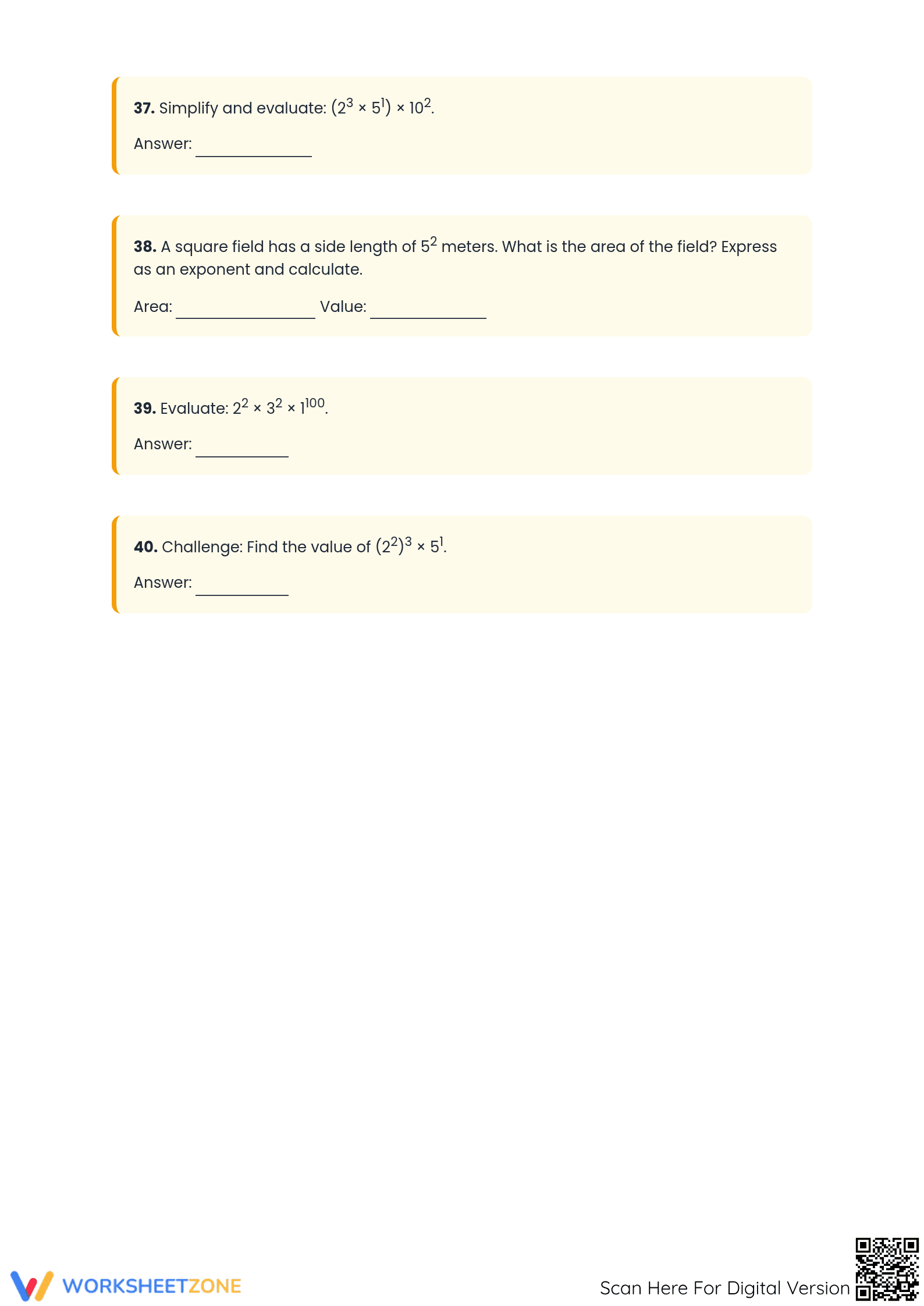
This four-page PDF is divided into four distinct sections to guide student learning. It begins with basic multiplication evaluation and progresses to larger bases and exponent comparison using inequality symbols. The final section challenges students with eight real-world word problems involving bacteria growth, data storage, and area calculations. A full answer key is provided for immediate grading or self-check.
Skill Progression
- Guided practice: The first 12 problems focus on single-digit bases and low exponents to build confidence in the multiplication rule.
- Supported practice: Problems 13 through 32 introduce larger numerical bases and comparison tasks that require multi-step calculation.
- Independent practice: The final 8 application problems demand higher-order thinking to translate text into exponential expressions without scaffolding.
This structure follows the gradual-release model, moving from direct calculation to abstract problem-solving.
Standards Alignment
The worksheet is primarily aligned with 8.EE.A.1, which requires students to know and apply the properties of integer exponents. Students practice the product of powers property and numerical evaluation to mastery. Both standard codes can be copied directly into lesson plans, IEP goals, or district curriculum mapping tools.
How to Use It
Use this as a post-instruction practice set after introducing the laws of exponents. It works excellently as a formative assessment to identify students struggling with larger base calculations versus conceptual application. Expect most students to complete the 40-problem set within 45 to 60 minutes of focused work time.
Who It's For
Designed for students in Grades 6 through 8, this resource supports diverse learners through its clear sectioning. It is ideal for general education classrooms or as an intervention tool for high school students needing a refresher on pre-algebra concepts. Pair it with a visual anchor chart for exponent rules for maximum student support.
According to the NAEP framework for middle school mathematics, procedural fluency with exponents is a critical precursor to success in high school algebra. This 40-task worksheet aligns with the "Evaluating and Simplifying Numerical Expressions" strand, providing the repetitive practice necessary for cognitive automaticity. Fisher & Frey (2014) emphasize that gradual release—moving from basic evaluation to real-world application as seen in Part 4 of this PDF—optimizes the transfer of mathematical knowledge. By requiring students to compare exponential values and solve contextualized problems, the resource meets the depth of knowledge (DOK) requirements suggested by RAND AIRS 2024 studies on high-quality instructional materials. This structured approach ensures that Grade 8 students are prepared for the rigorous demands of 8.EE.A.1 and future quadratic modeling.


