


























Views
Downloads


Printable Exponent Division Worksheet | Grade 8 Math
Paste this activity's link or code into your existing LMS (Google Classroom, Canvas, Teams, Schoology, Moodle, etc.).
Students can open and work on the activity right away, with no student login required.
You'll still be able to track student progress and results from your teacher account.
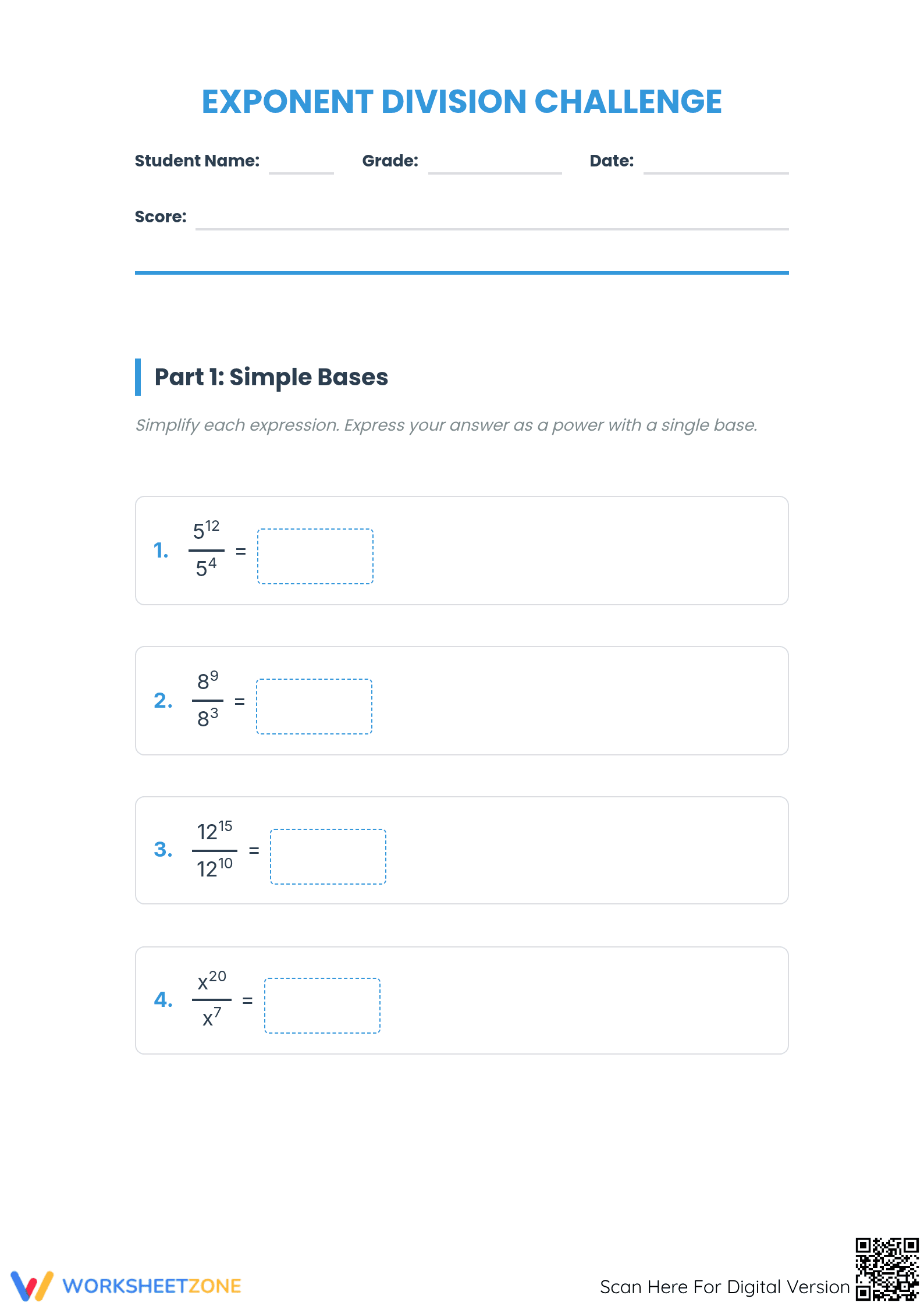
This Grade 8 math worksheet helps students master the quotient rule for exponents through structured practice. By simplifying 15 diverse expressions, learners build the confidence needed to handle complex algebraic terms. It is an essential resource for developing fluency in generating equivalent numerical expressions according to established mathematical properties.
At a Glance
- Grade: 8 · Subject: Math
- Standard:
8.EE.A.1— Apply properties of integer exponents to generate equivalent numerical expressions using the division property- Skill Focus: Quotient Rule for Exponents
- Format: 4 pages · 15 problems · Answer key included · PDF
- Best For: Independent practice or formative assessment
- Time: 25–35 minutes
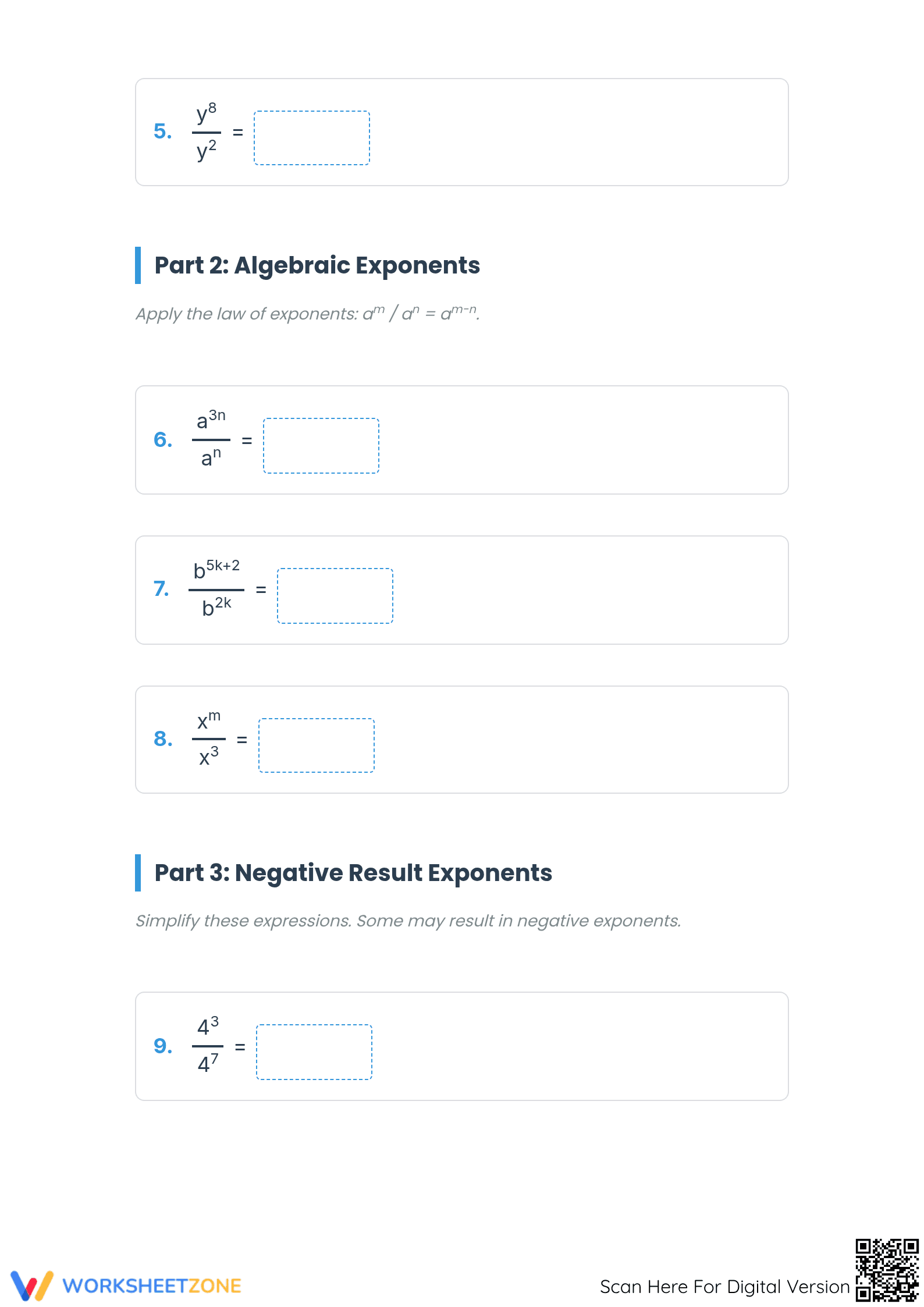
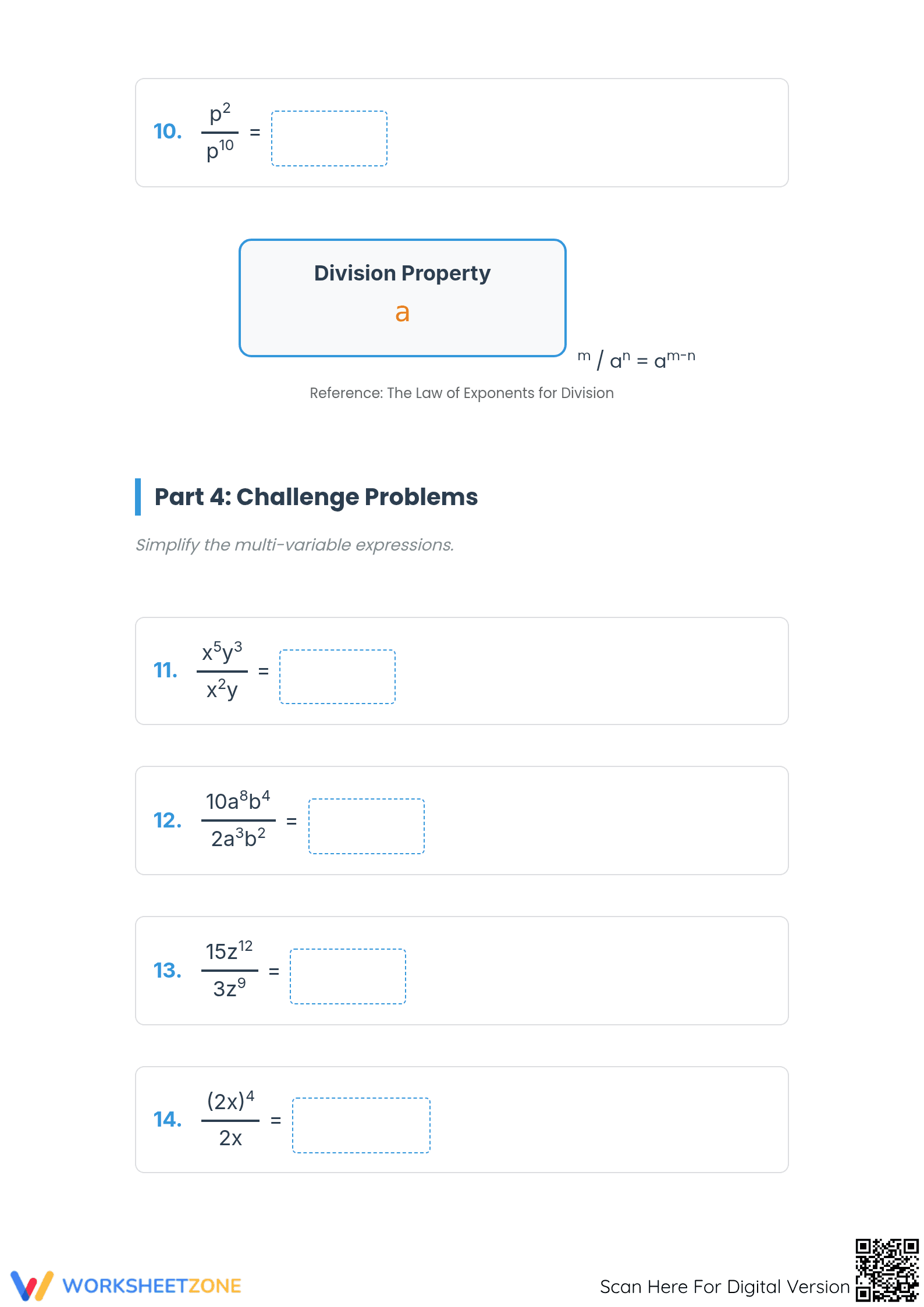
This comprehensive four-page PDF contains 15 problems divided into four distinct parts. The layout includes spacious boxes for student answers and a dedicated reference section explaining the Division Property of exponents. The worksheet progresses from numeric bases to algebraic exponents and multi-variable challenge problems, supported by a full answer key for rapid grading.
Skill Progression
- Guided practice: The first five problems focus on simple numeric and single-variable bases, allowing students to apply the basic subtraction rule with immediate success.
- Supported practice: Problems 6 through 10 introduce algebraic exponents like a^3n/a^n and cases resulting in negative exponents, requiring deeper conceptual understanding.
- Independent practice: The final section presents multi-variable challenge expressions and fractional coefficients, demanding high-level synthesis of exponent laws in complex scenarios.
This worksheet follows a gradual-release model, moving from high scaffolding to independent mastery.
Standards Alignment
This resource is meticulously aligned with 8.EE.A.1, which requires students to know and apply the properties of integer exponents to generate equivalent numerical expressions. The tasks specifically target the quotient rule, ensuring students can manipulate both positive and negative integers. This standard code can be copied directly into lesson plans, IEP goals, or district curriculum mapping tools.
How to Use It
Assign this worksheet as an independent practice set immediately following a direct instruction lesson on the laws of exponents. Alternatively, use the Part 4 Challenge Problems as an exit ticket to gauge which students have achieved mastery. During the activity, observe if students are correctly subtracting negative integers in Part 3, as this is a common point of error. Completion typically takes 30 minutes.
Who It's For
Designed for Grade 8 students or high schoolers requiring remediation in algebraic foundations. It is ideal for general education classrooms, small group intervention, or as a targeted resource for students with IEP goals focused on expressions and equations. This worksheet pairs naturally with a digital exponent calculator or an anchor chart detailing the division property.
Mathematics education research emphasizes that mastery of exponent properties is a critical gateway to success in high school algebra and beyond. According to a RAND AIRS 2024 analysis, students who engage in structured, multi-phase practice—moving from simple numeric bases to abstract algebraic variables—demonstrate significantly higher retention rates of the quotient rule. This worksheet implements these findings by providing 15 problems that transition through four levels of complexity, including negative integer outcomes and multi-variable expressions. By isolating the division property (8.EE.A.1) within a predictable "At a Glance" format, the resource allows educators to effectively target specific learning gaps. This approach aligns with evidence-based instructional designs that prioritize clear modeling followed by a scaffolded progression toward independent application of mathematical laws.


